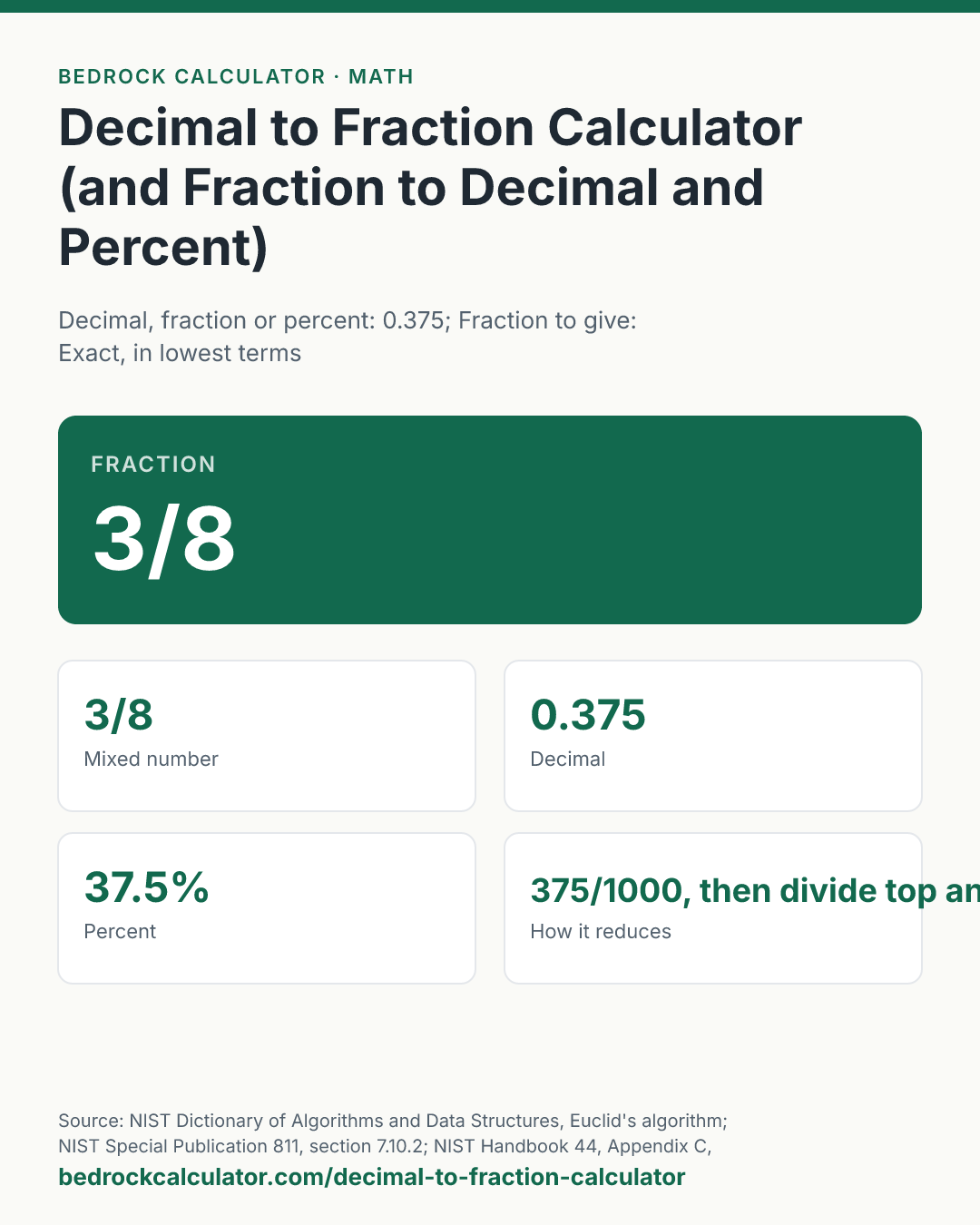
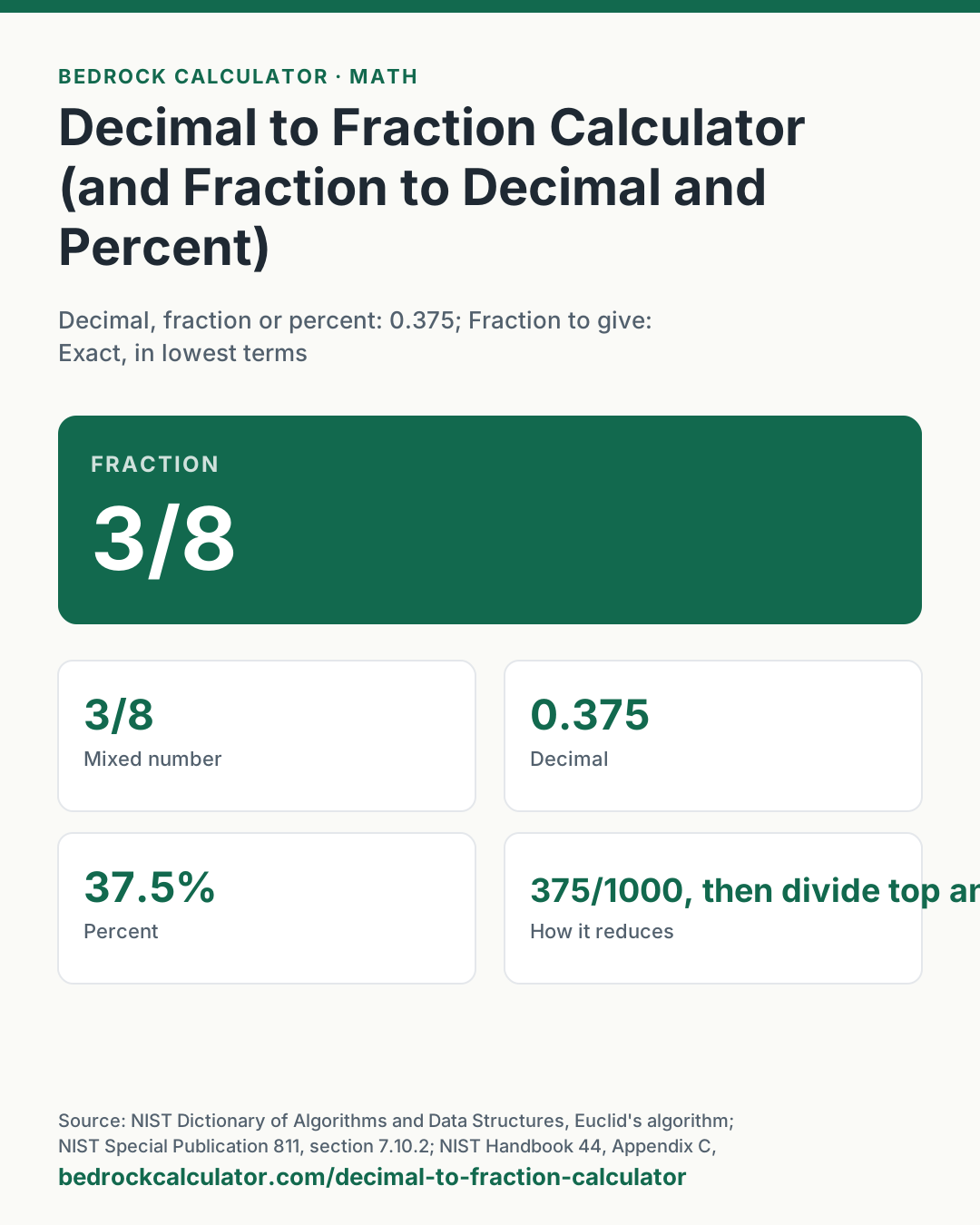
Quick Answer: 0.375 as a fraction is 3/8: write it as 375/1000, then divide top and bottom by 125. As a percent it is 37.5%.
What does this calculator do?
This decimal to fraction calculator converts in every direction between decimals, fractions, mixed numbers and percents, and it does so exactly. Type 0.375 and it gives 3/8; type 3/8 and it gives 0.375 and 37.5%; type 1/3 and it gives the decimal as 0.(3), with the repeating digit in brackets, rather than a rounded 0.333333.
It also rounds to a fraction with a fixed denominator, which is what you need for a tape measure. A drawing that says 2.3 inches is no use to someone holding a ruler marked in sixteenths, and the calculator gives the nearest sixteenth, 2 5/16, along with how far the rounding moved it.
Because the value is held as an exact fraction of whole numbers, nothing is lost along the way. A decimal is only an approximation when it repeats; the calculator shows the repeating block instead of cutting it off.
Using the Decimal to Fraction Calculator
- Type a value in any of these forms: a decimal (0.375), a fraction (3/8), a mixed number with a space (1 3/8), a percent (37.5%), or a repeating decimal with the repeating digits in brackets, so 0.1666... is typed 0.1(6).
- Leave Fraction to give on exact for the fraction in lowest terms, or pick a denominator from 1/2 to 1/64 to round to the nearest one.
- Read the fraction at the top. The cards give the mixed number, the exact decimal, the percent, how a decimal reduces, and the rounded fraction with its rounding error.
How is this calculated?
- Read the value as an exact fraction. A decimal with k digits after the point is that many digits over 10 to the power k: 0.375 is 375/1000. A percent is divided by 100. A mixed number is the whole part times the denominator plus the numerator, over the denominator.
- Read a repeating decimal. With n digits before the bracket and r digits inside it, the value is all the digits minus the digits before the bracket, over n zeros' worth of 10 and r nines. For 0.1(6) that is (16 - 1)/90.
0.ab̄ = (ab − a)/(10ⁿ (10^r − 1))
- Reduce to lowest terms. The numerator and denominator are divided by their greatest common divisor, found by Euclid's algorithm: replace the larger number by its remainder after dividing by the smaller, until the remainder is zero.
375/1000 = (375 ÷ 125)/(1000 ÷ 125) = 3/8
- Mixed number. The whole part is the numerator divided by the denominator, rounded toward zero; the remainder is the new numerator.
- Decimal by long division. The numerator is divided by the denominator one digit at a time. Each step leaves a remainder; when a remainder repeats, so do the digits from that point, and that block is put in brackets. The percent is the same expansion of the fraction times 100.
- Nearest fraction with a fixed denominator. When you choose a denominator d, the value is multiplied by d, rounded half up to a whole number, and put over d, then reduced. The rounding error card shows the rounded value minus the original.
nearest = (round(x × d))/d
Worked Example
The default value is 0.375.
- Three digits after the point: 375/1000.
- The greatest common divisor of 375 and 1000 is 125 (1000 ÷ 375 leaves 250; 375 ÷ 250 leaves 125; 250 ÷ 125 leaves 0).
- 375 ÷ 125 = 3 and 1000 ÷ 125 = 8, giving 3/8.
- As a percent: 37.5%.
A tape measure reading, from the 2.3 inches to sixteenths preset: 2.3 × 16 = 36.8, which rounds to 37. That is 37/16, or 2 5/16 inches, and rounding moved it by +0.0125 inches.
How Do You Convert a Repeating Decimal to a Fraction?
Type it with the repeating part in brackets. The 0.1(6) preset gives 1/6. The digits before the bracket are 1 and the block is 6, so the value is (16 - 1) over 90, which is 15/90 and reduces to 1/6. The common-decimals table shows 0.(3) as 1/3 and 0.(6) as 2/3.
If you type 0.333 without brackets, you get exactly 333/1000, because that is the number you wrote. Only the bracket says the digits go on forever.
How Do You Turn a Fraction into a Decimal or Percent?
Divide the top by the bottom. 1 3/4 is 7/4, which is 1.75, or 175%. A fraction in lowest terms gives a terminating decimal only when its denominator has no prime factors other than 2 and 5; otherwise the decimal repeats. 1/3 gives 0.(3), which is 33.(3)%.
Sixteenths of an Inch as Decimals
The second reference table lists every sixteenth of an inch as a decimal. Every one terminates, because 16 is a power of 2: 3/16 is 0.1875 and 11/16 is 0.6875. Use it in reverse to read a decimal drawing dimension off a tape measure.
What does this calculator not account for?
- Irrational numbers. Pi and the square root of 2 have no exact fraction. Typing 3.14159 gives the exact fraction for those six digits, not for pi.
- Measurement precision. A decimal from a measuring instrument already carries rounding. The fraction is exact for the digits typed, not for the object measured.
- Very long repeating blocks. The repeating block is found up to 2,000 digits. A fraction whose block is longer is shown with its first 2,000 digits and an ellipsis.
- Rounding direction. The nearest-denominator option rounds half up. For a cut that must not be too short, check the rounding error card and step up a sixteenth if it is negative.
- Thousands commas. Type 1250.5, not 1,250.5.
What mistakes do people make with this?
- Reading 0.3 as 1/3. 0.3 is exactly 3/10. One third is 0.(3).
- Forgetting to reduce. 375/1000 is correct but not in lowest terms; 3/8 is the usual answer.
- Writing a mixed number without a space. 13/8 is thirteen eighths; 1 3/8 is one and three eighths. They are the same value, but 1 3/8 typed as 13/8 by accident is a different number.
- Percent of a fraction. 3/8 is 37.5%, not 3.8%. Multiply the decimal by 100.
- Rounding inches to tenths. Most tape measures in the United States are marked in sixteenths. Round to the denominator on your tape.
Frequently Asked Questions
What is 0.375 as a fraction?
How do I convert inches in decimals to fractions?
How do I write 12.5% as a fraction?
What is 1/3 as a decimal?
What is 0.1 as a fraction?
How do I turn a decimal into a percent?
Sources
- NIST Dictionary of Algorithms and Data Structures, Euclid's algorithm: the greatest common divisor used to reduce fractions. xlinux.nist.gov/dads/HTML/euclidalgo.html
- NIST Special Publication 811, section 7.10.2: the percent symbol as the number 0.01. nist.gov/pml/special-publication-811/nist-guide-si-chapter-7-rules-and-style-conventions-expressing-values
- NIST Handbook 44, Appendix C, General Tables of Units of Measurement: the definition of the inch. nist.gov/pml/owm/nist-handbook-44-current-edition