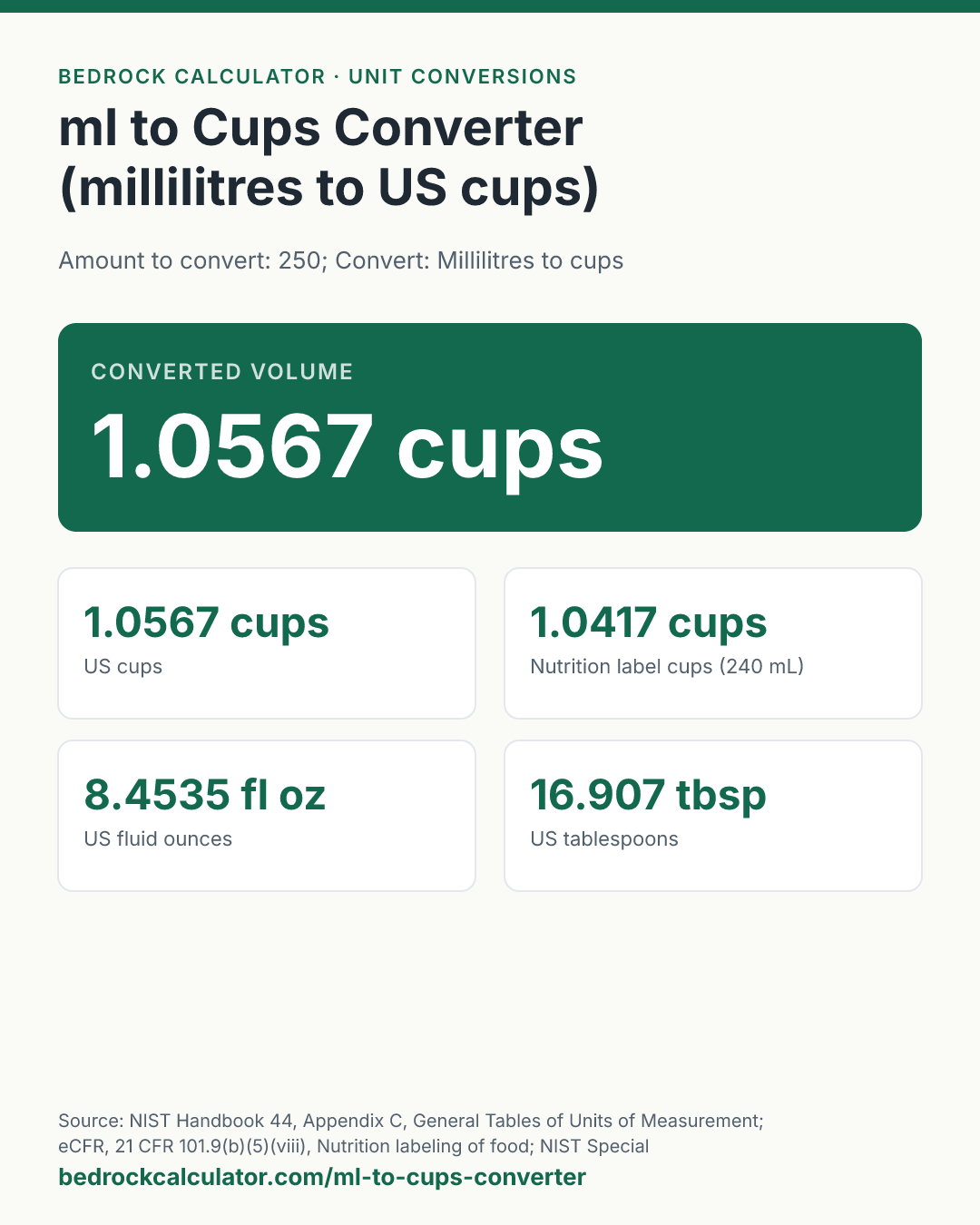
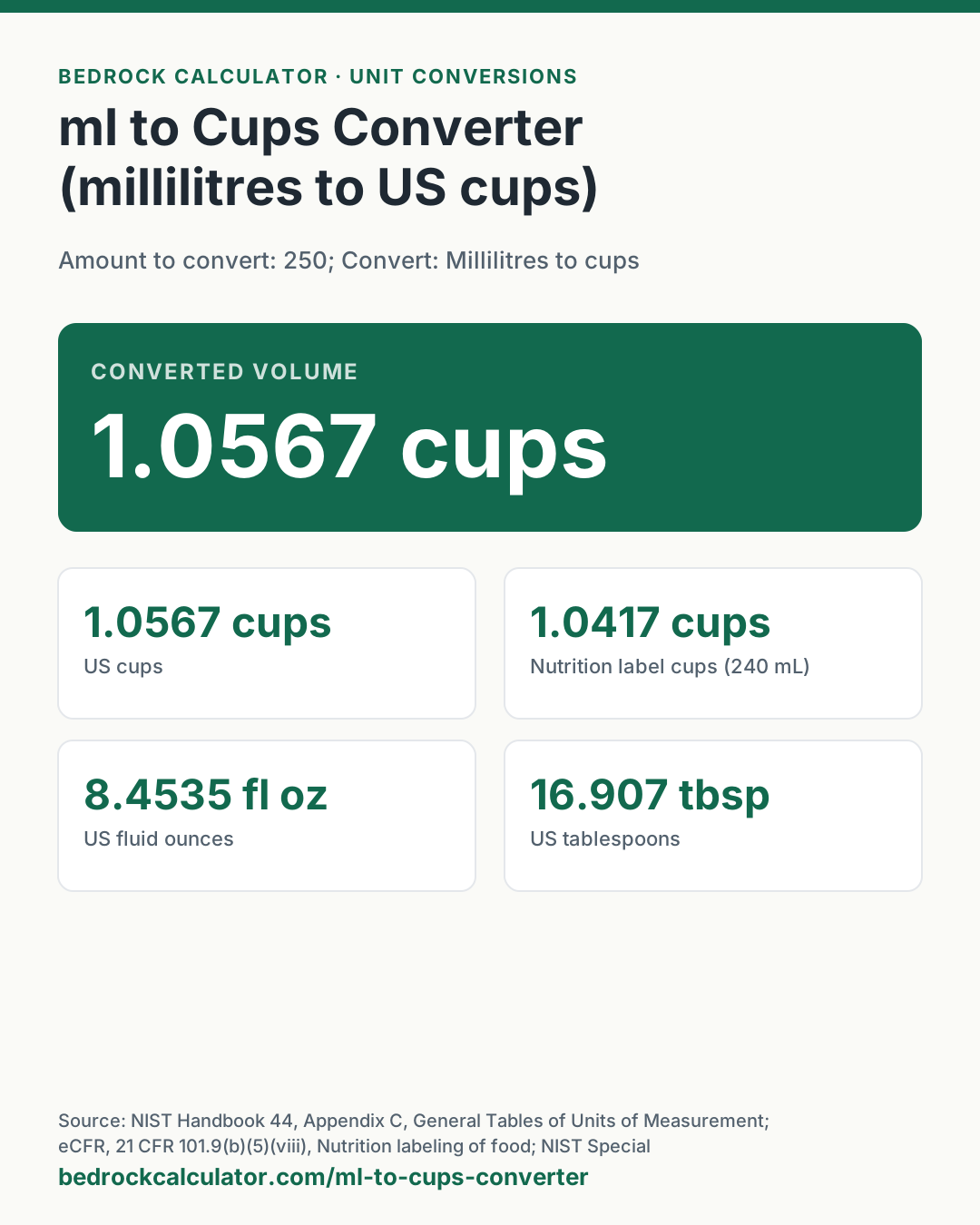
Quick Answer: 250 mL is 1.0567 cups in US customary cups, and one US cup is 236.59 mL. On the 240 mL cup used on nutrition labels, 250 mL is 1.0417 cups.
What does this calculator do?
This ml to cups converter turns millilitres into US cups and US cups back into millilitres. Its starting value is 250 mL, the size of a common carton and the volume many recipes from outside the United States call "a cup".
Alongside the main answer, it shows the same volume in the 240 mL label cup, in US fluid ounces and in tablespoons.
The cup used for the main answer is the US customary cup. NIST Handbook 44 defines it as one sixteenth of the US gallon of 231 cubic inches, which makes it exactly 236.5882365 mL. That is the cup on American measuring cups and in American cookbooks. The converter uses that exact value and rounds only what it displays.
There is a second American cup, the label cup of exactly 240 mL. Federal labelling rules use it for serving sizes on Nutrition Facts panels. It is slightly larger than the customary cup, so the same volume reads as slightly fewer label cups. The converter shows both so you can tell which one a figure is in.
Using the ml to Cups Converter
- Type the amount. Millilitres can be any number; fractions of a cup go in as decimals, so three quarters is 0.75.
- Choose Millilitres to cups or Cups to millilitres.
- Read the headline: US cups to four decimal places, or millilitres to two. The cards add label cups, fluid ounces and tablespoons.
The presets load 100 mL, 600 mL and one cup. Two tables below the converter cover 25 mL to a litre and an eighth of a cup to 8 cups, each downloadable as CSV.
How is this calculated?
- Choose the starting unit. The direction says whether your number is millilitres or US cups. A negative amount is read as zero.
- Convert through the cubic metre. The millilitre is a millionth of a cubic metre. The US cup is the US gallon of 231 cubic inches, at 2.54 cm to the inch, divided by 16. The converter multiplies by the size of the starting unit and divides by the size of the target.
cups = mL/236.5882365; mL = cups × 236.5882365
- Add the other measures. The same step gives label cups of exactly 240 mL (21 CFR 101.9), US fluid ounces (8 to the cup) and US tablespoons (16 to the cup).
- Round for display only. The arithmetic runs at 34 significant digits. Cups, label cups, fluid ounces and tablespoons are rounded half up to four places; millilitres to two.
Worked Example
The default, 250 mL to cups:
- US cups: 250 ÷ 236.5882365 = 1.0567 cups.
- Label cups: 250 ÷ 240 = 1.0417.
- Fluid ounces: 8.4535. Tablespoons: 16.907.
So 250 mL is a little more than one US cup: about one cup plus one tablespoon.
100 mL to cups: 100 ÷ 236.5882365 = 0.4227 cups, a little under half a cup.
600 mL to cups: 2.5361 cups, or exactly 2.5 label cups.
One cup to millilitres: 236.59 mL. Three quarters of a cup is 177.44 mL.
Millilitres and Cups at a Glance
| Millilitres | US cups | Label cups (240 mL) |
|---|---|---|
| 50 | 0.2113 | 0.2083 |
| 100 | 0.4227 | 0.4167 |
| 125 | 0.5283 | 0.5208 |
| 150 | 0.634 | 0.625 |
| 200 | 0.8454 | 0.8333 |
| 240 | 1.0144 | 1 |
| 250 | 1.0567 | 1.0417 |
| 500 | 2.1134 | 2.0833 |
| 1,000 | 4.2268 | 4.1667 |
| US cups | Millilitres |
|---|---|
| 0.25 | 59.15 |
| 0.5 | 118.29 |
| 0.75 | 177.44 |
| 1 | 236.59 |
| 2 | 473.18 |
| 4 | 946.35 |
Every value is from the converter's reference tables.
How Many Cups Is 250 ml?
In US customary cups, 250 mL is 1.0567 cups. Many recipes from Australia, New Zealand and Canada use a "metric cup" that is close to 250 mL, so in those recipes 250 mL simply is one cup, about a tablespoon more than an American one.
If you are following such a recipe with American measuring cups, that tablespoon per cup matters more for baking than for soup.
Which Cup Should You Use?
- Following an American recipe: the US customary cup, which is what the headline gives.
- Reading a Nutrition Facts label: the 240 mL label cup. A serving of "1 cup (240 mL)" is a label cup.
- Following a recipe written in millilitres: use the millilitres directly if you have a metric jug; otherwise convert to US cups here.
- Following a British recipe: British recipes mostly give weights or millilitres, and their pints and fluid ounces are imperial, which this converter does not cover.
What does this calculator not account for?
- Metric and imperial cups. Only the US customary cup and the 240 mL label cup are converted. Cups defined in other countries are different sizes.
- Weight. A cup of flour and a cup of water weigh very different amounts. For grams, use the grams to teaspoons converter on this site, which also gives cups and uses measured USDA weights for common ingredients.
- How the cup is filled. Liquids should be read at eye level in a liquid measuring cup. Dry ingredients in a dry cup are levelled, and the result depends on packing.
- Thirds of a cup. A third of a cup has no exact decimal, so typing 0.333 gives a figure a hair low.
What mistakes do people make with this?
- Assuming a cup is 250 mL in an American recipe. It is 236.59 mL. Over several cups in a cake, the extra liquid adds up.
- Confusing the label cup with the measuring cup. The label cup is a labelling convention; your measuring cup is the customary one.
- Reading 0.634 cups as 6 tablespoons. Use the tablespoon card instead: 150 mL is 10.1442 tablespoons.
- Mixing millilitres and grams. For water they are close; for most foods they are not.
Frequently Asked Questions
How many cups is 100 ml?
How many cups is 150 ml?
How many cups is 600 ml?
How many cups is 500 ml?
How many ml is a cup?
How many ml is 3/4 cup?
How many cups are in a litre?
How many cups is 1 ml?
Sources
- NIST Handbook 44, Appendix C, General Tables of Units of Measurement: the US gallon and cup. nist.gov/pml/owm/nist-handbook-44-current-edition
- eCFR, 21 CFR 101.9(b)(5)(viii), Nutrition labeling of food: the 240 mL cup used for serving sizes. ecfr.gov/current/title-21/chapter-I/subchapter-B/part-101/subpart-A/section-101.9
- NIST Special Publication 811, Guide for the Use of the International System of Units (2008), Appendix B: conversion factors to SI. nist.gov/pml/special-publication-811