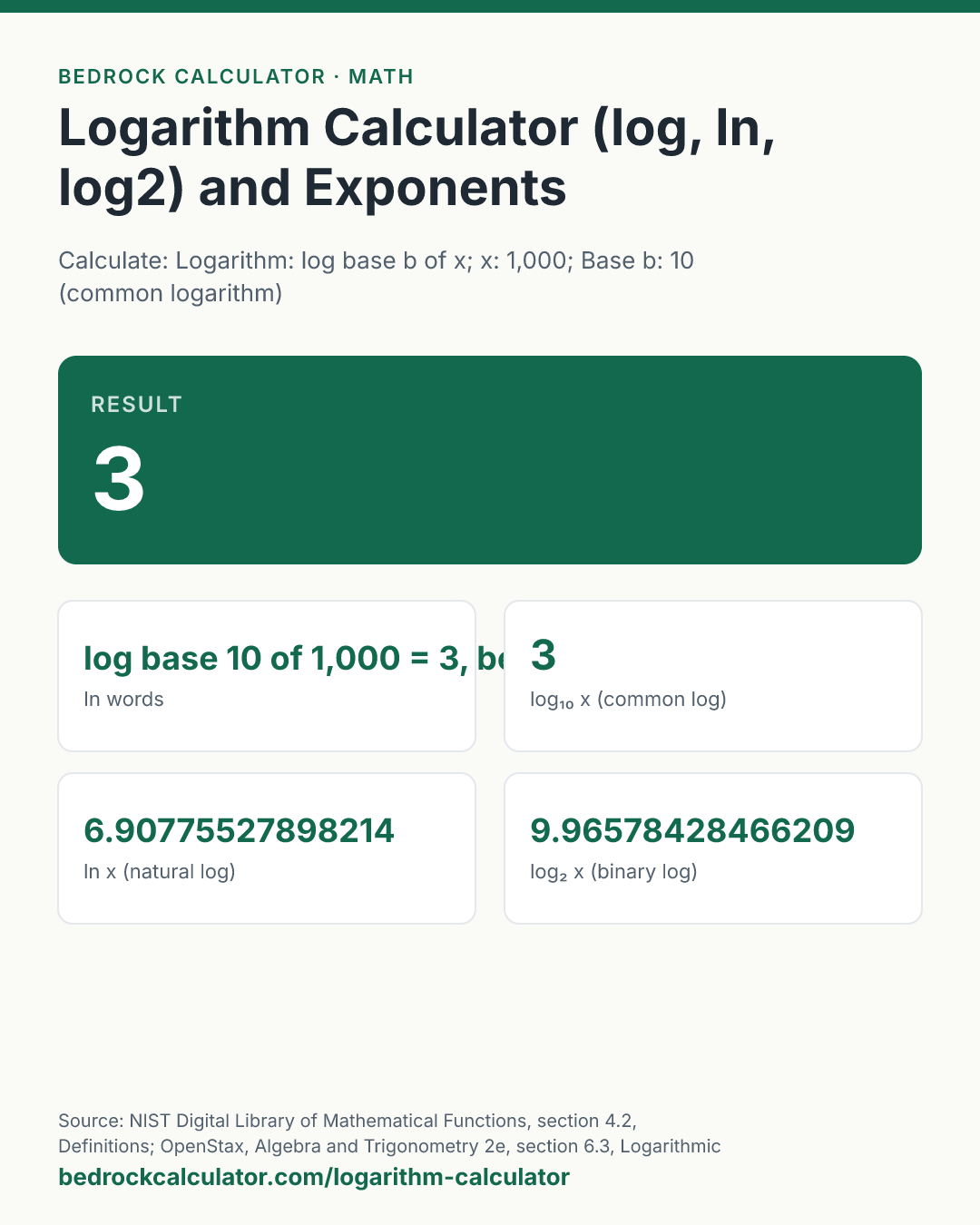

Quick Answer: The base 10 logarithm of 1,000 is 3, because 10 to the power 3 is 1,000. The natural logarithm of 1,000 is 6.9078 and its base 2 logarithm is 9.9658.
What does this calculator do?
This logarithm calculator finds the logarithm of a number in any base (10, e, 2, or one you choose) and does the reverse operation too: the base raised to a power, including e to the x and 10 to the x.
Whichever you ask for, the cards also show the common, natural and binary logarithms of the same number and the three common powers of it.
A logarithm answers the question "what power?". The base 10 logarithm of 1,000 is 3 because 10³ is 1,000. The base 2 logarithm of 1,024 is 10 because ten doublings make 1,024. Logarithms turn multiplication into addition and powers into multiplication, which is why they appear wherever quantities grow or shrink by a constant factor: decibels, the pH scale, earthquake magnitudes, compound growth and the number of bits a value needs.
The NIST Digital Library of Mathematical Functions defines the logarithm in any base as the natural logarithm divided by the natural logarithm of the base, and a general power as e raised to the exponent times the natural log of the base. The calculator works from those definitions to 34 significant digits.
Using the Logarithm Calculator
- Choose Logarithm to find log base b of x, or Power to find b to the power x.
- Enter x.
- Choose the base: 10, e, 2, or another base, which you then type in the box below.
- Read the result at the top and the sentence under it. The cards give log₁₀ x, ln x, log₂ x, eˣ, 10ˣ and 2ˣ for the same x.
How is this calculated?
- Natural logarithm. ln x is computed by decimal.js for x greater than zero. The logarithm of zero or a negative number is not a real number, and the card says so.
- Logarithm in another base. The change of base rule, DLMF 4.2.8, divides the natural logarithm of x by the natural logarithm of the base. The base must be positive and not 1. When x is an exact power of the base, the result is exact: log₁₀ 1000 is 3, not 2.9999999999.
log _bx = ln x/ln b
- Powers. b to the power x is computed as e raised to x ln b (DLMF 4.2.28). A negative base with a non-whole exponent has no real value, and 0 to a negative power is undefined; the calculator reports both instead of returning a number.
bˣ = e^(x ln b)
- e. The base e is computed as e¹ to 34 digits, 2.718281828459045..., not typed in.
- Show the result. Results are rounded half up to 15 significant figures, with thousands separators, and switch to scientific notation at 10¹⁵ and above, so e to the 1,000 appears as 1.97007111401705 × 10⁴³⁴.
Worked Example
Using the defaults, log base 10 of 1,000:
- 1,000 = 10 × 10 × 10 = 10³.
- So log₁₀ 1000 = 3.
- ln 1000 = 6.90775527898214, and log₂ 1000 = 9.96578428466209.
- Check the change of base: 6.90775527898214 ÷ ln 10 (2.30258509299405) = 3.
A base the calculator buttons rarely have, from the log₅ 30 preset: ln 30 ÷ ln 5 = 2.11328275255938, and 5 to that power is 30.
What Is the Natural Logarithm?
The natural logarithm, written ln, uses the base e, about 2.71828. It is "natural" because the rate of growth of eˣ is eˣ itself, which makes e the base that falls out of calculus, continuous compounding and radioactive decay. The ln 10 preset gives ln 10 = 2.30258509299405.
Natural and common logarithms differ only by that constant factor: ln x = 2.30258509299405 × log₁₀ x.
How Do You Calculate e to the x or 10 to the Power x?
Switch to power mode and choose base e or 10, or read the eˣ and 10ˣ cards in either mode. The e to the 2 preset gives e² = 7.38905609893065. Powers of 10 are exact: 10 to the power 3 is 1,000, and 10 to the power 2 is 100.
Powers are also how exponential change works. Something that grows 5% per period is multiplied by 1.05 each time, so after 10 periods it has grown by a factor of 1.05¹⁰. The 1.05 to the 10 preset gives 1.62889462677744. A logarithm runs that backwards: the number of periods needed to reach a factor F is log base 1.05 of F.
Common, Natural and Binary Logarithms
The reference table gives all three logarithms for numbers from 0.001 to 1,000,000. Notice the patterns: logarithms of numbers below 1 are negative, the logarithm of 1 is 0 in every base, and log₂ of a power of two (2, 4, 8, 16, 64, 1,024) is a whole number.
What does this calculator not account for?
- Complex logarithms and powers. The logarithm of a negative number, and a negative number to a fractional power, are complex. Only real results are given. Powers of i, which cycle through i, -1, -i and 1, are outside the real numbers this calculator handles.
- Logarithm of zero. It has no value; it tends to minus infinity as x approaches 0.
- Extremely large exponents. Results beyond about 10 to the power 9 quadrillion overflow decimal.js and are reported as not a real number.
- Precision of the base e. e is irrational; 34 significant digits are carried and 15 shown.
What mistakes do people make with this?
- Assuming log means the same base everywhere. In most school maths and on calculators log means log₁₀; in many programming languages and higher maths, log means ln. Check which one your source uses.
- Splitting the log of a sum. log(a + b) is not log a + log b. The rule is for products: log(ab) = log a + log b.
- Taking the log of zero or a negative number. It is undefined in the real numbers.
- Reading log₂ as log × 2. The 2 is the base, not a multiplier. "2 log 2" means 2 times log 2.
- Confusing eˣ with 10ˣ. e² is 7.38905609893065; 10² is 100.
Frequently Asked Questions
What is log 2?
How do I convert ln to log?
What is log base 2 used for?
What is the logarithm of 1?
How do I find a log in a base my calculator does not have?
Is exponential notation the same as exponents?
Sources
- NIST Digital Library of Mathematical Functions, section 4.2, Definitions: the natural logarithm, logarithms to a general base (4.2.8) and general powers (4.2.28). dlmf.nist.gov/4.2
- OpenStax, Algebra and Trigonometry 2e, section 6.3, Logarithmic Functions: the logarithm as the inverse of the exponential, common and natural logarithms. openstax.org/books/algebra-and-trigonometry-2e/pages/6-3-logarithmic-functions