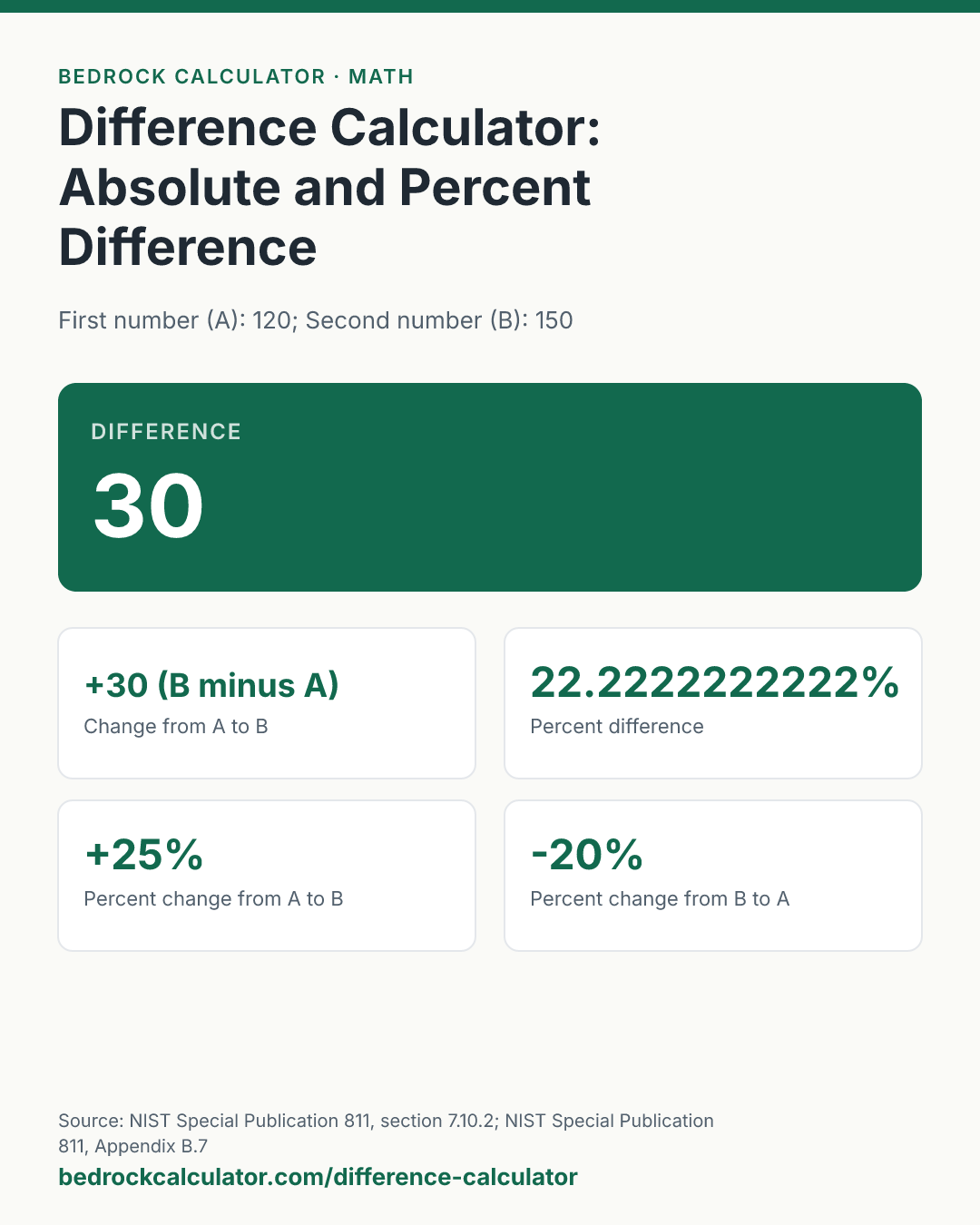

Quick Answer: The difference between 120 and 150 is 30. As a percent difference that is 22.22%; as a percent change it is +25% going up from 120 and -20% going down from 150.
What does this calculator do?
This difference calculator compares two numbers every way people usually need: the absolute difference (how far apart they are), the signed change from the first to the second, the percent difference, the percent change in each direction, how many times the first number the second one is, and which is smaller.
The reason for showing so many is that "difference" is ambiguous, and the right figure depends on the question. If you want to know how far apart two prices are, the absolute difference answers it. If one number is a starting point and the other a later value, percent change is the right measure, and it depends on which is which: 120 to 150 is +25%, while 150 to 120 is -20%. If neither number is the reference, as when comparing two measurements of the same thing or two shops' prices, the percent difference treats them symmetrically by dividing the gap by their average.
The arithmetic is exact decimal arithmetic, so a difference between $24.99 and $19.49 comes out as exactly 5.5, with no stray digits.
Using the Difference Calculator
- Enter the first number, A, and the second number, B. Money works the same way; enter 24.99 for $24.99.
- Read the difference at the top. It is always zero or positive.
- Use the cards for the signed change, the percent difference, the two percent changes, the ratio and the order.
How is this calculated?
- Absolute difference. B minus A, with the sign dropped.
|B − A|
- Signed change. B minus A, keeping the sign: positive if B is larger.
- Percent difference. The absolute difference divided by the average of the sizes of the two numbers, times 100. Because it uses the average, swapping A and B gives the same answer. Using the sizes (absolute values) keeps it meaningful when one number is negative.
percent difference = (|A − B|)/((|A| + |B|)/2) × 100
- Percent change in each direction. The signed change divided by the size of the starting value, times 100. From A to B divides by |A|; from B to A divides by |B|. A change from zero has no percentage, and the card says so.
change from A to B = (B − A)/|A| × 100
- Ratio and order. B divided by A, and a plain statement of which number is smaller.
- Show the results. Values are rounded half up to 12 significant figures with trailing zeros dropped.
Worked Example
Using the defaults, A = 120 and B = 150:
- Difference: 150 - 120 = 30.
- Change from A to B: +30.
- Percent difference: 30 ÷ ((120 + 150) ÷ 2) = 30 ÷ 135 = 0.2222..., so 22.2222222222%.
- Percent change from 120 to 150: 30 ÷ 120 = +25%.
- Percent change from 150 to 120: -30 ÷ 150 = -20%.
- B is 1.25 times A.
How Do You Calculate the Difference Between Two Prices?
Subtract the smaller from the larger. The $24.99 versus $19.49 preset gives 5.5, which is $5.50. To say how much cheaper the second price is in percentage terms, read the change from A to B: -22.0088035214%. To say how much dearer the first is relative to the second, read the change from B to A: +28.2195997948%.
Both describe the same $5.50 gap, measured from different starting points.
What Is 6 Less Than a Number?
"6 less than x" means x minus 6. The 6 less than 20 preset puts 20 as A and 6 as B; the difference between them is 14, which is 20 minus 6. Watch the wording: "6 less than 20" is 20 - 6, not 6 - 20, which would be -14.
How Do You Compare Two Measurements of the Same Thing?
When two instruments, two labs or two trials measure the same quantity, neither result is the true value, so neither should be the base of a percentage. The percent difference divides by their average, which treats them equally.
The 9.8 versus 10.2 preset, two readings of the same quantity, gives a percent difference of 4%, while the percent changes are +4.08163265306% one way and -3.92156862745% the other, depending only on which reading you happened to list first.
Percent Difference Versus Percent Change
The reference table runs the calculator on several pairs. Look at 100 and 150: the percent change is +50% one way and -33.3333333333% the other, but the percent difference is 40% either way. For two numbers close together, like 1,000 and 1,001, all three measures agree to about a tenth of a percent; they drift apart as the gap widens.
What does this calculator not account for?
- Percentage points. The difference between two percentages, such as 4% and 5%, is one percentage point. Entering 4 and 5 here gives that point difference as the plain difference, and the percent change between the rates as the change card.
- Other definitions of percent difference. Some fields divide by the larger value, or by a known reference value, instead of the average. This calculator uses the average, the common convention when neither number is the reference.
- Differences of more than two numbers. For the spread of a whole list, use the range on the average calculator.
- Units. Both numbers must be in the same unit; the difference is in that unit.
What mistakes do people make with this?
- Using percent difference when one value is the starting point. A price rising from 120 to 150 is a 25% increase, not 22%.
- Swapping the base of a percent change. Divide by the starting value, not the ending one.
- Expecting a rise and a fall of the same percent to cancel. +25% followed by -20% returns to the start; +25% followed by -25% does not.
- Mixing signs. The absolute difference is always positive. Use the signed card when direction matters.
- Percent difference across zero. For -5 and 8 the percent difference is 200%, since the gap is as big as the two sizes put together. Percentages lose meaning when values straddle zero; the plain difference, 13, is clearer.
Frequently Asked Questions
How do you find the difference between two numbers?
What is the difference between percent difference and percent change?
How do I calculate the percent difference between two measurements?
Can the difference be negative?
How do I compare two prices as a percentage?
Sources
- NIST Special Publication 811, section 7.10.2: the percent symbol as the number 0.01. nist.gov/pml/special-publication-811/nist-guide-si-chapter-7-rules-and-style-conventions-expressing-values
- NIST Special Publication 811, Appendix B.7: rules for rounding numbers. nist.gov/pml/special-publication-811/nist-guide-si-appendix-b-conversion-factors