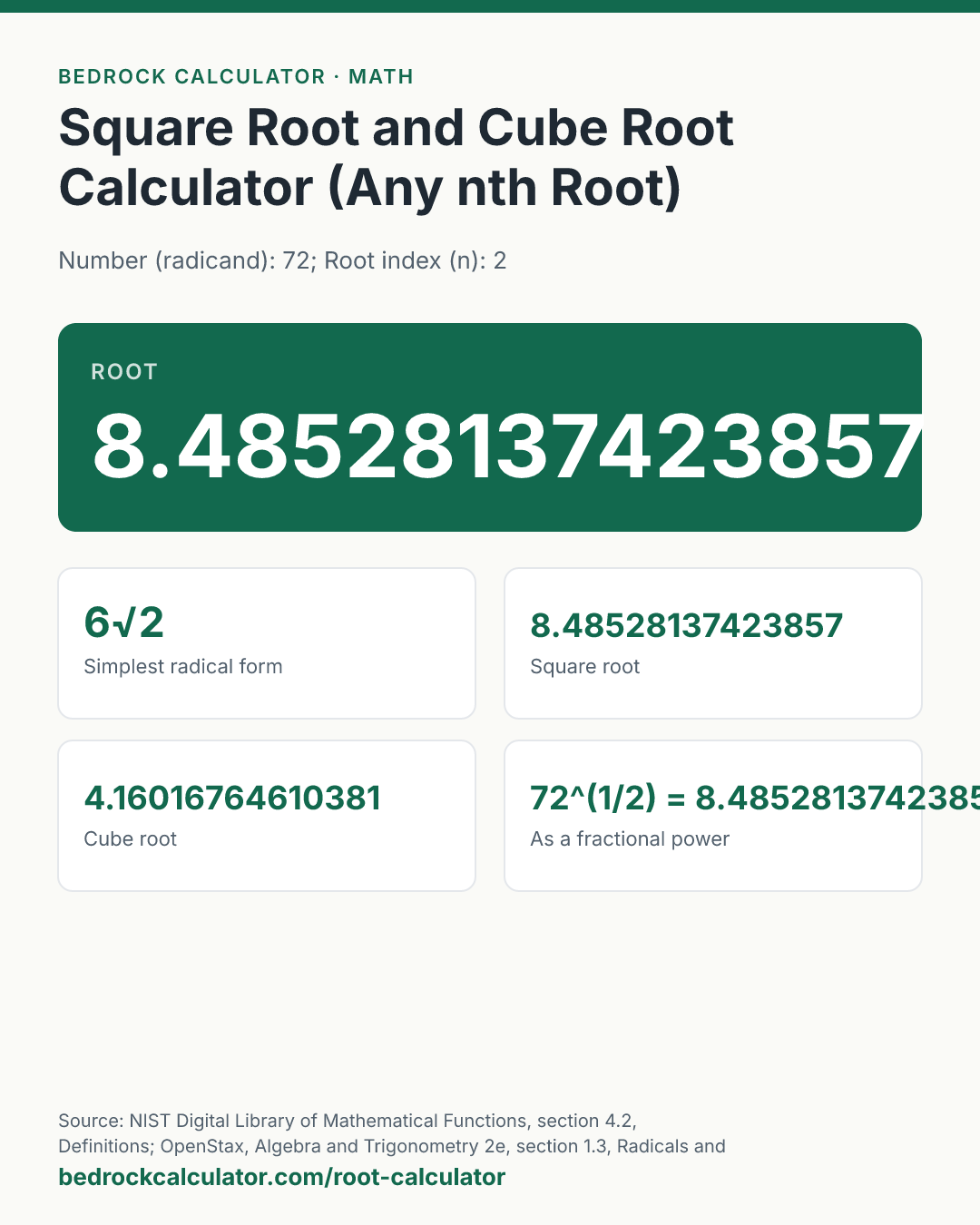

Quick Answer: The square root of 72 is 8.4853, which simplifies to 6√2 because 72 is 36 × 2 and 36 is a perfect square. Its cube root is 4.1602.
What does this calculator do?
This square root and cube root calculator finds any root of a number: the square root, the cube root, the fourth root, or the nth root for any whole number n up to 100.
For whole numbers it also gives the simplest radical form, so the square root of 72 comes back as 6√2 as well as a decimal, which is the form most algebra courses want.
A root undoes a power. The square root of x is the number that gives x when multiplied by itself; the cube root is the number that gives x when used as a factor three times. In general, the nth root of x is x raised to the power 1/n, which is how the NIST Digital Library of Mathematical Functions defines fractional powers.
Every result is computed to 34 significant digits and shown to 15. Perfect squares and cubes come back exact: the cube root of 27 is 3, not 2.9999999.
Using the Cube Root Calculator
- Enter the number under the root sign (the radicand). Decimals and negative numbers are allowed.
- Enter the root index n: 2 for a square root, 3 for a cube root, 4 for a fourth root, and so on.
- Read the root at the top. The cards always show the square root and the cube root of the same number, the simplest radical form, the root written as a fractional power, and a check that raises the root back to the power n.
How is this calculated?
- Choose the method by index. A square root uses decimal.js's square root and a cube root its cube root; both are correctly rounded at 34 significant digits and exact when the answer is a whole number or a terminating decimal.
- Other roots as fractional powers. For n of 4 or more, the root of |x| is computed as |x| raised to the power 1/n. If that result, cut to 25 significant digits, gives exactly |x| when raised to the power n, the exact value is used, so the fourth root of 16 is exactly 2.
n√x = x^(1/n)
- Negative numbers. An odd root of a negative number is the negative of the root of its size: the cube root of -8 is -2. An even root of a negative number is not a real number, and the calculator says so rather than returning a complex value.
- Simplest radical form. For a whole number up to 10¹², the number is split into prime factors. Each prime appearing at least n times is taken outside the root as many whole times as it can be, and the leftover primes stay inside.
√72 = √(2³ × 3²) = 2 × 3√2 = 6√2
- Check. The root is raised back to the power n and shown to 15 significant figures, which should give back the radicand.
Worked Example
Using the defaults, the square root of 72:
- 72 = 2³ × 3². The prime 2 appears three times, so one pair comes out as a single 2, leaving one 2 inside. The prime 3 appears twice, so one 3 comes out.
- Outside the root: 2 × 3 = 6. Inside: 2. So √72 = 6√2.
- As a decimal: 8.48528137423857.
- Check: 8.48528137423857 squared gives back 72.
- The cube root of 72 is 4.16016764610381.
A perfect cube, the Cube root of 27 preset: 3 × 3 × 3 = 27, so the cube root is exactly 3, and the radical card notes it is a perfect cube.
How Do You Find a Cube Root?
For a perfect cube, look for the number that multiplies by itself three times to give it: 64 is 4 × 4 × 4, so its cube root is 4. For anything else, estimate between the nearest perfect cubes and refine, or use this calculator.
Unlike a square root, a cube root of a negative number is fine: the Cube root of -8 preset gives -2, because -2 × -2 × -2 = -8. The cube root is also called the third root.
What Is the Fourth Root of 16?
2, because 2 × 2 × 2 × 2 = 16. A fourth root is the square root of the square root: √16 is 4 and √4 is 2. People sometimes search for it as "4 square root of 16", but the 4 here is the root index, not a multiplier.
Square Roots and Cube Roots from 1 to 100
The reference table lists the square root, simplest radical form and cube root of common numbers. Perfect squares (1, 4, 9, 16, 25, 36, 49, 64, 81, 100) have whole-number square roots, and perfect cubes (1, 8, 27, 64) have whole-number cube roots; 64 is both.
What does this calculator not account for?
- Complex roots. Even roots of negative numbers, such as √-4, are imaginary (2i). Only real roots are computed. Every number also has other complex nth roots besides the real one; those are not listed.
- The negative square root. Every positive number has two square roots, one positive and one negative. The calculator gives the principal (positive) one, as the √ sign means.
- Radical form for decimals and huge numbers. Simplest radical form is given for whole numbers up to 10¹² only.
- Fractional indexes. The index must be a whole number from 2 to 100. For a power such as x^(2/3), use the logarithm and exponent calculator.
- Display precision. Irrational roots never end; 15 significant figures are shown.
What mistakes do people make with this?
- Taking the square root of each term of a sum. √(a + b) is not √a + √b. Roots only split over multiplication: √(ab) = √a × √b.
- Reading √x² as x for negative x. The square root of a square is the absolute value: √((-3)²) is 3.
- Forgetting the radical is simplified only when a perfect power divides the number. √15 is already as simple as it gets, since 15 has no square factor.
- Rounding before squaring. 1.414 squared is not 2. Keep the full root for the next step.
- Mixing up the index and a coefficient. ³√8 is the cube root of 8, which is 2; 3√8 is three times the square root of 8.
Frequently Asked Questions
What is the square root of 2?
How do I simplify a square root?
Why is the square root of 0.25 larger than 0.25?
Can you take the cube root of a negative number?
What is the cube root of 64?
What is raíz cuadrada?
Sources
- NIST Digital Library of Mathematical Functions, section 4.2, Definitions: general powers as exp(a ln z), which defines fractional powers and roots. dlmf.nist.gov/4.2
- OpenStax, Algebra and Trigonometry 2e, section 1.3, Radicals and Rational Exponents: nth roots, simplifying radicals and the rational exponent a^(1/n). openstax.org/books/algebra-and-trigonometry-2e/pages/1-3-radicals-and-rational-exponents