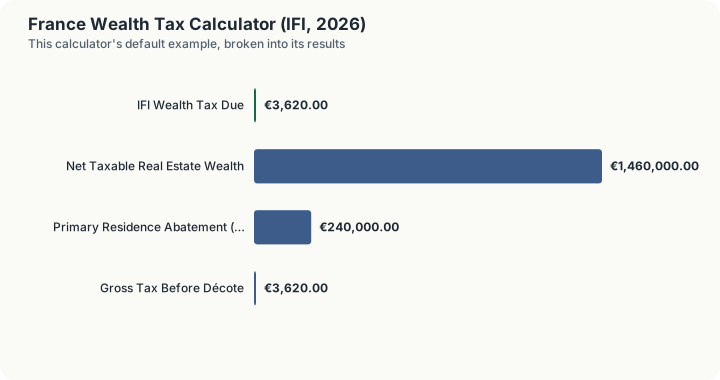
Quick Answer: A household with €2,000,000 in gross real estate value, an €800,000 primary residence (which gets a 30% abatement), and €300,000 of deductible mortgage debt has a net taxable real estate wealth of €1,460,000 -- above the €1,300,000 entry threshold -- and owes €3,620 in IFI (Impôt sur la Fortune Immobilière) for 2026.
Overview
The IFI (Impôt sur la Fortune Immobilière) is France's wealth tax on real estate -- and ONLY real estate. Unlike the old ISF (Impôt de Solidarité sur la Fortune) it replaced in 2018, financial assets like stocks, bonds, and cash are entirely outside its scope; only property (directly owned, or owned through real-estate-holding companies/SCPIs in proportion to your stake) counts toward the taxable base. If your net taxable real estate wealth at 1 January exceeds €1,300,000, you owe IFI on a progressive scale that starts counting from €800,000 -- a two-step threshold structure that regularly confuses first-time filers.
This calculator applies that exact structure: it nets your primary residence's 30% statutory abatement and any genuinely deductible debt against your gross real estate value, checks whether the result clears the €1,300,000 entry threshold, and -- if it does -- applies the six-bracket progressive scale (0.5% to 1.5%) along with the "décote" relief that softens the transition for households just above the threshold.
The IFI is assessed annually per household (foyer fiscal) based on your situation at 1 January of the relevant year, and it is a genuinely separate filing and payment obligation from ordinary income tax -- even though both are administered by the same tax authority and often declared around the same time of year. Because only real estate counts, two households with identical total net worth can face dramatically different IFI outcomes depending on how much of that wealth sits in property versus financial assets: a household with €3,000,000 entirely in a diversified investment portfolio owes €0 in IFI, while a household with the same €3,000,000 concentrated in real estate could owe several thousand euros, illustrating why this tax rewards (or at least doesn't penalize) diversification away from property specifically.
How This Is Calculated
- Start from your gross real estate value -- the total market value of all real estate you and your household own at 1 January, including your primary residence.
- Apply the 30% primary residence abatement to the value of your primary residence specifically (not to your other real estate).
- Subtract deductible debts -- outstanding mortgage balances and other liabilities genuinely tied to acquiring, maintaining, or improving your real estate holdings.
- Compare the result (net taxable wealth) against the €1,300,000 entry threshold. If you are at or below it, you are simply not liable for IFI -- €0, full stop.
- If above the threshold, apply the progressive scale STARTING FROM €800,000, not from €1,300,000: 0% up to €800,000; 0.5% from €800,000-€1,300,000; 0.7% from €1,300,000-€2,570,000; 1% from €2,570,000-€5,000,000; 1.25% from €5,000,000-€10,000,000; 1.5% above €10,000,000.
- Apply the décote if your net taxable wealth falls between €1,300,000 and €1,400,000: décote = €17,500 − (1.25% × net taxable wealth). This relief exists specifically to smooth the effect of just barely crossing the €1,300,000 threshold, since crossing it exposes your ENTIRE wealth (from €800,000 up) to tax, not just the amount above €1,300,000.
Worked Example
Using the calculator's default inputs -- €2,000,000 gross real estate, €800,000 of which is the primary residence, €300,000 of deductible debt:
- Primary residence abatement: €800,000 × 30% = €240,000.
- Net taxable wealth: €2,000,000 − €240,000 − €300,000 = €1,460,000.
- Compare to threshold: €1,460,000 exceeds €1,300,000, so IFI applies.
- Apply the scale: €800,000-€1,300,000 at 0.5% = €500,000 × 0.5% = €2,500. €1,300,000-€1,460,000 at 0.7% = €160,000 × 0.7% = €1,120. Gross tax = €2,500 + €1,120 = €3,620.
- Décote check: €1,460,000 is above the €1,400,000 upper bound of the décote zone, so no décote applies.
- Final IFI due: €3,620.
Now compare a household with net taxable wealth of exactly €1,350,000 (inside the décote zone): gross tax on that amount is €2,850, but the décote of €17,500 − (€1,350,000 × 1.25%) = €625 reduces the final bill to €2,225 -- nearly 22% lower than the uncapped bracket math alone would suggest.
What This Does Not Account For
- Real estate held through companies or SCPIs, where only the portion of the company's value attributable to real estate (and your ownership percentage) counts toward your taxable base -- this calculator assumes you have already computed your correct share.
- The overall tax cap ("plafonnement"), which limits the combined total of your income tax, IFI, and social contributions to 75% of your prior year's income -- a separate relief mechanism not modeled here.
- Business-asset exemptions for real estate used in an operating trade or business (biens professionnels), which can be excluded from the IFI base entirely under specific conditions.
- Usufruct/bare-ownership valuation splits (démembrement de propriété), which change how jointly-split ownership interests are valued for IFI purposes.
- Charitable-donation IFI tax reductions, which some taxpayers use to offset a portion of their IFI liability separately from this calculation.
- Rental property specific debt-deductibility restrictions and anti-abuse rules limiting certain related-party or recently-incurred debts from being deducted.
Common Pitfalls
- Confusing the €1,300,000 figure with where the tax scale starts. €1,300,000 is only the ENTRY THRESHOLD for being liable at all -- once you're liable, the actual progressive scale is computed starting from €800,000, meaning your first €800,000 of net taxable wealth is untaxed but the €800,000-€1,300,000 band IS taxed (at 0.5%) once you're over the threshold.
- Forgetting the primary residence abatement only applies to the primary residence. A rental property or vacation home receives no such abatement -- only the home you actually live in as your main residence.
- Ignoring the décote near the threshold, which can materially reduce the tax bill for households whose net taxable wealth sits just above €1,300,000 -- without it, crossing the threshold by a small amount would produce a disproportionately large jump in tax owed.
- Deducting debts that aren't genuinely tied to real estate. Only liabilities connected to acquiring, maintaining, or improving taxable real estate are deductible -- unrelated personal debts and certain related-party loans are excluded or restricted.
- Assuming financial assets count toward IFI. They do not -- stocks, bonds, cash, and business shares are entirely outside the IFI base (a major structural difference from the old ISF), which only ever taxes real estate.
Frequently Asked Questions
What's the difference between IFI and the old ISF wealth tax?
Do I have to pay IFI if my net taxable wealth is exactly €1,300,000?
Why does the tax scale start at €800,000 instead of €1,300,000?
What is the décote, and who benefits from it?
Does my mortgage reduce my IFI liability?
Is my stock portfolio included in IFI?
Sources
- French Public Finances Directorate (impots.gouv.fr), the official authority for the national tax authority this calculator relates to. impots.gouv.fr
Note on verification: the exact décote formula text was not independently re-confirmed against a primary BOFiP (bofip.impots.gouv.fr, BOI-PAT-IFI) page during this build; it is corroborated by consistent figures across several current secondary sources and matches the historical, unchanged ISF/IFI décote structure, but is flagged here for a follow-up primary-source check.
Also consulted: IFI barème (six brackets, 0% to 1.5%), €1,300,000 threshold, 30% primary residence abatement, and the €1,300,000-€1,400,000 décote formula: cross-checked against multiple current (2026) French tax-advisory sources citing the unchanged IFI structure in place since 2018; Code Général des Impôts, articles 964 to 983 (Impôt sur la Fortune Immobilière).