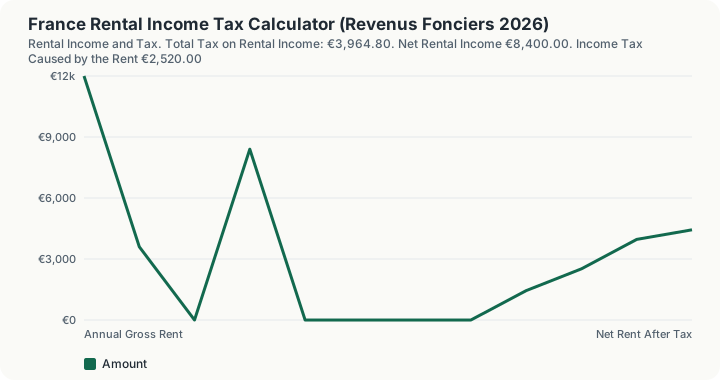
Quick Answer: On EUR 12,000 of unfurnished rent under the micro-foncier regime, with EUR 40,000 of other household income and a single-part foyer, the total tax is EUR 3,964.80. That is EUR 1,444.80 of prelevements sociaux at 17.2% plus EUR 2,520.00 of extra income tax, leaving EUR 4,435.20 of the EUR 8,400 net rental income. The effective rate on net rental income is 47.2%, and the regime reel on the same figures would cost EUR 5,654.56.
What does this calculator do?
French tax on unfurnished letting (revenus fonciers) is two taxes, not one, and the second is the one that surprises people. Income tax applies at your marginal band, because rental income stacks on top of everything else the household earns. On top of that sit the prelevements sociaux at a flat 17.2%, which apply from the first euro with no allowance and no banding.
There are two regimes. Micro-foncier replaces every real expense with a flat 30% abattement. It is available only where gross rent is EUR 15,000 or less, and it can never produce a deficit however much the landlord actually spent. Regime reel deducts actual charges and can produce a deficit foncier.
That deficit is where most explanations go wrong. Interest is set against rental income first. Any deficit that interest creates is ring-fenced by CGI art. 156 I 3 and can never reduce your salary; it carries forward ten years against future rental income only. Only the deficit created by the other charges is eligible for the EUR 10,700 imputation against global income, and anything above that cap also carries forward ten years.
Two further points this calculator gets right that summaries often do not. The frais de gestion forfait is exactly EUR 20 per local, a flat sum fixed by CGI art. 31 I 1 e, not a percentage. And the raised EUR 21,400 cap for energy-renovation works did not expire: LF 2026 art. 47 extended it to 31 December 2027.
How is this calculated?
Micro-foncier:
net = R × (1 − 0.30)
Regime reel, with interest applied first:
after interest = R − I; net = max(0, after interest − C)
where $C$ is the total deductible charges including the EUR 20 per local forfait. Then, in both regimes:
PS = net × 17.2%
income tax = T(other + net − deficit imputed) − T(other)
Step 1: Test micro-foncier eligibility. Gross rent above EUR 15,000 forces the regime reel whatever you selected.
Step 2a (micro-foncier): Apply the 30% abattement and take the remainder as net rental income. Real charges are ignored entirely, and no deficit can arise.
Step 2b (regime reel), Build the deductible charges: repairs and allowed improvement works, insurance, taxe fonciere, copropriete provisions, real management fees, plus EUR 20 for each let local.
Step 3 (reel only): Subtract mortgage interest from gross rent. If that goes negative, the shortfall is the interest-generated deficit, and income after interest is floored at zero.
Step 4 (reel only): Subtract the other charges from whatever survived step 3. If that goes negative, the shortfall is the deficit from other charges.
Step 5: Determine the imputation cap. EUR 10,700 normally; EUR 21,400 where the works qualify as energy renovation.
Step 6: Impute against global income the lesser of the other-charges deficit and the cap.
Step 7: Carry forward the interest-generated deficit plus any other-charges deficit above the cap, available for ten years against rental income only.
Step 8: Charge the prelevements sociaux at 17.2% on positive net rental income. A deficit year attracts none.
Step 9: Compute the income tax difference. The bareme is run twice: once on the household's other income alone, and once on other income plus net rental income minus any imputed deficit. The difference is the tax the rent actually caused.
Step 10: Report the deductible CSG. Of the 9.2 CSG points, 6.8 are deductible from taxable income in the year the levy is paid, which is the following year. It is reported and is deliberately not applied to this year's tax.
Step 11: Compute the other regime too and report which is cheaper.
Worked Example
EUR 12,000 of gross rent, micro-foncier, one local, EUR 40,000 of other household income, single, no children.
Step 1: Micro-foncier eligibility. EUR 12,000 is at or below the EUR 15,000 ceiling, so micro-foncier applies
Step 2: The 30% abattement. EUR 12,000 x 30% = EUR 3,600.00
Step 3: Net rental income. EUR 12,000 - EUR 3,600.00 = EUR 8,400.00
Step 4: Prelevements sociaux at 17.2%. EUR 8,400.00 x 17.2% = EUR 1,444.80
Step 5: Income tax on the household without the rent. The bareme applied to EUR 40,000 on one part: the baseline
Step 6: Income tax on the household with the rent. The bareme applied to EUR 40,000 + EUR 8,400.00 = EUR 48,400.00
Step 7: The income tax the rent caused. The difference between steps 6 and 5: EUR 2,520.00
The whole EUR 8,400 landed in the 30% band, which is why the figure is exactly 30% of it.
Step 8: Total tax on the rent. EUR 2,520.00 + EUR 1,444.80 = EUR 3,964.80
Step 9: Net rent after tax. EUR 8,400.00 - EUR 3,964.80 = EUR 4,435.20
Step 10: Effective rate on net rental income. EUR 3,964.80 / EUR 8,400.00 = 47.2%
Step 11: CSG deductible next year. EUR 8,400.00 x 6.8% = EUR 571.20
Step 12: The same figures under the regime reel. Deductible charges are only the EUR 20 forfait, so net income is EUR 11,980, and the total tax comes to EUR 5,654.56
Micro-foncier is cheaper by EUR 1,689.76 here, and it will be cheaper whenever real charges fall short of 30% of gross rent. With EUR 12,000 of rent, that break-even is EUR 3,600 of annual charges.
What does this calculator not account for?
- The tax is computed on this year only. Carried-forward deficits are calculated and reported, but no future year is modelled, so the ten-year benefit of a carry-forward never appears in the headline.
- The CSG deductible is reported, not applied. The 6.8 deductible points reduce taxable income in the year the levy is paid, which is the following year. Applying them here would overstate this year's relief.
- The three-year lock on electing the regime reel is not enforced. Opting out of micro-foncier binds you for three years. The calculator will let you switch back and forth freely.
- The micro-BIC regime for furnished lettings is not modelled. Location meublee is a different regime entirely (30% and EUR 15,000 for non-classified, 50% and EUR 77,700 for classified, per Loi Le Meur 2024-1039 art. 7 and CGI art. 50-0) and deserves its own page.
- The LF 2026 art. 47 amortissement for new acquisitions is not modelled. The 3.5% to 5.5% new-build and 3% to 4% rehabilitated rates, on 80% of the acquisition price net of fees with a nine-year commitment and an EUR 8,000 annual cap, are a distinct regime.
- The EUR 15,300 special cap is not modelled.
- Improvement works are taken at face value. For residential premises they are broadly deductible; for commercial premises only where they address asbestos or disability access; construction, reconstruction and extension never qualify. The calculator does not test which category your works fall into.
- The quotient familial cap is applied by the underlying income tax primitive, but no other credits or reductions are. Pinel, Denormandie, Malraux and the like are absent.
- IFI, the wealth tax on real estate, is not computed.
What mistakes do people make with this?
Believing the EUR 21,400 energy cap expired. It did not. LF 2026 art. 47 extended it to 31 December 2027. A good deal of advice written in 2025 says otherwise.
Treating the frais de gestion as a percentage. CGI art. 31 I 1 e fixes it at exactly EUR 20 per local. Not 20% of anything, and not per property owner.
Expecting an interest-heavy deficit to shelter your salary. It cannot. Interest is applied first and the deficit it creates is ring-fenced to future rental income for ten years. Only the deficit from repairs, insurance, taxe fonciere and the like reaches your global income, and only up to the cap.
Forgetting the prelevements sociaux when comparing to a salary. A 30% income tax band on rental income is really 47.2% once the 17.2% social levies are added. That is the effective rate this page reports, and it is why French rental yields look thinner after tax than before.
Electing the regime reel on a whim. It binds for three years. If your charges are below 30% of rent in any of those years, you are paying for the privilege.
Adding service charges recovered from the tenant into the rent without also deducting them. Under the regime reel the recovered charges are income and the expenditure is a deduction. Under micro-foncier the 30% abattement is supposed to cover it.
Frequently Asked Questions
Which regime should I choose?
Why is the effective rate 47.2% when I am in the 30% band?
Did the CSG rate on rental income go up in 2026?
Can a deficit foncier reduce my salary tax?
What counts for the raised EUR 21,400 cap?
Am I forced onto the regime reel?
Sources
- Prelevements sociaux at 17.2%: CSG 9.2% plus CRDS 0.5% plus prelevement de solidarite 7.5%. The 2026 carve-out keeping revenus fonciers at 9.2% CSG is CSS art. L. 136-8 IV 1, reaching L. 136-6 I a, confirmed on Legifrance at LEGIARTI000053278668 and in the impots.gouv.fr IR 2026 brochure. legifrance.gouv.fr/codes/article_lc/LEGIARTI000053278668
Also consulted: Micro-foncier, EUR 15,000 ceiling and 30% abattement: CGI art. 32, via BOFiP BOI-RFPI-DECLA-10. The election out of micro-foncier binds for three years; Deductible charges: CGI art. 31 I 1, read directly on Legifrance (version en vigueur 21/02/2026 to 01/01/2027). This is the source for the EUR 20 per local frais de gestion forfait at art. 31 I 1 e, for the insurance deduction at art. 31 I 1 a bis, and for the taxe fonciere deduction at art. 31 I 1 c, which expressly excludes the arts. 231 ter and 231 quater taxes on offices, commercial premises, storage and parking. It is also the source for the rule that improvement works are broadly deductible for residential premises but for commercial ones only where they address asbestos or disability access; Deficit foncier: CGI art. 156 I 3. The EUR 10,700 cap, the EUR 21,400 energy cap extended to 31/12/2027 by LF 2026 art. 47, the rule that interest-generated deficit is never imputable against global income, and the ten-year carry-forward against rental income; Deductible CSG: CGI art. 154 quinquies II, 6.8 points deductible from taxable income in the year of payment.
All read 2026-08-31. Full citation list in engine/primitives/france-tax.ts section 7.
Legifrance: legifrance.gouv.fr/codes/article_lc/LEGIARTI000053278668