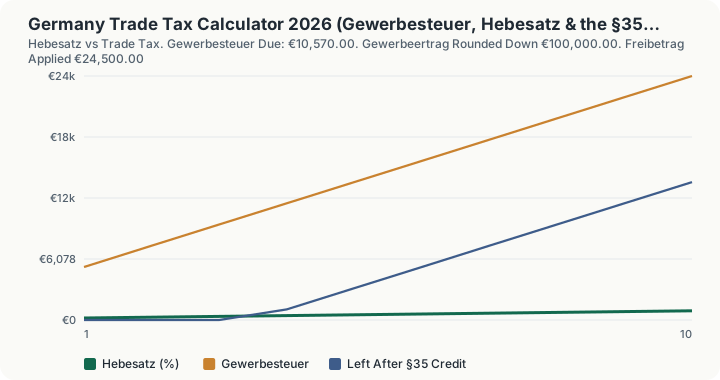
Quick Answer: On a Gewerbeertrag of EUR 100,000 for a sole trader in a municipality with a 400% Hebesatz, the Gewerbesteuer is EUR 10,570.00, an effective 10.57% of trade profit. The §35 EStG credit refunds four times the Steuermessbetrag, capped at the trade tax actually payable, so it is also EUR 10,570.00 here and the net burden is EUR 0.00. Every Gemeinde sets its own Hebesatz.
What does this calculator do?
The Gewerbesteuer is the only major German business tax whose rate is set by the municipality rather than by federal law. The federal statute supplies everything except the multiplier: a EUR 24,500 Freibetrag for natural persons and partnerships, a 3.5% Steuermesszahl, and a rounding rule. The municipality then multiplies the resulting Steuermessbetrag by its own Hebesatz, which it sets under its constitutional right of self-administration. The statutory minimum is 200%; large cities commonly sit far above that. No primary source fixes a Hebesatz nationally, so you must look up your own Gemeinde's published figure. This single number swings the bill by a factor of several.
For sole traders and partners there is a second mechanism that changes the answer entirely. Section 35 EStG reduces income tax by four times the Gewerbesteuer-Messbetrag, capped at the trade tax actually payable. Because the tax itself is the Messbetrag multiplied by the Hebesatz divided by 100, the arithmetic produces a clean break-even: at a Hebesatz of exactly 400% the credit equals the tax and the trade tax costs a sole trader nothing. Below 400% the cap binds and the credit is limited to the tax paid, so it is still fully offset. Above 400% the credit stops covering the tax and a genuine burden appears.
Corporations get neither the Freibetrag nor the credit. A GmbH bears the whole trade tax on the whole trade profit, on top of Körperschaftsteuer and the Solidaritätszuschlag.
How is this calculated?
Messbetrag = (⌊Gewerbeertrag/100⌋ × 100 − Freibetrag) × 3.5%
Gewerbesteuer = Messbetrag × Hebesatz/100; §35 credit = min(4 × Messbetrag, Gewerbesteuer)
Step 1: Round the Gewerbeertrag down to full EUR 100. EUR 100,000 rounded down to full hundreds = EUR 100,000.00
§11 Abs. 1 Satz 3 GewStG requires this before anything else happens. A Gewerbeertrag of EUR 100,099 would also round to EUR 100,000.
Step 2: Deduct the Freibetrag. EUR 100,000.00 - EUR 24,500.00 = EUR 75,500.00
The EUR 24,500 allowance is for natural persons and partnerships. The bodies under §11 Abs. 1 Satz 3 Nr. 2 GewStG get EUR 5,000. Corporations get nothing.
Step 3: Apply the Steuermesszahl of 3.5%. EUR 75,500.00 x 3.5% = EUR 2,642.50
This is the Steuermessbetrag, and it is the pivot of the whole calculation: the municipality multiplies it, and §35 EStG quadruples it.
Step 4: Apply the municipal Hebesatz. EUR 2,642.50 x 400 / 100 = EUR 10,570.00
Step 5: Compute the §35 EStG credit before its cap. EUR 2,642.50 x 4 = EUR 10,570.00
§35 Abs. 1 EStG reduces income tax by "das Vierfache" of the Messbetrag.
Step 6: Apply the §35 Abs. 1 Satz 5 cap. min(EUR 10,570.00, EUR 10,570.00) = EUR 10,570.00
The credit cannot exceed the trade tax actually payable.
Step 7: Net trade tax burden. EUR 10,570.00 - EUR 10,570.00 = EUR 0.00
Step 8: Effective rate on trade profit. EUR 10,570.00 / EUR 100,000 = 10.57%
That is the gross rate. For a sole trader at this Hebesatz the net rate is zero, since the credit absorbs it entirely.
Worked Example
The same EUR 100,000 of trade profit, run through four different situations.
Case A: sole trader, 400% Hebesatz. Step 1. Rounded Gewerbeertrag EUR 100,000.00 Step 2. Less Freibetrag: EUR 75,500.00 Step 3. Messbetrag: EUR 75,500 x 3.5% = EUR 2,642.50 Step 4. Trade tax: EUR 2,642.50 x 4.00 = EUR 10,570.00 Step 5. Credit: min(EUR 10,570.00, EUR 10,570.00) = EUR 10,570.00 Step 6. Net burden: EUR 0.00
Case B: the same sole trader in a city with a 490% Hebesatz. Step 1. Messbetrag is unchanged at EUR 2,642.50 Step 2. Trade tax: EUR 2,642.50 x 4.90 = EUR 12,948.25 Step 3. Credit: min(4 x EUR 2,642.50, EUR 12,948.25) = min(EUR 10,570.00, EUR 12,948.25) = EUR 10,570.00 Step 4. Net burden: EUR 12,948.25 - EUR 10,570.00 = EUR 2,378.25
Above 400% the credit is frozen at four times the Messbetrag while the tax keeps rising, so every point of Hebesatz above 400 is a real cost. The 90 points from 400% to 490% cost EUR 2,378.25.
Case C: a GmbH, 400% Hebesatz. Step 1. Rounded Gewerbeertrag EUR 100,000.00 Step 2. Freibetrag: EUR 0.00. Taxable trade profit stays at EUR 100,000.00 Step 3. Messbetrag: EUR 100,000 x 3.5% = EUR 3,500.00 Step 4. Trade tax: EUR 3,500 x 4.00 = EUR 14,000.00 Step 5. §35 credit: EUR 0.00. Corporations are not entitled to it. Step 6. Net burden: EUR 14,000.00
The same profit costs a GmbH EUR 14,000 and a sole trader nothing, at the same Hebesatz. That gap is the Freibetrag and the credit together.
Case D: a sole trader with EUR 20,000 of trade profit, any Hebesatz. Step 1. Rounded: EUR 20,000.00 Step 2. Less the EUR 24,500 Freibetrag, floored at zero: EUR 0.00 Step 3. Messbetrag: EUR 0.00 Step 4. Trade tax: EUR 0.00
Below the Freibetrag a sole trader pays no Gewerbesteuer at all, regardless of how high the municipal multiplier is.
What does this calculator not account for?
- The Hebesatz is entirely yours to supply. No default here is a national figure or an average, and none is presented as one. Look up your Gemeinde's published Hebesatz.
- The Gewerbeertrag is an input, not a derivation. The §8 GewStG add-backs (a quarter of financing costs above the EUR 200,000 allowance, portions of rents and leases, licence fees) and the §9 GewStG reductions (the property-related 1.2% of Einheitswert reduction, the extended Kürzung for property companies, certain dividends) are not computed. Enter the Gewerbeertrag itself.
- No income tax, Körperschaftsteuer or Solidaritätszuschlag. The §35 credit is shown as an amount, not applied to an actual income tax computation, so it is not checked against whether you have enough income tax to absorb it.
- The §35 credit is also capped by the actual Einkommensteuer attributable to the trade income (the anteilige Einkommensteuer limitation), which is not modelled here. The two caps implemented are the four-times-Messbetrag rule and the actual-trade-tax rule.
- No Gewerbeverlust carryforward under §10a GewStG.
- No Zerlegung. A business with establishments in several municipalities has its Messbetrag apportioned between them under §§28 to 34 GewStG, each applying its own Hebesatz. This calculator applies a single Hebesatz.
- Partnership specifics are not modelled, including how the Messbetrag and the §35 credit are allocated among partners according to their profit shares.
- The Freibetrag is not pro-rated for a business that existed for only part of the year.
What mistakes do people make with this?
- Looking for a national Gewerbesteuer rate. There is not one. The federal statute fixes only the 3.5% Steuermesszahl; the municipality supplies the multiplier, and the range across German municipalities is wide enough that the same profit can carry very different bills a few kilometres apart.
- Forgetting the rounding step. §11 Abs. 1 Satz 3 GewStG rounds the Gewerbeertrag down to full EUR 100 before the Freibetrag is applied. It rarely matters much but it is the first operation, not an afterthought.
- Giving a GmbH the EUR 24,500 Freibetrag. Corporations get no Freibetrag and no §35 credit. Applying either to a GmbH understates its tax substantially.
- Assuming trade tax is always a real cost for a sole trader. At or below a 400% Hebesatz it is fully offset by the §35 credit. The cost only appears above 400%, and it grows linearly from there.
- Assuming the §35 credit means trade tax never matters. It caps out at four times the Messbetrag. In a city at 900% the credit covers well under half the tax.
- Confusing Gewerbeertrag with accounting profit. They differ by the §8 add-backs and §9 reductions, and the add-backs in particular can make the Gewerbeertrag substantially larger than the profit for a business with significant rent or financing costs.
- Thinking a Freiberufler needs the Freibetrag. They do not. A freiberufliche Tätigkeit is outside the scope of §2 GewStG entirely, which is worth more than any allowance.
Frequently Asked Questions
What is a typical Hebesatz and why does this calculator not tell me?
Why does the §35 credit exactly cancel the trade tax at 400%?
Do freelancers pay Gewerbesteuer?
Why does a GmbH pay so much more trade tax than a sole trader?
What is the Gewerbeertrag and how do I find mine?
Sources
- Federal Ministry of Finance (Germany), the official authority for the national tax authority this calculator relates to. bundesfinanzministerium.de
Also consulted: §11 Abs. 1 Satz 3 GewStG. "Der Gewerbeertrag ist auf volle 100 Euro nach unten abzurunden", and the Freibetrag amounts: EUR 24,500 for natural persons and partnerships, EUR 5,000 for the Nr. 2 bodies (certain associations and public-law enterprises), and none for corporations; §11 Abs. 2 GewStG. "Die Steuermesszahl für den Gewerbeertrag beträgt 3,5 Prozent."; §2 Abs. 1 Satz 2 GewStG. "Unter Gewerbebetrieb ist ein gewerbliches Unternehmen im Sinne des Einkommensteuergesetzes zu verstehen", which imports the §15 Abs. 2 Satz 1 EStG definition and is why freiberufliche activity falls outside the tax; §15 Abs. 2 Satz 1 EStG. An activity is a Gewerbebetrieb only where it is "weder als Ausübung von Land- und Forstwirtschaft noch als Ausübung eines freien Berufs noch als eine andere selbständige Arbeit anzusehen"; §35 Abs. 1 EStG. Income tax is reduced by "das Vierfache" of the Gewerbesteuer-Messbetrag; §35 Abs. 1 Satz 5: "Der Abzug des Steuerermäßigungsbetrags ist auf die tatsächlich zu zahlende Gewerbesteuer beschränkt." Both caps are implemented. The credit is available to natural persons and partners, not to corporations.
All read at gesetze-im-internet.de on 2026-08-30. The Hebesatz is not in any of these sources and has no national value. Each Gemeinde sets and publishes its own under its constitutional right of self-administration; §16 Abs. 4 Satz 2 GewStG sets only the 200% minimum. It is a required user input in this calculator precisely so that it cannot be silently guessed.