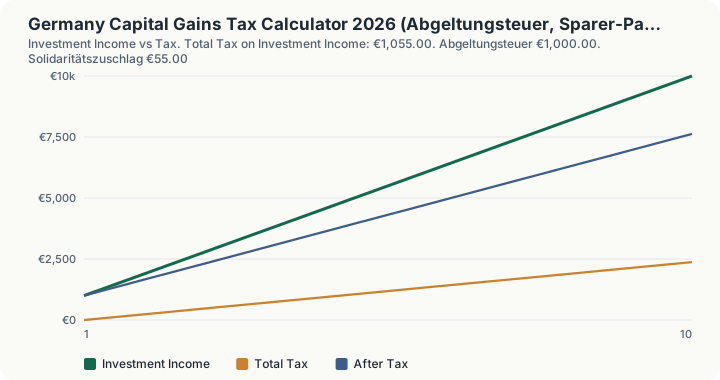
Quick Answer: €5,000 of investment income for a single filer with no church membership leaves €4,000 taxable after the €1,000 Sparer-Pauschbetrag. That produces €1,000.00 of Abgeltungsteuer at 25%, plus €55.00 of Solidaritätszuschlag at 5.5%, for a total of €1,055.00 and €3,945.00 kept: an effective rate of 21.10% on the gross income.
What does this calculator do?
Germany taxes capital gains, dividends and interest at a flat rate rather than at your personal income tax rate. §32d Abs.1 Satz 1 EStG states it plainly: the income tax on Einkünfte aus Kapitalvermögen "beträgt 25 Prozent".
Two things layer on top, and one of them behaves in a way almost nobody expects.
The Solidaritätszuschlag adds 5.5% of the flat tax. What matters is that the €20,350 Freigrenze which shelters most people from the Soli on ordinary income tax does not apply here. §3 Abs.3 SolzG draws that threshold expressly by reference to "Absatz 1 Nummer 1 und 2", and Kapitalertragsteuer is a separate basis under Nummer 5. The surcharge bites from the first euro of flat tax.
Church tax is the counterintuitive one. Church membership makes the flat tax itself lower, not higher. Because church tax on Abgeltungsteuer is a deductible Sonderausgabe, it feeds back into its own base, and §32d Abs.1 Sätze 3-5 handle this by replacing the plain 25% with a statutory formula:
Tax = (e − 4q)/(4 + k)
where $e$ is the income under §20, $q$ is creditable foreign withholding tax, and $k$ is the church tax rate. With no foreign tax this reduces to $e/(4+k)$: at $k = 0.09$ that is $1/4.09 = 24.45\%$, not 25%. The total bill is still higher, because the church tax is then charged on top, but the Abgeltungsteuer line itself falls.
The final piece is the Sparer-Pauschbetrag: €1,000 for a single filer, €2,000 jointly assessed. It is a substitute for expenses, not an addition to them. §20 Abs.9 EStG says "der Abzug der tatsächlichen Werbungskosten ist ausgeschlossen", so custody fees, data subscriptions and trading costs are not deductible on top.
How is this calculated?
Step 1: Set the Sparer-Pauschbetrag. €1,000 for a single filer, €2,000 for joint assessment, per §20 Abs.9 EStG.
Step 2: Apply the allowance. The allowance actually used is the lesser of the gross investment income and the available allowance. Income entirely inside the allowance produces no tax at all.
Step 3: Compute the taxable base. Gross investment income less the allowance used, floored at zero. This is the $e$ of §32d.
Step 4: Determine the church tax rate. Zero if you are not a church member. Otherwise it comes from your federal state: 8% in Bayern and Baden-Württemberg, 9% in the other fourteen states.
Step 5: Apply the statutory flat-tax formula. $(e - 4q) / (4 + k)$, floored at zero, where $q$ is the creditable foreign withholding tax you entered. With $k = 0$ and $q = 0$ this is simply $e / 4$, which is 25%.
Step 6: Compute the church tax. The Abgeltungsteuer from step 5 multiplied by the church tax rate. It is charged on the flat tax, not on the income.
Step 7: Compute the Solidaritätszuschlag. The Abgeltungsteuer from step 5 multiplied by 5.5%, with no Freigrenze. Note that this is computed on the reduced flat tax where church tax applies, so church membership lowers the Soli too.
Step 8: Total the tax and the net income. Abgeltungsteuer plus church tax plus Soli. Net investment income is gross less that total.
Step 9: Report both rates. The headline rate is the Abgeltungsteuer divided by the taxable base: 25.00%, or less where church tax applies. The effective rate is the total tax divided by the gross income, which is lower than either because the allowance shelters part of the income.
Step 10: Build the range table. The same computation is repeated at ten income levels from one fifth of your figure up to double it, in equal steps.
Worked Example
Defaults: €5,000 of investment income, single, no church membership, Nordrhein-Westfalen, no creditable foreign tax.
Step 1: Find the allowance. Single filing status gives a Sparer-Pauschbetrag of €1,000
Step 2: Apply it. min(€5,000, €1,000) = €1,000 used
Step 3: Find the taxable base. €5,000 − €1,000 = €4,000
Step 4: Find the church tax rate. Not a church member, so k = 0
Step 5: Apply the flat-tax formula. (€4,000 − 0) ÷ (4 + 0) = €1,000.00, which is exactly 25.00% of the base
Step 6: Compute the church tax. €1,000.00 × 0 = €0.00
Step 7: Compute the Solidaritätszuschlag. €1,000.00 × 5.5% = €55.00, from the first euro, with no Freigrenze
Step 8: Total the tax. €1,000.00 + €0.00 + €55.00 = €1,055.00
Step 9: Compute what you keep. €5,000 − €1,055.00 = €3,945.00
Step 10: Compute the effective rate on the gross. €1,055.00 ÷ €5,000 = 21.10%
The church tax case, worked separately
Change one input (church membership in Nordrhein-Westfalen, where k = 0.09) and the arithmetic reorders:
Step A: Apply the (4 + k) divisor. €4,000 ÷ 4.09 = €978.00, a rate of 24.45% on the base rather than 25.00%
Step B: Compute the church tax on that figure. €978.00 × 9% = €88.02
Step C: Compute the Soli on the reduced flat tax. €978.00 × 5.5% = €53.79, lower than the €55.00 above
Step D: Total. €978.00 + €88.02 + €53.79 = €1,119.81, an effective rate of 22.40%
So church membership raised the total bill by €64.81, but it lowered both the Abgeltungsteuer and the Soli. That is not a rounding artefact; it is the statutory divisor doing exactly what §32d Abs.1 Sätze 3-5 says it does. In Bayern or Baden-Württemberg, where k = 0.08, the same income gives a flat tax of €980.39 at 24.51% and a total of €1,112.74.
What does this calculator not account for?
- The Günstigerprüfung (§32d Abs.6 EStG). A taxpayer whose personal marginal rate is below the flat rate can elect assessment at the ordinary scale instead. This calculator always applies the flat regime, so a low-income investor's real bill may be lower than shown.
- The Teileinkünfteverfahren and §32d Abs.2 exceptions. Substantial shareholdings, loans to related parties and certain closely-held situations fall outside the flat regime entirely.
- Loss offsetting and the Verlustverrechnungstöpfe. Losses on shares can only offset gains on shares; other losses sit in a separate pot. Neither pot, nor loss carryforwards, nor the Verlustbescheinigung mechanism is modelled. The income figure you enter is treated as an already-netted annual result.
- The Vorabpauschale on accumulating funds and the Teilfreistellung partial exemptions for equity, mixed and real estate funds under the InvStG. Fund investors will overstate their tax here unless they enter an already-exempted figure.
- The Freistellungsauftrag mechanics. The calculator applies the full statutory allowance rather than tracking how you have split it across banks. An allowance under-allocated across brokers produces withholding this page does not show.
- Foreign tax credit limits. The $q$ input is subtracted through the statutory formula as written. Per-country credit ceilings under §32d Abs.5 are not enforced.
- Kapitalertragsteuer withholding versus final assessment. The figure here is the tax due, not the cash-flow timing of bank withholding and any refund at assessment.
- Only eight federal states appear in the selector, though the church tax rates are 8% in Bayern and Baden-Württemberg and 9% everywhere else, so the two rate cases are both covered.
- Non-residents, treaty relief and the church tax exit (Kirchenaustritt) mid-year are not modelled.
What mistakes do people make with this?
Assuming church membership pushes the flat tax above 25%. It lowers it, to 24.45% at k = 0.09 and 24.51% at k = 0.08. The total bill rises because church tax is then added, but the Abgeltungsteuer and the Soli both fall. Any calculator that computes 25% and then adds 9% of it on top is overstating the tax.
Expecting the Soli Freigrenze to apply. It does not reach Kapitalertragsteuer. §3 Abs.3 SolzG defines it by reference to Absatz 1 Nummern 1 and 2 only, and investment income is Nummer 5. The 5.5% applies from the first euro of flat tax even for someone who pays no Soli at all on their salary.
Deducting custody fees or trading costs on top of the allowance. §20 Abs.9 EStG expressly excludes actual Werbungskosten. The Sparer-Pauschbetrag replaces them; it does not sit alongside them.
Forgetting to lodge or split the Freistellungsauftrag. The allowance is not applied automatically across banks. Money held at several brokers with no allocation instruction will be withheld against in full.
Assuming the flat rate is always the best outcome. Where your personal marginal rate is below roughly 25%, the Günstigerprüfung under §32d Abs.6 may produce a lower bill. This calculator does not run that test.
Treating fund distributions as ordinary investment income. Equity funds carry a Teilfreistellung that exempts part of the return before the flat tax applies. Entering the gross distribution overstates the tax.
Frequently Asked Questions
What is the Abgeltungsteuer rate in Germany for 2026?
Why does church tax make my flat tax lower?
How much is the Sparer-Pauschbetrag in 2026?
Do I pay Solidaritätszuschlag on investment income even though I do not pay it on my salary?
Can I deduct my broker fees against my gains?
Does the federal state I live in change my capital gains tax?
Sources
- §32d EStG, Abs.1 Satz 1 ("Die Einkommensteuer für Einkünfte aus Kapitalvermögen ... beträgt 25 Prozent") and Abs.1 Sätze 3-5 (the (e − 4q)/(4 + k) church-tax formula): gesetze-im-internet.de/estg/__32d.html
- §20 Abs.9 EStG (Sparer-Pauschbetrag of €1,000 and €2,000 jointly, and the exclusion of actual Werbungskosten): gesetze-im-internet.de/estg/__20.html
- §4 SolzG 1995 (the 5.5% rate): gesetze-im-internet.de/solzg_1995/__4.html
- §3 SolzG 1995 (Abs.1 Nr.5 makes Kapitalertragsteuer a basis in its own right; the Abs.3 Freigrenze is drawn by reference to Absatz 1 Nummern 1 und 2 only): gesetze-im-internet.de/solzg_1995/__3.html
Also consulted: Church tax rates of 8% in Bayern and Baden-Württemberg and 9% in the other states, from the state table in engine/primitives/germany-tax.ts.
All provisions were read at gesetze-im-internet.de on 2026-08-30. Full citations sit in engine/primitives/germany-business-tax.ts section 2.