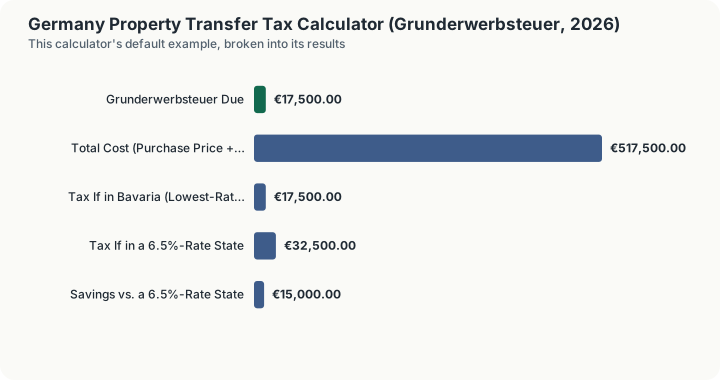
Quick Answer: Buying a €500,000.00 property in Bavaria in 2026 costs €17,500.00 in Grunderwerbsteuer (3.5%, Germany's lowest state rate), for a total outlay of €517,500.00 -- versus €32,500.00 in a 6.5%-rate state like North Rhine-Westphalia, a difference of €15,000.00 on an identical purchase price.
Overview
Grunderwerbsteuer is Germany's real estate transfer tax, due once whenever ownership of German real property changes hands through a purchase (with narrow exceptions for transfers between close relatives or within certain corporate restructurings). Unlike income tax, it is not a federal, uniform rate: Article 105 of Germany's Basic Law (Grundgesetz) lets each of the 16 states (Bundesländer) set its own rate, and since a 2006 constitutional reform devolved that power from the federal government, states have used it freely. The result is a nationwide patchwork ranging from 3.5% to 6.5% of the purchase price -- a gap that can mean a five-figure difference in cash due at closing for an identical property, depending purely on which side of a state border it sits.
This calculator applies the correct current rate for any of Germany's 16 states to your purchase price and shows the tax due, the total cost of the transaction, and a direct comparison against the lowest- and highest-rate states nationwide, so you can see exactly how much of your transfer tax bill is a function of geography rather than the property itself.
Germany's currency is the euro (€); every figure here is denominated in euros, and rates are flat percentages of the purchase price with no brackets or value-based surcharges (unlike some countries' tiered or "mansion tax" transfer levies).
Because the rate is entirely a function of which state the property sits in, Grunderwerbsteuer is one of the few German property-related costs that a buyer can meaningfully "shop around" simply by choosing where to buy -- a consideration that matters most for buyers weighing similarly priced properties near a state border (for example, near the Bavaria/Baden-Württemberg or Berlin/Brandenburg lines), where a short distance can carry a materially different tax bill. It also means investors comparing yield across a multi-state portfolio need to factor transfer tax into their acquisition-cost model on a state-by-state basis, not as a single nationwide constant.
How This Is Calculated
- Identify the state's current rate. Each of the 16 Bundesländer sets one flat Grunderwerbsteuer rate that applies uniformly regardless of property value.
- Apply the flat rate to the purchase price.
- Add it to the purchase price for total cash cost at closing (before other separate closing costs like notary fees, land registry fees, and any agent commission, which this calculator does not include).
Current 2026 Rates by State (Verified)
- Bavaria (Bayern): 3.5% -- the lowest rate nationwide, unchanged since the statutory floor was set in 1983.
- Baden-Württemberg: 5.0% -- since 2011.
- Berlin: 6.0% -- since 2014.
- North Rhine-Westphalia (NRW): 6.5% -- since 2015, tied for the current nationwide maximum.
- Hamburg: 5.5% -- since 1 January 2023.
- Other states range between these figures; Brandenburg, Saarland, and Schleswig-Holstein also currently levy 6.5%, while Lower Saxony, Rhineland-Palatinate, Saxony-Anhalt, and Thuringia levy 5.0%.
Worked Example
Using the calculator's default inputs:
- Purchase Price: €500,000.00
- State: Bavaria (3.5%)
Step by step:
- Bavaria's current Grunderwerbsteuer rate is 3.5%.
- Tax due: €500,000.00 × 3.5% = €17,500.00.
- Total cost at closing (purchase price + transfer tax): €500,000.00 + €17,500.00 = €517,500.00.
- For comparison, the same €500,000.00 purchase in a 6.5%-rate state (e.g. North Rhine-Westphalia) would owe €32,500.00 -- €15,000.00 more for an identical property, purely from the state's chosen rate.
What This Does Not Account For
- Other closing costs. Notary fees (typically ~1.5%-2% of purchase price, mandatory in Germany for any property sale), land registry fees (Grundbuchamt, typically ~0.5%), and any real estate agent commission (Maklerprovision, now often split between buyer and seller since a 2020 law change) are all separate from, and in addition to, Grunderwerbsteuer.
- Exemptions and reduced-consideration transfers. Transfers between spouses, direct-line relatives (parents, children, grandchildren), or via inheritance/gift are generally exempt from Grunderwerbsteuer entirely -- this calculator assumes a standard arm's-length purchase.
- Share-deal structuring. Large commercial transactions sometimes structure a property acquisition as a corporate share transfer (Share Deal) rather than a direct asset purchase, which can trigger different Grunderwerbsteuer rules (including anti-abuse thresholds tightened by 2021 legislation) not modeled here.
- New-build VAT interactions. For certain new-build purchases, Grunderwerbsteuer and value-added tax (Umsatzsteuer) treatment can interact in ways specific to the contract structure, which this calculator does not model.
- Local surcharges beyond the stated state rate. The rate shown is the full statutory state rate; no municipality adds a further Grunderwerbsteuer surcharge on top of it (unlike Grundsteuer, which has an additional municipal Hebesatz).
Common Pitfalls
- Assuming a single nationwide rate. Unlike many countries' transfer taxes, Germany has no federal Grunderwerbsteuer rate at all -- the entire tax is state-set, so the same purchase can cost dramatically different amounts depending purely on location.
- Forgetting Grunderwerbsteuer is due regardless of financing. The tax is owed on the full purchase price (or, in some cases, an assessed value if higher) whether the purchase is all-cash or mortgage-financed, and is typically due within a month of the notarized purchase contract, before the property transfer is registered.
- Confusing Grunderwerbsteuer with Grundsteuer. Grunderwerbsteuer is a one-time transaction tax paid by the buyer at purchase; Grundsteuer (see the companion Germany Property Tax Calculator) is a separate, recurring annual property tax paid by the owner every year thereafter.
- Not budgeting for it as cash-in-hand. German mortgage lenders typically do not finance Grunderwerbsteuer, notary fees, or registry fees as part of the loan-to-value calculation -- buyers usually need this amount in cash on top of any down payment.
- Overlooking recent rate changes. Several states changed rates within the last few years (Thuringia cut its rate in January 2024; Bremen raised its rate in July 2025) -- always confirm the current rate with your state's Finanzministerium before a transaction, since this calculator reflects rates verified as of 2026.
Frequently Asked Questions
Which German state has the lowest Grunderwerbsteuer rate?
Which state has the highest rate?
Who pays Grunderwerbsteuer, the buyer or the seller?
Can I avoid Grunderwerbsteuer by buying from a family member?
Is Grunderwerbsteuer tax-deductible?
When exactly is Grunderwerbsteuer due, and what happens if it isn't paid?
Does the rate depend on whether the buyer is a foreign national or non-resident?
Sources
- Current 2026 state rate table cross-corroborated across two independent research passes citing Bundesfinanzministerium (BMF) and state Finanzministerium rate data, agreeing on all 16 states' current rates and recent change dates (e.g. Thuringia's January 2024 reduction, Bremen's July 2025 increase). bundesfinanzministerium.de
Also consulted: Grunderwerbsteuergesetz (GrEStG) -- federal framework law; Article 105 Grundgesetz (Basic Law) for the states' rate-setting authority since the 2006 föderalismusreform.