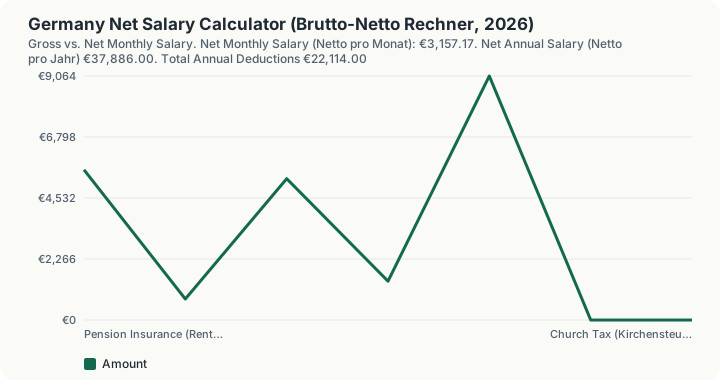
Quick Answer: A single filer in North Rhine-Westphalia earning a €60,000.00 gross annual salary, with no church-tax membership and no children, takes home an estimated €37,886.00 net per year (€3,157.17 net per month) in Germany for 2026, after €13,050.00 in social insurance contributions and €9,064.00 in income tax.
Overview
Germany's payroll system runs on two largely independent tracks that both come straight out of your gross salary: Sozialversicherung (the four mandatory social-insurance contributions -- pension, unemployment, health, and long-term care) and Steuern (income tax, the solidarity surcharge, and church tax if applicable). Together they typically remove somewhere between a quarter and just over a third of gross pay for a median earner, which is why the gap between a German job offer's "Brutto" (gross) and "Netto" (net) figure surprises so many newcomers, expats, and even long-time residents comparing offers across states.
This calculator (a "Brutto-Netto-Rechner") reconstructs that full chain for 2026: it applies the current employee-side social-insurance rates and contribution ceilings, computes taxable income after the standard statutory deductions, runs that through the exact §32a EStG progressive tax formula (including Ehegattensplitting for married couples), and layers on the solidarity surcharge and church tax where they apply. The result is a transparent, line-by-line breakdown of exactly where each euro of gross salary goes -- useful for evaluating a German job offer, planning a move between states, or simply understanding a payslip (Gehaltsabrechnung) that otherwise reads like a wall of abbreviations.
Germany's currency is the euro (€), and every figure in this calculator is denominated in euros.
How This Is Calculated
- Social insurance contributions (Sozialversicherung), employee share only. Each of the four contributions applies to gross salary up to its own annual ceiling (Beitragsbemessungsgrenze), beyond which no further contribution is owed on that component: - Pension insurance (Rentenversicherung): 9.3% of gross salary, capped at €101,400/year. - Unemployment insurance (Arbeitslosenversicherung): 1.3% of gross salary, capped at €101,400/year. - Health insurance (Krankenversicherung): 7.3% plus half of the 2026 average additional contribution rate (Zusatzbeitrag, 2.9% average, so 1.45% employee share) = 8.75% of gross salary, capped at €69,750/year. - Long-term care insurance (Pflegeversicherung): 1.8% of gross salary (2.3% in Saxony, which historically shifts more of the burden to employees), plus a 0.6-point surcharge for childless employees, minus a 0.25-point discount per child (from the 2nd through the 4th child under 25), capped at €69,750/year.
- Taxable income (zu versteuerndes Einkommen). Gross salary minus total social-insurance contributions, minus the €1,230 standard employee work-expense deduction (Arbeitnehmer-Pauschbetrag), minus the €36 (single) / €72 (married) standard special-expenses deduction (Sonderausgaben-Pauschbetrag).
- Income tax (Einkommensteuer), §32a EStG. A five-zone progressive formula with continuously rising marginal rates (not simple flat brackets): 0% up to €12,348, then a smoothly rising rate through two progression zones up to 42% at €69,879, flat 42% up to €277,825, and 45% above that. Married couples use Ehegattensplitting: combined taxable income is halved, taxed once at these single-filer rates, and the result doubled -- always at least as favorable as filing separately.
- Solidarity surcharge (Solidaritätszuschlag). 5.5% of income tax, but only above a 2026 Freigrenze of €20,350 (single) / €40,700 (married) of income tax itself -- and even then, capped in a "Milderungszone" (mitigation zone) at 11.9% of the amount by which tax exceeds that threshold, so roughly 90% of taxpayers now owe no soli at all.
- Church tax (Kirchensteuer). 8% of income tax in Bavaria and Baden-Württemberg, 9% elsewhere -- only if you are a registered member of a tax-collecting church (mainly Catholic or Evangelical) and have not formally left (Kirchenaustritt).
- Net salary. Gross salary minus all of the above.
Worked Example
Using the calculator's default inputs:
- Gross Annual Salary: €60,000.00
- Filing Status: Single
- State: North Rhine-Westphalia (9% church-tax state, but not a church member here)
- Children Under 25: 0
Step by step:
- Social insurance: Pension 9.3% × €60,000 = €5,580.00; Unemployment 1.3% × €60,000 = €780.00; Health 8.75% × €60,000 = €5,250.00; Long-term care (childless, 1.8%+0.6%=2.4%) × €60,000 = €1,440.00. Total: €13,050.00.
- Taxable income: €60,000.00 − €13,050.00 − €1,230.00 − €36.00 = €45,684.00 (falls in the second progression zone, €17,800-€69,878).
- Income tax: Using the zone-3 formula with z = (45,684 − 17,799) / 10,000 = 2.7885: tax = (173.10 × 2.7885 + 2,397) × 2.7885 + 1,034.87 = €9,064.88, rounded down to €9,064.00.
- Solidarity surcharge: €9,064.00 is well below the €20,350 Freigrenze, so €0.00.
- Church tax: Not a church member, so €0.00.
- Net salary: €60,000.00 − €13,050.00 − €9,064.00 − €0.00 − €0.00 = €37,886.00/year, or €3,157.17/month.
For comparison, the same salary for a Bavarian filer who is a registered church member adds 8% × €9,064.00 = €725.12 in church tax, dropping net pay to €37,160.88/year (€3,096.74/month).
What This Does Not Account For
- Monthly Lohnsteuerklassen (tax class) withholding mechanics. This calculator models the annual tax liability an employee would ultimately owe, the way a year-end assessment computes it. Actual month-to-month payroll withholding depends on which Lohnsteuerklasse (I through VI) applies -- married couples choosing III/V or IV/IV-with-factor will see very different per-paycheck withholding even though their combined annual liability (as modeled here via splitting) is identical.
- Church tax capping (Kappung). Most states cap church tax at 2.75%-4% of taxable income for very high earners, which this calculator does not apply since it varies by state and usually requires an explicit application to your Landeskirche.
- Private health/care insurance (PKV). This models statutory (GKV) contributions only. Higher earners above the Versicherungspflichtgrenze (€77,400/year in 2026) may opt into private insurance with entirely different, age- and health-rated premiums.
- Additional voluntary benefits. Company pension contributions (betriebliche Altersvorsorge), capital-forming payments (vermögenswirksame Leistungen), and other salary-sacrifice arrangements common in German employment contracts are not modeled.
- Non-salary income and itemized deductions. Investment income (taxed separately under the 25% Abgeltungsteuer flat rate), rental income, or itemized Werbungskosten above the €1,230 standard deduction are out of scope.
- Employer-side contributions. Only the employee's own deductions are shown; the employer pays a roughly matching share for pension, unemployment, and health insurance (and a different long-term-care share, especially in Saxony) that never appears on your payslip's net figure but is part of your total employment cost.
Common Pitfalls
- Comparing gross salaries across states without adjusting for church tax and Pflegeversicherung differences. A €60,000 offer in Saxony (higher long-term-care employee share) or Bavaria (church member) nets out differently than the identical figure in a 9%-church-tax, non-Saxony state.
- Assuming the solidarity surcharge still applies broadly. Since the 2021 reform raised the Freigrenze dramatically, roughly 90% of taxpayers now pay zero soli -- a common outdated assumption is that soli still applies to everyone at a flat 5.5%.
- Forgetting Ehegattensplitting favors uneven-income couples the most. The tax saving from splitting is largest when one spouse earns significantly more than the other; two spouses with identical incomes see little to no splitting benefit.
- Ignoring the childless Pflegeversicherung surcharge. Employees over 23 without children pay an extra 0.6 percentage points on long-term-care insurance that is easy to miss when estimating take-home pay.
- Treating the calculator's monthly net figure as an exact payslip match. Real payslips can differ by a few euros from rounding conventions, mid-year rate changes, or employer-specific benefits -- treat this as a close estimate, not a substitute for your actual Gehaltsabrechnung.
Frequently Asked Questions
Why does my payslip show different withholding than this calculator's monthly figure?
Do I have to pay church tax?
What is Ehegattensplitting and should married couples always use it?
Why is Saxony different for long-term-care insurance?
Is the solidarity surcharge being phased out completely?
Sources
- Solidaritätszuschlaggesetz 1995 (SolzG 1995); 2026 Freigrenzen per the Steuerfortentwicklungsgesetz of 23 December 2024 (BGBl I 2024 Nr. 449), as reflected in the BMF's Amtliches Lohnsteuer-Handbuch (LStH) 2026. bmf.gv.at
- Federal Ministry of Finance (Germany), the official authority for the national tax authority this calculator relates to. bundesfinanzministerium.de
Also consulted: Einkommensteuergesetz (EStG) §32a -- Einkommensteuertarif, current consolidated text (gesetze-im-internet.de), assessment year 2026; Einkommensteuergesetz (EStG) §9a -- Arbeitnehmer-Pauschbetrag, and §10c -- Sonderausgaben-Pauschbetrag, current text; Deutsche Rentenversicherung Knappschaft-Bahn-See -- official 2026 Sozialversicherungsrechengrößen announcement (following the Sozialversicherungsrechengrößen-Verordnung 2026, Federal Law Gazette, 26 November 2025); GKV-Schätzerkreis -- official 2026 average Zusatzbeitrag estimate (2.9%); Pflegeunterstützungs- und -entlastungsgesetz (PUEG), in force since 1 July 2023, for long-term-care insurance rates, the childless surcharge, and the per-child discount.