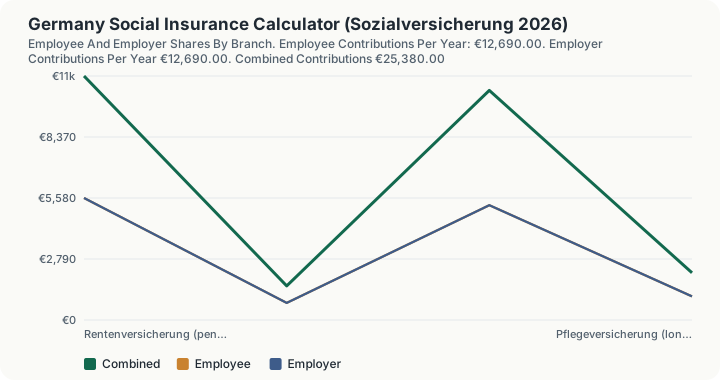
Quick Answer: On a gross salary of EUR 60,000 in 2026 with one child, the employee pays EUR 12,690.00 a year in social insurance and the employer pays the same again, so the true cost of employment is EUR 72,690.00. That employee share is exactly 21.15% of gross, the figure the Deutsche Rentenversicherung publishes as the average total. A childless employee pays 21.75%. Above EUR 69,750 and again above EUR 101,400 the contributions stop, and the effective rate starts falling.
What does this calculator do?
German social insurance has four branches, each with its own rate and each split between employee and employer. In 2026 the combined rates are 18.6% for the Rentenversicherung, 14.6% plus an average 2.9% Zusatzbeitrag for the Krankenversicherung, 2.6% for the Arbeitslosenversicherung and 3.6% for the Pflegeversicherung.
Two features make the arithmetic less obvious than four percentages suggest.
The first is that there are two contribution ceilings, not one. Pension and unemployment contributions stop at EUR 101,400 a year. Health and long-term care contributions stop much earlier, at EUR 69,750. A salary between those two figures is fully assessed for two branches and frozen for the other two, and above EUR 101,400 nothing further is charged at all.
The second is that the Pflegeversicherung is the only branch that is not split evenly. Childless members aged 23 and over pay a 0.6 point surcharge that the employer does not share. Members with children get 0.25 points off for the second through the fifth child. And Saxony, alone among the states, splits the branch 2.3% employee to 1.3% employer rather than 1.8% each.
This calculator computes contributions only. It does not compute Lohnsteuer, Solidaritaetszuschlag or Kirchensteuer.
How is this calculated?
- Cap the salary at each branch's Beitragsbemessungsgrenze. There are two, and the calculator applies each to the branches it governs.
Base_(RV, AV) = min(Gross, 101,400); Base_(KV, PV) = min(Gross, 69,750)
- Apply the pension and unemployment rates to the higher base. Both are split evenly.
RV_employee = Base_(RV, AV) × 9.3%; AV_employee = Base_(RV, AV) × 1.3%
- Apply the health rate to the lower base, adding half the fund's Zusatzbeitrag. The general rate of 14.6% is split 7.3% each way, and the Zusatzbeitrag has been shared equally since 2019, so an employee on the 2.9% average pays 8.75%.
KV_employee = Base_(KV, PV) × (7.3% + Zusatzbeitrag/2)
- Build the long-term care rate from the base rate, the childless surcharge and the per-child reductions. The employee base is 1.8%, or 2.3% in Saxony. With no children the surcharge of 0.6 points is added. With two or more children, 0.25 points is subtracted for each child from the second through the fifth, so the reduction stops after four of them.
PV_employee = Base_employee + 0.6%_childless − 0.25% × (min(children, 5) − 1)⁺
PV_employer = Base_(KV, PV) × 1.8% (1.3% in Saxony)
- Sum both sides and report the effective rate against full gross. Dividing by the whole salary rather than by the capped base is what makes the ceilings visible.
Rate_effective = (∑employee contributions)/Gross
Worked Example
An employee earns EUR 60,000 gross with one child, outside Saxony, in a fund charging the average 2.9% Zusatzbeitrag. Both ceilings are above the salary, so every branch is assessed on the full EUR 60,000.
Step 1 - Rentenversicherung. EUR 60,000 x 9.3% = EUR 5,580.00 from the employee, and the same from the employer
Step 2 - Arbeitslosenversicherung. EUR 60,000 x 1.3% = EUR 780.00 each
Step 3 - Krankenversicherung. 7.3% + (2.9% / 2) = 8.75%; EUR 60,000 x 8.75% = EUR 5,250.00 each
Step 4 - Pflegeversicherung. One child means no surcharge and no reduction: EUR 60,000 x 1.8% = EUR 1,080.00 each
Step 5 - The employee total. EUR 5,580.00 + EUR 780.00 + EUR 5,250.00 + EUR 1,080.00 = EUR 12,690.00
Step 6 - The check that matters. EUR 12,690.00 / EUR 60,000 = 21.15%, which is exactly the employee-side total the Deutsche Rentenversicherung publishes for 2026
Step 7 - The cost of employment. EUR 60,000 + EUR 12,690.00 = EUR 72,690.00
Now remove the child.
Step 8 - The childless surcharge. 1.8% + 0.6% = 2.4%; EUR 60,000 x 2.4% = EUR 1,440.00
Step 9 - The childless employee total. EUR 5,580.00 + EUR 780.00 + EUR 5,250.00 + EUR 1,440.00 = EUR 13,050.00, or 21.75%, again matching the published figure
Step 10 - Who pays it. EUR 13,050.00 - EUR 12,690.00 = EUR 360.00, which is 0.6% of gross, and the employer's total does not move at all
Now raise the salary to EUR 150,000, above both ceilings.
Step 11 - Pension and unemployment, capped at EUR 101,400. EUR 101,400 x 9.3% = EUR 9,430.20 and EUR 101,400 x 1.3% = EUR 1,318.20
Step 12 - Health and care, capped at EUR 69,750. EUR 69,750 x 8.75% = EUR 6,103.13 and EUR 69,750 x 1.8% = EUR 1,255.50
Step 13 - The employee total on EUR 150,000. EUR 9,430.20 + EUR 1,318.20 + EUR 6,103.13 + EUR 1,255.50 = EUR 18,107.03
Step 14 - What the ceilings do to the rate. EUR 18,107.03 / EUR 150,000 = 12.07%, against 21.15% on EUR 60,000. The contribution system is sharply regressive at the top.
The Ceilings, The Surcharge And The Saxony Split
The two ceilings bite at different salaries, and the gap between them is wide. At EUR 60,000 every branch is live. At EUR 80,000 the pension contribution has grown to EUR 7,440.00 but the health contribution is already frozen at EUR 6,103.13, exactly what it is at EUR 150,000 or at EUR 1,000,000. Between EUR 69,750 and EUR 101,400 a raise carries pension and unemployment contributions only.
Above EUR 101,400 a raise is free of contributions entirely. The employee total at EUR 101,400 and at EUR 200,000 is identical to the cent. Everything earned above the top ceiling carries no social insurance at all.
The childless surcharge costs exactly 0.6% of assessed pay and the employer contributes nothing to it. On EUR 60,000 that is EUR 360.00 a year. It applies from the month after the member turns 23 and stops permanently once they have a child.
The per-child reduction is a ladder that stops at the fifth child. On EUR 60,000 the employee's Pflege rate runs 1.80% with one child, then 1.55%, 1.30%, 1.05% and 0.80% with five, which is EUR 480.00 a year. A sixth child changes nothing, because the statute grants the reduction only from the second child through the fifth.
Saxony moves 0.5 points from the employer to the employee and leaves the total untouched. On EUR 60,000 a Saxon employee pays EUR 1,380.00 of Pflegeversicherung against EUR 1,080.00 elsewhere, and the Saxon employer pays EUR 780.00 against EUR 1,080.00. The combined 3.6% is identical; only the split differs.
Your fund's Zusatzbeitrag matters half as much as it looks. Because it is split evenly, a fund charging 3.9% rather than the 2.9% average costs the employee 0.5% of assessed pay, which is EUR 300.00 a year on EUR 60,000, not EUR 600.00.
The EUR 77,400 Versicherungspflichtgrenze is a different line from the EUR 69,750 ceiling. The lower figure is where health contributions stop. The higher one is where an employee first becomes free to leave the statutory scheme for private cover. A salary of EUR 72,000 is between them: capped, but still compulsorily insured.
What does this calculator not account for?
- Income tax. Lohnsteuer, the Solidaritaetszuschlag and Kirchensteuer are all separate and are not computed here.
- Private health insurance. Above EUR 77,400 an employee may leave the statutory scheme, at which point the health and care figures here no longer describe what they pay.
- The Umlage contributions U1, U2 and U3, and statutory accident insurance, all of which the employer pays on top of the four branches modelled here.
- Minijobs, Midijobs and the Uebergangsbereich, where the employee share is reduced on a sliding scale below EUR 2,000 a month.
- Voluntarily insured members, civil servants, the self-employed and the Kuenstlersozialkasse, none of which follow the employee split used here.
- The knappschaftliche Rentenversicherung, the miners' scheme, which has its own higher ceiling of EUR 124,800.
- Pay-period mechanics. This is an annual calculation. Real payroll assesses each month against a monthly ceiling of EUR 8,450 and EUR 5,812.50, which can differ from the annual result where pay is uneven or the year is partial.
- Whether your fund's Zusatzbeitrag is the average. The 2.9% default is the official average for 2026, not your fund's rate. Individual funds charge more and less.
What mistakes do people make with this?
- Using one ceiling for all four branches. Health and care stop at EUR 69,750, roughly EUR 31,650 earlier than pension and unemployment.
- Assuming the employer always matches the employee. It does not on the childless surcharge, and it does not in Saxony.
- Adding the whole Zusatzbeitrag to the employee's rate. Only half of it is theirs.
- Confusing the EUR 77,400 Versicherungspflichtgrenze with the EUR 69,750 contribution ceiling. They do different jobs.
- Expecting the per-child reduction for a first child. The first child removes the surcharge; the reduction starts with the second.
- Reading the effective rate as flat. It is 21.15% at EUR 60,000 and 12.07% at EUR 150,000.
Frequently Asked Questions
Why are there two contribution ceilings?
How much is the childless surcharge?
Do children reduce my contributions?
What is different about Saxony?
Does a raise above EUR 101,400 cost me anything in contributions?
Is the Zusatzbeitrag the same everywhere?
Sources
- Federal Ministry of Finance (Germany), the official authority for the national tax authority this calculator relates to. bundesfinanzministerium.de
Also consulted: Sozialversicherungsrechengroessen-Verordnung 2026 (SVBezGrV 2026), gesetze-im-internet.de. Section 4(1): pension ceiling of EUR 101,400 a year, EUR 8,450 a month. Section 2(2): EUR 69,750 and EUR 5,812.50 for health and care. Section 2(1): Versicherungspflichtgrenze of EUR 77,400. Section 1: Bezugsgroesse of EUR 47,460. Read 31 August 2026; Deutsche Rentenversicherung, "Zahlen und Tabellen der gesetzlichen Rentenversicherung", Stand 18.6.2026, page 2. All five rates with their employee and employer split, and the published employee totals of 21.15% and 21.75%. Read 31 August 2026; Section 241 SGB V, gesetze-im-internet.de: "Der allgemeine Beitragssatz betraegt 14,6 Prozent der beitragspflichtigen Einnahmen der Mitglieder." Read 31 August 2026; Section 55 SGB XI, gesetze-im-internet.de: the 0.6 point childless surcharge from the month after the 23rd birthday, and the 0.25 point reduction for the second through the fifth child while each is under 25. Read 31 August 2026; Bundesministerium fuer Gesundheit, Bekanntmachung of 7 November 2025 under section 242a(2) SGB V, BAnz AT 10.11.2025 B7: average Zusatzbeitragssatz of 2.9% for 2026, restated on bundesgesundheitsministerium.de. Read 31 August 2026; Bundesministerium fuer Gesundheit, "Finanzierung der sozialen Pflegeversicherung": the 3.6% rate, the 4.2% childless total and the Saxony split of 2.3% to 1.3%. Read 31 August 2026.