
Quick Answer: One inch is exactly 2.54 cm, so 22 inches is 55.88 cm and 30 cm is 11.811024 inches. To go from inches to centimetres, multiply by 2.54; to go from centimetres to inches, divide by 2.54.
What does this calculator do?
This inches to cm converter works in both directions. Type a length, choose inches to centimetres or centimetres to inches, and it gives the converted figure plus the same length in feet and inches, millimetres and metres.
The number behind it is not a measurement. Since the international yard and pound agreement of 1959, the inch has been defined as exactly 2.54 centimetres, so every inch figure on this page converts without any error of its own. The only rounding is the rounding chosen for display, and the page tells you where that happens.
The feet and inches line is there because centimetre figures often arrive as heights or furniture sizes, and people in the United States think about those in feet. A centimetre figure such as 180 is easier to picture as 5 ft 10.87 in than as 70.87 inches.
Using the Inches to cm Converter
- Type the length in the box. Decimals are fine: 5.5 means five and a half inches, and 2.75 means two and three quarter inches.
- Choose Inches to centimetres if the number you typed is in inches, or Centimetres to inches if it is in centimetres.
- Read the converted length at the top of the results. The cards below it show the total in centimetres and in inches, the feet and inches split, and the length in millimetres and metres.
The preset buttons load three common cases: a 22 inch carry-on bag or screen, a 30 cm ruler, and a height of 180 cm. Below the converter, two tables list common lengths in each direction, and each can be downloaded as a CSV file.
How is this calculated?
- Choose the starting unit. The direction you pick tells the converter whether your number is in inches or centimetres. A negative number is read as zero, since a length cannot be less than nothing.
- Convert through the metre. Each unit is stored once as its exact size in metres: the inch as 0.0254 m (the international yard of 0.9144 m divided by 36) and the centimetre as 0.01 m. The converter multiplies your number by the size of the unit you started in and divides by the size of the unit you want. The ratio between the two sizes is exactly 2.54.
centimetres = inches × 0.0254/0.01 = inches × 2.54
inches = centimetres/2.54
- Split into feet and inches. The total in feet is cut at the decimal point. The whole part is the feet; the fraction left over is turned back into inches and rounded half up to two decimal places. If the leftover rounds up to a full 12 inches, one foot is added and the inches read zero, so you never see 5 ft 12 in.
- Convert to millimetres and metres. The same length is converted to millimetres (25.4 to the inch) and metres (0.0254 to the inch) by the same exact factors.
- Round for display only. The arithmetic runs at 34 significant digits and is rounded half up only when shown: centimetres to four decimal places, inches to six, millimetres to three and metres to six, with trailing zeros dropped.
Worked Example
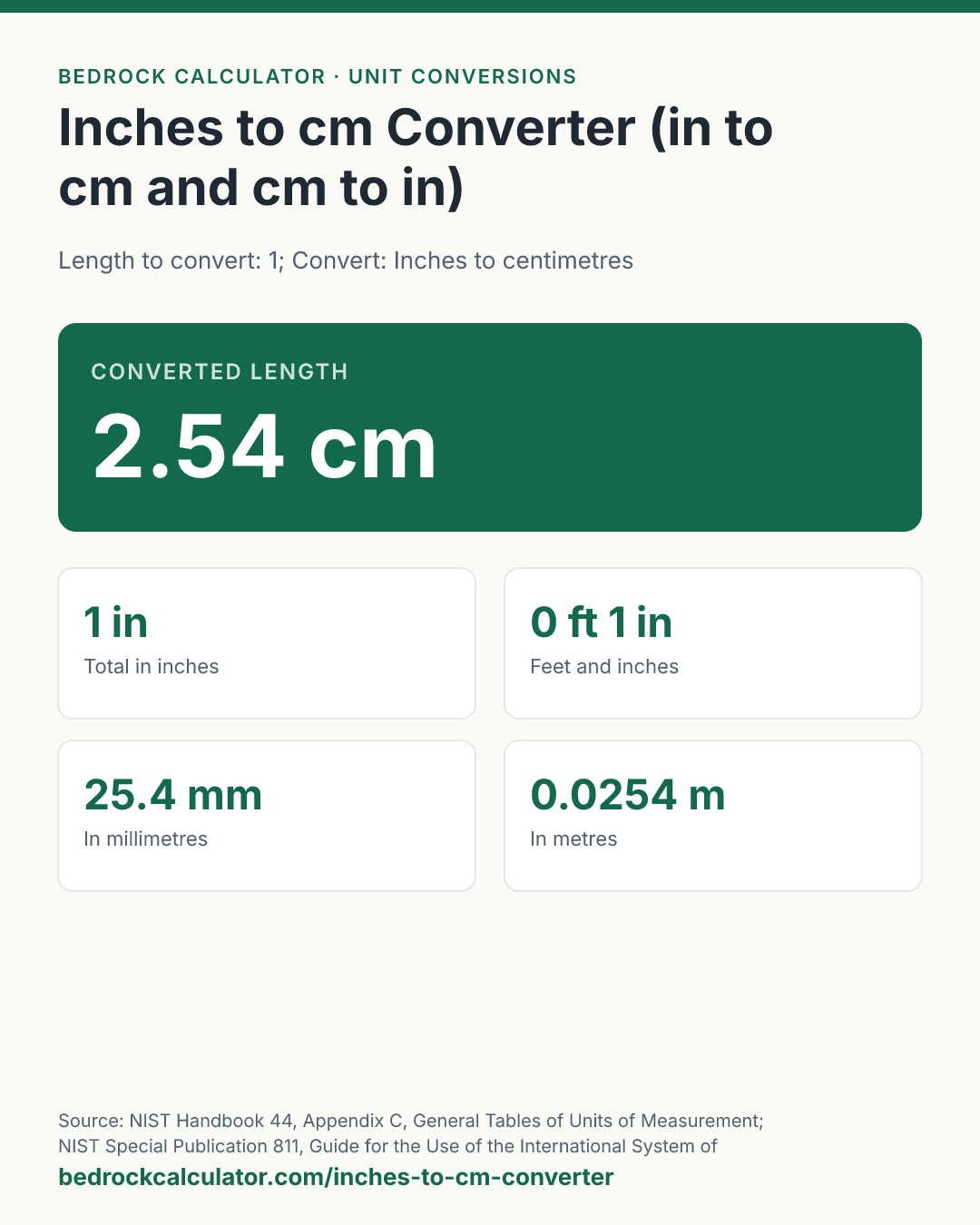
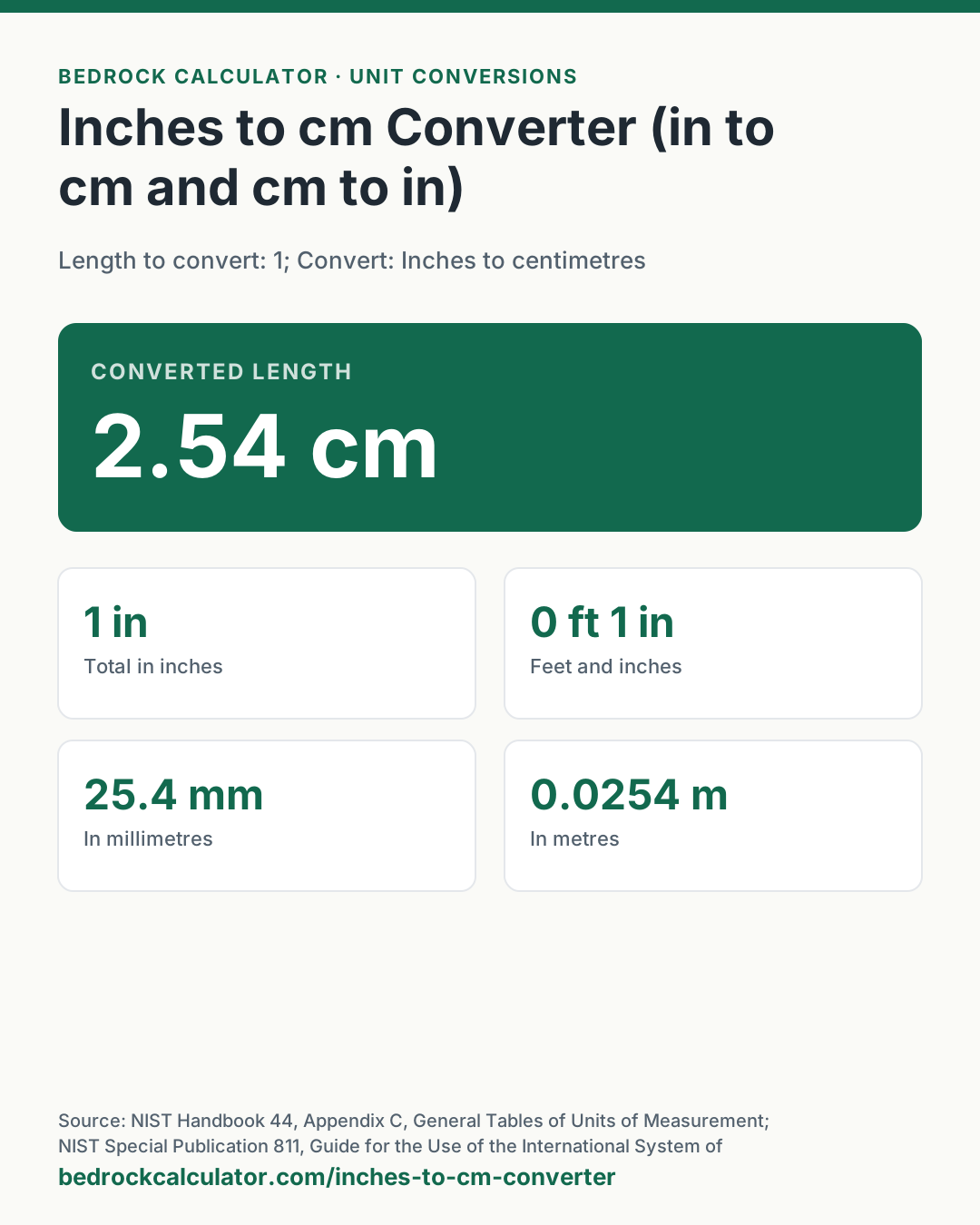
Using the default input, 1 inch, inches to centimetres:
- Centimetres: 1 × 2.54 = 2.54 cm.
- Millimetres: 25.4 mm. Metres: 0.0254 m.
- Feet and inches: less than a foot, so 0 ft 1 in.
A 22 inch carry-on bag:
- Centimetres: 22 × 2.54 = 55.88 cm, or 558.8 mm.
- Feet and inches: 1 ft 10 in.
Going the other way, a 30 cm ruler:
- Inches: 30 ÷ 2.54 = 11.81102362..., shown as 11.811024 in.
- Feet and inches: 0 ft 11.81 in. A 30 cm ruler is a little shorter than a 12 inch ruler, which is 30.48 cm.
And a height of 180 cm:
- Inches: 180 ÷ 2.54 = 70.866142 in.
- Feet and inches: 5 whole feet are 60 inches, leaving 10.866... inches, shown as 5 ft 10.87 in.
Common Inch and Centimetre Values
| Inches | Centimetres | Millimetres |
|---|---|---|
| 0.25 | 0.635 | 6.35 |
| 0.5 | 1.27 | 12.7 |
| 1 | 2.54 | 25.4 |
| 6 | 15.24 | 152.4 |
| 12 (one foot) | 30.48 | 304.8 |
| 22 | 55.88 | 558.8 |
| 24 | 60.96 | 609.6 |
| 32 | 81.28 | 812.8 |
| 36 (one yard) | 91.44 | 914.4 |
| 65 | 165.1 | 1,651 |
| 100 | 254 | 2,540 |
Every centimetre figure in this table is exact. The full tables below the converter go further in both directions.
How Do You Convert Inches to Centimetres?
Multiply the inches by 2.54. That is all there is to it, and because 2.54 is exact, the answer is exact too: 12 inches is 30.48 cm, not "about 30". To go from centimetres to inches, divide by 2.54.
If you only need a rough figure in your head, multiplying by two and a half gets you close for small lengths, but the gap grows as the length does, so use the exact factor for anything you will cut, order or ship.
Centimetres to Inches and Feet
People often want centimetres turned into feet and inches together, especially for heights and furniture. The converter does this on the Feet and inches card. A centimetre figure of 160 becomes 62.992126 inches in total, which splits into 5 ft 2.99 in. For heights, the dedicated height converter rounds the inches to one place, the way heights are usually written.
What does this calculator not account for?
- Screen sizes. A 32 inch or 65 inch TV is measured across the diagonal of the screen, not its width. The converter changes the unit of that diagonal; it does not work out width and height, which depend on the aspect ratio.
- Fractions typed as fractions. Enter 2 3/4 inches as 2.75. The box takes decimals only.
- Feet and inches typed together. To convert 5 ft 7 in, turn it into inches first (5 × 12 + 7 = 67) or use the height converter, which takes feet and inches as separate boxes.
- Long decimal inputs. A centimetre input with many decimals produces inch figures with more digits than the display shows, and those are rounded half up. The downloaded tables hold the same rounded values.
- Measuring error. The conversion is exact, but the length you start from is only as good as the tape or ruler that produced it.
What mistakes do people make with this?
- Using 2.5 instead of 2.54. The shortcut always comes out short, and the shortfall grows with the length. 72 inches is exactly 182.88 cm, and the shortcut misses that by a few centimetres. Fine for a guess, wrong for cutting fabric or ordering a blind.
- Dividing when you should multiply. Centimetres are smaller than inches, so the centimetre number is always the bigger one. If 10 inches came out as about 4 cm, the division went the wrong way.
- Reading 5.5 ft as 5 ft 5 in. A decimal foot is a fraction of 12 inches, so 5.5 ft is 5 ft 6 in. Convert to inches first if the number is in decimal feet.
- Mixing up centimetres and millimetres. Hardware, bike parts and phone specs are often given in millimetres. 25.4 mm is one inch; 25.4 cm is ten inches.
- Rounding twice. Round once, at the end. Rounding the inches before converting multiplies the rounding error by 2.54.
Frequently Asked Questions
How many centimetres are in an inch?
How many centimetres is 22 inches?
How many inches is 30 cm?
How many inches is 10 cm?
Is there a metric to inches calculator for millimetres too?
Why is an inch exactly 2.54 cm?
How do I convert inches to feet and centimetres at the same time?
Sources
- NIST Handbook 44, Appendix C, General Tables of Units of Measurement: definitions of the inch, foot and yard. nist.gov/pml/owm/nist-handbook-44-current-edition
- NIST Special Publication 811, Guide for the Use of the International System of Units (2008), Appendix B: conversion factors to SI. nist.gov/pml/special-publication-811
- National Bureau of Standards Miscellaneous Publication 233, Units of Weight and Measure (revised to the 1959 refinement of the yard and the pound announced in the Federal Register, 24 FR 5348). nvlpubs.nist.gov/nistpubs/Legacy/MP/nbsmiscellaneouspub233.pdf
- NIST, The US Survey Foot: retirement of the survey foot at the end of 2022 and the international foot of 0.3048 m. nist.gov/pml/us-surveyfoot