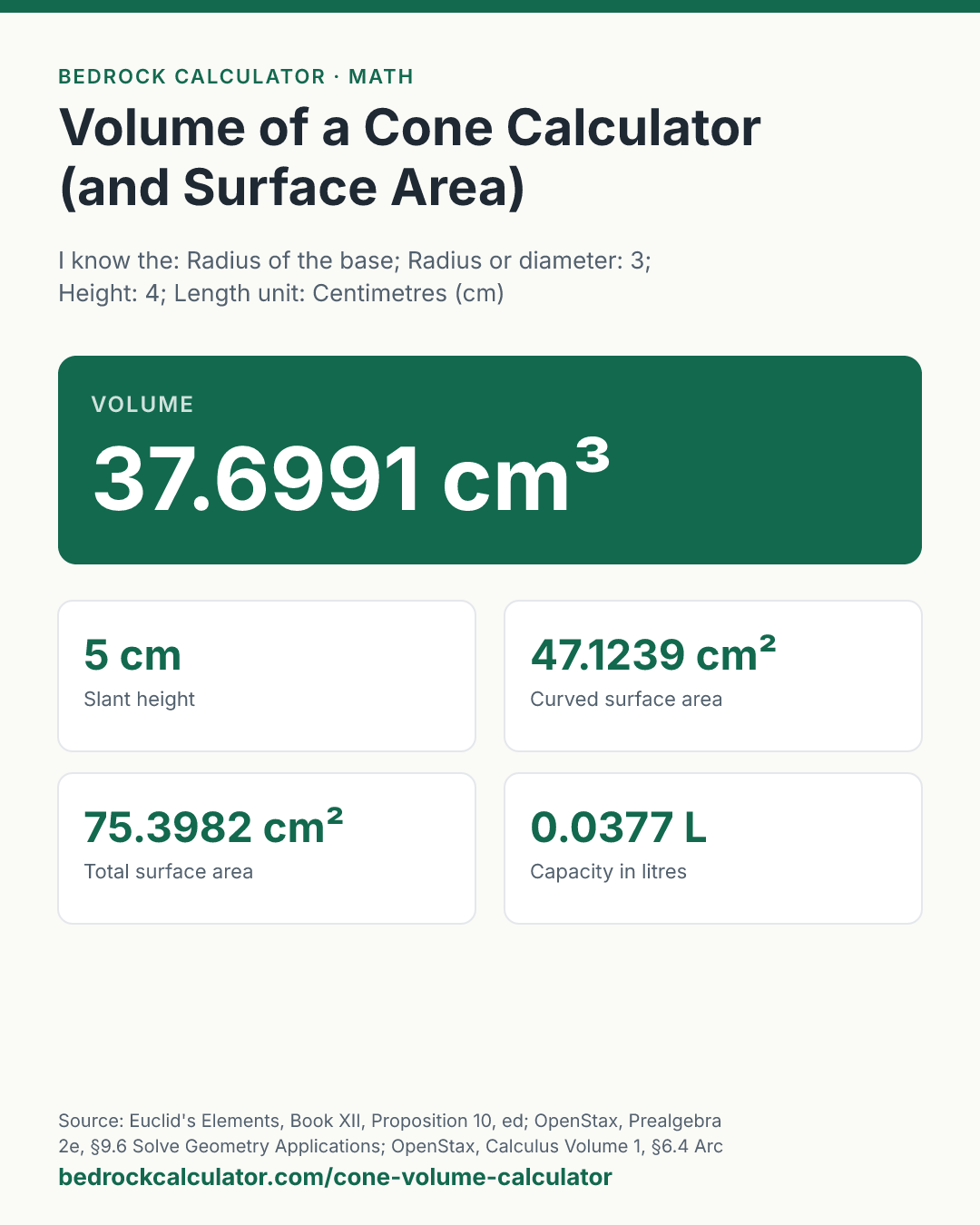
Quick Answer: The volume of a cone is one third of pi r² h. A cone with a base radius of 3 cm and a height of 4 cm holds 37.6991 cm³, exactly a third of the cylinder with the same base and height.
What does this calculator do?
This calculator finds the volume of a cone from the radius or diameter of its circular base and its height. It also gives the slant height down the side, the area of the base, the curved surface, the total surface, and the capacity in litres and US gallons.
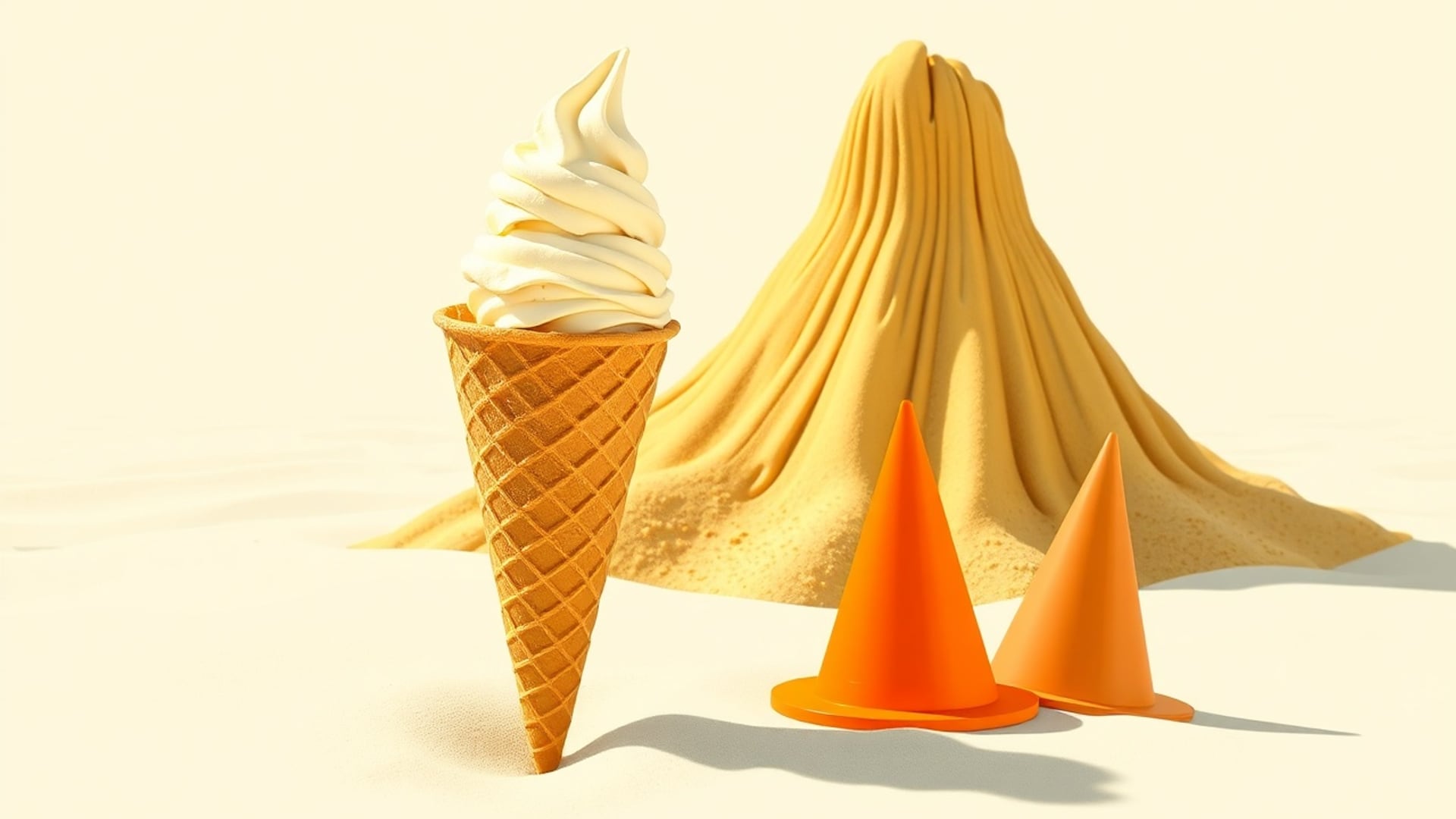
When the lengths are in feet, yards or metres it adds cubic yards, the unit sand, gravel and mulch are sold in, since a heap of loose material settles into something close to a cone.
The formula is the cylinder's with a third in front. Euclid showed that any cone is a third of the cylinder on the same base with the same height, and the same is true of a pyramid and its prism. The reason is the taper: every slice of a cone is a circle, but the circles shrink steadily to a point, and adding up those shrinking slices gives exactly a third of the full stack.
Lengths can be in any unit, as long as the radius and height share it. The volume comes back in that unit cubed and the surfaces in that unit squared. The calculator assumes a right circular cone, with its tip directly above the centre of the base. Pi is carried to 34 significant digits and the results are rounded to four decimal places only for display.
Using the Volume of a Cone Calculator
- Say whether you have the radius or the diameter of the base, and enter it.
- Enter the height, measured straight up from the centre of the base to the tip.
- Pick the unit.
The cards give the slant height, the base area, the curved surface, the total surface and the capacity. The presets load an ice cream cone 5 cm across and 12 cm deep, a pile of sand 10 ft across and 4 ft high, and a funnel with a radius of 6 inches and a depth of 8. The table below the calculator lists cones of height 10 with radii from 1 to 20.
How is this calculated?
- Radius and base. A diameter is halved. The base is a circle of area pi r².
r = d/2; B = πr²
- Volume. A third of the base area times the height.
V = 1/3πr²h
- Slant height. The radius, the height and the slant height form a right triangle, so the slant height comes from the Pythagorean theorem.
ℓ = √(r² + h²)
- Curved surface. Cut a cone's side along a slant line and flatten it, and you get a sector of a circle whose radius is the slant height and whose arc is the base's circumference. Its area is pi r times the slant height.
A_curved = πrℓ; A_total = πrℓ + πr²
- Capacity. For units with a cubic form in the unit tables, the volume is converted to litres, US gallons of 231 cubic inches and, for feet, yards and metres, cubic yards of 27 cubic feet.
- Round for display to four decimal places, half up.
Worked Example
The default is a cone with a radius of 3 cm and a height of 4 cm.
- Base area: pi × 3², shown as 28.2743 cm².
- Volume: a third of 28.2743 × 4, carried at full precision, which is 12 pi, shown as 37.6991 cm³.
- Slant height: the square root of 9 + 16, exactly 5 cm.
- Curved surface: pi × 3 × 5 = 15 pi, 47.1239 cm². Total with the base: 75.3982 cm².
An ice cream cone 5 cm across and 12 cm deep has a radius of 2.5 cm and holds 78.5398 cm³ of ice cream if it is level with the rim. The slant height down the side is 12.2577 cm.
A pile of sand 10 ft across and 4 ft high has a radius of 5 ft and a volume of 104.7198 ft³. Divided by 27 cubic feet per cubic yard, that is 3.8785 yd³, the figure to quote when ordering.
A funnel with a radius of 6 inches and a depth of 8 holds 301.5929 in³, or 1.3056 US gallons. Its slant height is a neat 10 in, since 6, 8 and 10 are a Pythagorean triple.
What Is the Volume of a Cone?
The volume of a cone is V = ⅓πr²h, one third of the area of its circular base times its vertical height. A useful check is the cylinder: fill a cone with water and pour it into a cylinder of the same base and height, and it takes three cones to fill it.
The table below the calculator shows the volume growing with the square of the radius: at a height of 10, doubling the radius from 5 to 10 takes the volume from 261.7994 to 1,047.1976, four times as much.
What Is the Formula for the Surface Area of a Cone?
The total surface area is πrℓ + πr², the curved side plus the circular base, where ℓ is the slant height. For an open cone such as a party hat or a funnel, use the curved part alone. The slant height is not given directly by most problems, so find it first from the radius and height.
What does this calculator not account for?
- Frustums. A cone with its top sliced off, like a bucket or a lampshade, is a frustum. Its volume is the full cone's minus the small cone removed; run the calculator for both and subtract.
- Oblique cones. A cone whose tip is not over the centre has the same volume as a right cone with the same base and height, but a different curved surface.
- Real piles. A heap of gravel or sand has a rounded top and a spread-out foot, and its slope depends on the material. Treat the cone volume as an estimate and allow extra.
- Wall thickness. For what a funnel or cup holds, measure the inside.
- Unit conversion. The radius and height must be in the same unit.
What mistakes do people make with this?
- Forgetting the third. Without it you have the volume of a cylinder, three times too much.
- Using the slant height as the height. The volume needs the vertical height. The slant height is always longer, so using it inflates the answer.
- Using the diameter as the radius. The radius is squared, so this makes the volume four times too large.
- Mixing up curved and total surface. A cone of paper has no base; a solid cone does.
- Measuring a pile across the top. Measure the diameter across the base of the pile, at ground level.
Frequently Asked Questions
How do you calculate the volume of a cone?
How do I find the volume of a cone from its diameter?
Why is a cone one third of a cylinder?
How many cubic yards is a pile of gravel?
What is the slant height of a cone?
Is a cone a pyramid with a circular base?
Sources
- Euclid's Elements, Book XII, Proposition 10, ed. D. E. Joyce, Clark University: any cone is a third of the cylinder with the same base and equal height. mathcs.clarku.edu/~djoyce/elements/bookXII/propXII10.html
- OpenStax, Prealgebra 2e, §9.6 Solve Geometry Applications: Volume and Surface Area (cone V = ⅓πr²h). openstax.org/books/prealgebra-2e/pages/9-6-solve-geometry-applications-volume-and-surface-area
- OpenStax, Calculus Volume 1, §6.4 Arc Length of a Curve and Surface Area (lateral surface of a cone, πr times the slant height). openstax.org/books/calculus-volume-1/pages/6-4-arc-length-of-a-curve-and-surface-area
- NIST Digital Library of Mathematical Functions, §3.12 Mathematical Constants: the value of pi. dlmf.nist.gov/3.12
- NIST Handbook 44, Appendix C, General Tables of Units of Measurement (the US gallon, cubic foot and cubic yard). nist.gov/pml/owm/nist-handbook-44-current-edition