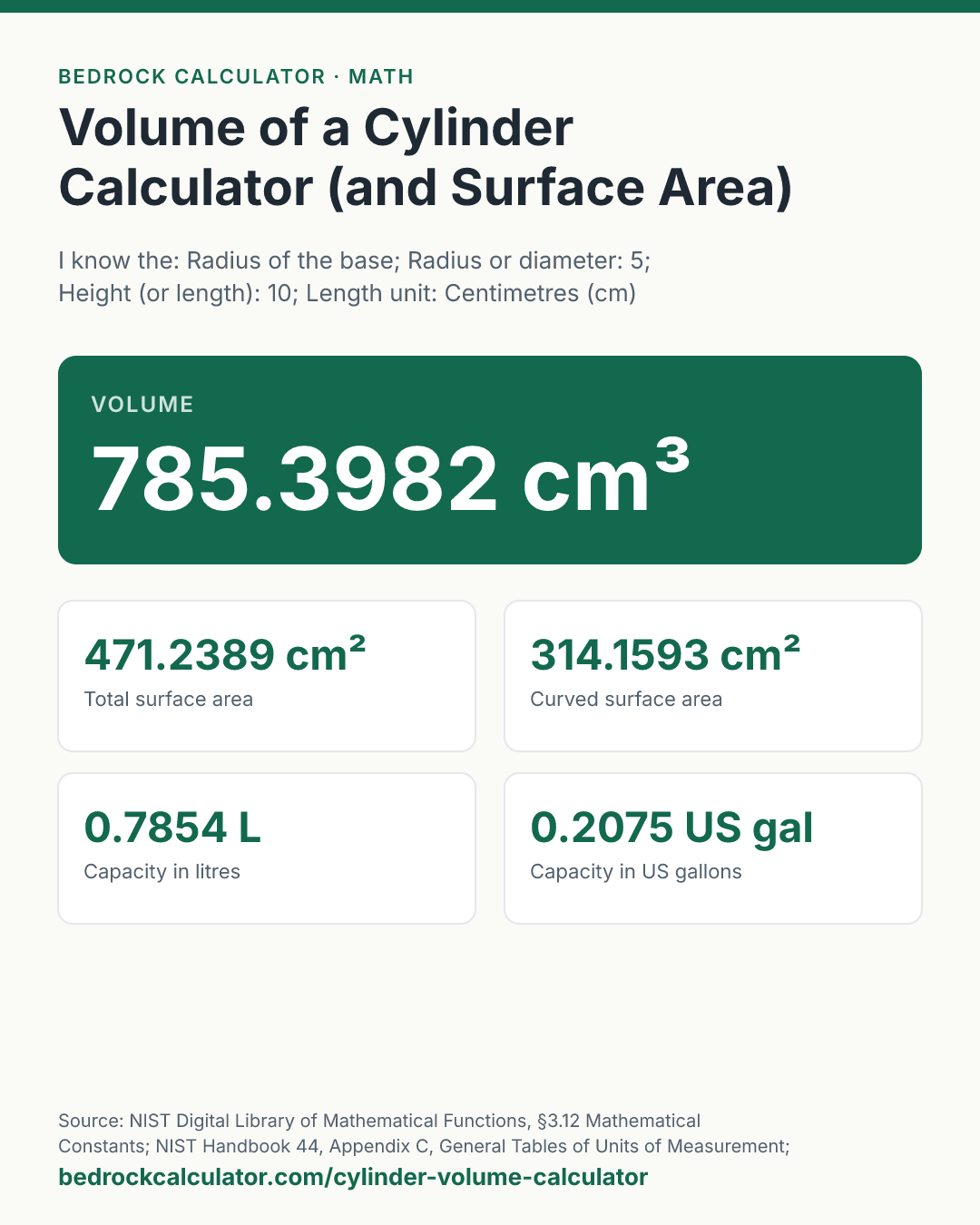
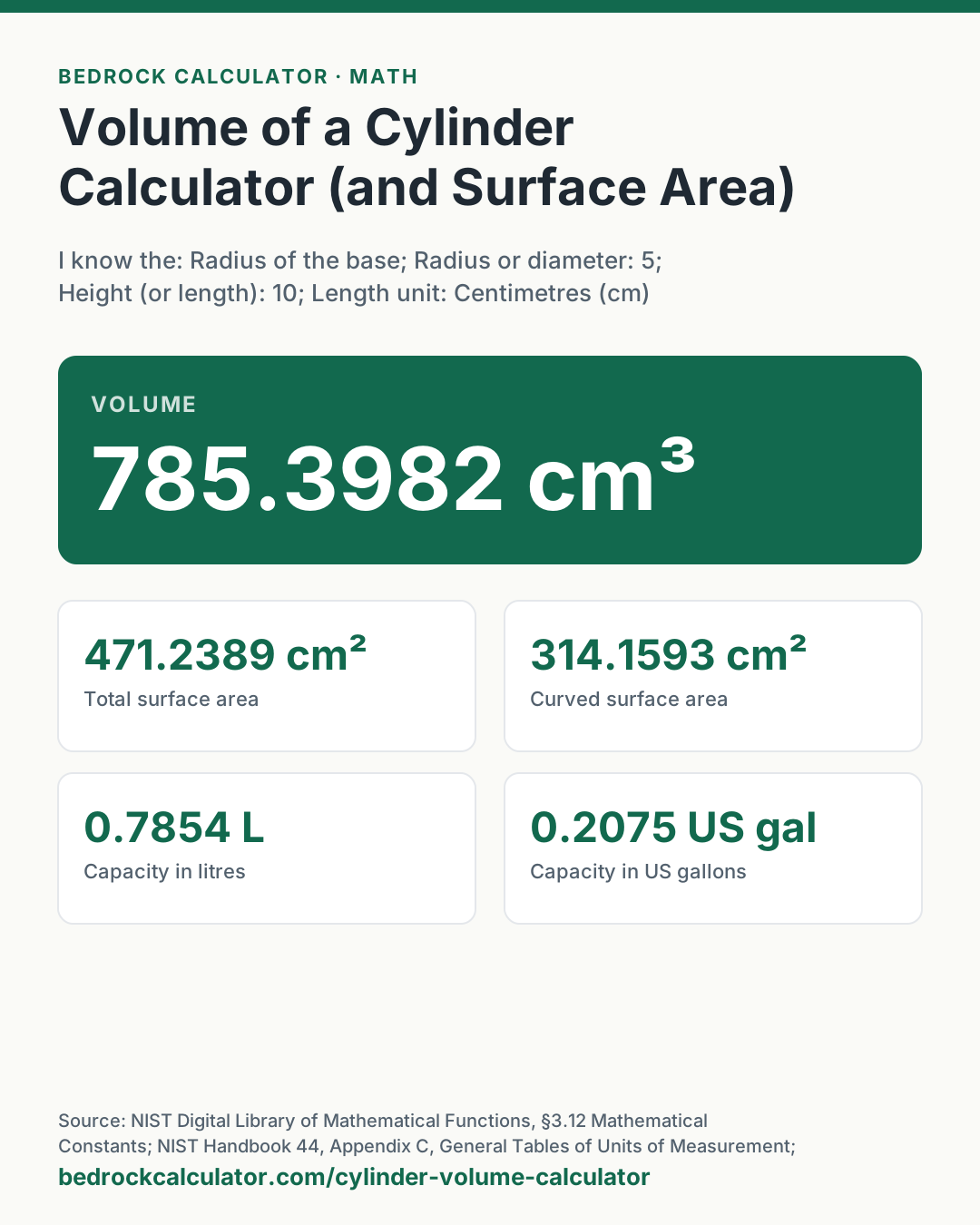
Quick Answer: The volume of a cylinder is the area of its circular end times its height, pi r² h. A cylinder with a radius of 5 cm and a height of 10 cm holds 785.3982 cm³, which is 0.7854 litres.
What does this calculator do?
This calculator finds the volume of a cylinder from the radius or diameter of its base and its height, and gives the surface area alongside: the curved side on its own, each circular end, and the total.
For the common length units it also converts the volume into litres and US gallons, which is usually what you want to know about a tank, a pipe or a can.
A cylinder is a circle pushed straight up through a height. That picture is the whole formula. Every horizontal slice is the same circle, with area pi r², and stacking a height h of those slices gives pi r² h. The same idea works for any prism: base area times height.
The calculator accepts any length unit and returns the volume in that unit cubed and the surface areas in that unit squared. It does not convert between units, so the radius and height must be in the same one. Pi is carried to 34 significant digits and the figures are rounded to four decimal places only for display.
Using the Volume of a Cylinder Calculator
- Say whether you have the radius or the diameter of the circular end, and enter it. For something that holds liquid, measure the inside.
- Enter the height. For a pipe or a log lying on its side, the height is its length.
- Choose the unit both lengths are in.
The headline is the volume. The cards give the radius (useful when you entered a diameter), the area of one end, the curved surface area, the total surface area, and the capacity in litres and US gallons. The capacity cards show for millimetres, centimetres, metres, inches, feet and yards; for kilometres, miles or plain numbers they read "Not available".
The presets load a soup can, a round water tank 4 feet across and 5 feet tall, and six metres of pipe with a 0.1 m bore.
How is this calculated?
- Find the radius. A diameter is halved. The area of each circular end is then pi times the radius squared.
r = d/2; A_end = πr²
- Volume. The end area times the height.
V = πr²h
- Curved surface. Unroll the side of a cylinder and it is a rectangle. One side of the rectangle is the height; the other is the distance around the circle, 2 pi r.
A_curved = 2πrh
- Total surface. The curved side plus the two circular ends.
A_total = 2πrh + 2πr² = 2πr(h + r)
- Capacity. For units that have a cubic form in the unit tables (a cubic millimetre is a microlitre, a cubic centimetre is a millilitre, and cubic metres, inches, feet and yards are defined exactly), the volume is converted to litres and to US liquid gallons of exactly 231 cubic inches.
- Round for display. The working is done with 34 digits of precision and rounded half up to four decimal places when shown.
Worked Example
The default is a cylinder with a radius of 5 cm and a height of 10 cm.
- End area: pi × 5², shown as 78.5398 cm².
- Volume: 78.5398 × 10, carried at full precision, shown as 785.3982 cm³. In capacity, that is 0.7854 L, or 0.2075 US gal.
- Curved surface: 2 × pi × 5 × 10, shown as 314.1593 cm².
- Total surface: the curved side plus two ends, 471.2389 cm².
A soup can 7.5 cm across and 11 cm tall has a radius of 3.75 cm. Its volume is 485.9651 cm³, which is 0.486 L. The paper label wraps the curved side, 259.1814 cm² of it.
A round water tank 4 feet across and 5 feet tall has a radius of 2 ft and a volume of 62.8319 ft³. That is 470.0149 US gallons, or 1,779.1999 litres. Painting the outside, top and bottom included, means covering 87.9646 ft².
Six metres of pipe with a 0.1 m bore holds 47.1239 L of water when full, even though its volume in cubic metres rounds to just 0.0471 m³. For small volumes in large units, the litre card is easier to read.
What Is the Formula for the Volume of a Cylinder?
V = pi r² h, where r is the radius of the circular end and h is the height. If you know the diameter, the formula can be written V = pi d² h ÷ 4, which is the same thing.
The table below the calculator lists volumes for radii from 0.5 to 20 at a height of 10, in whatever unit you are using.
How Do You Find the Surface Area of a Cylinder?
Add the curved side to the two ends. The curved side is the circumference times the height, 2 pi r h, and each end is a circle of area pi r². So the surface area of a cylinder is 2 pi r h + 2 pi r².
If the cylinder is open at one end, like a cup, subtract one end; if it is a tube open at both ends, use the curved surface only. The calculator shows the curved part and the total separately so you can do either.
How Many Gallons Does a Round Tank Hold?
Find the volume in cubic feet and multiply by about 7.48, the number of US gallons in a cubic foot, or let the calculator do it with the exact 231 cubic inches per gallon. The second table below the calculator lists common tank sizes in feet. A tank 6 feet across and 6 feet tall holds 1,269.04 US gallons.
Measure the inside diameter and the depth the water actually reaches, not the outside of the tank, or the figure will be high.
What does this calculator not account for?
- Wall thickness. The calculator works on one radius. For the capacity of a tank or pipe use the inside radius; for the material in a pipe wall, run it with the outside radius and again with the inside radius and subtract.
- Oblique cylinders. A cylinder that leans has the same volume as an upright one with the same base and vertical height, but its surface area is different. The surface areas here are for a right cylinder only.
- Partly filled tanks lying on their side. A horizontal tank half full holds half the volume, but at any other depth the liquid's cross-section is a circular segment, which this calculator does not compute.
- Imperial gallons. Gallons here are US liquid gallons. The UK imperial gallon is larger.
- Dished or domed ends. Many real tanks have rounded ends that hold more than a flat-ended cylinder of the same length.
What mistakes do people make with this?
- Using the diameter as the radius. The radius is squared, so this makes the volume four times too large.
- Mixing units. A radius in inches and a height in feet gives a meaningless number. Convert one first.
- Confusing curved and total surface area. For a label or a wrap, you want the curved surface. For painting a closed tank, you want the total.
- Reading cubic centimetres as litres. There are 1,000 cm³ in a litre. The litre card does that division for you.
- Measuring the outside of a container. The walls take up space. For what it holds, measure inside.
Frequently Asked Questions
How do you calculate the volume of a cylinder step by step?
How do I find the volume of a cylinder with the diameter?
What is the difference between volume and surface area?
How do I convert cubic centimetres to litres?
Does it matter which way up the cylinder is?
How do I find the radius of a cylinder?
Sources
- NIST Digital Library of Mathematical Functions, §3.12 Mathematical Constants: the value of pi. dlmf.nist.gov/3.12
- NIST Handbook 44, Appendix C, General Tables of Units of Measurement: the US gallon of 231 cubic inches and the cubic foot. nist.gov/pml/owm/nist-handbook-44-current-edition
- OpenStax, Prealgebra 2e, §9.6 Solve Geometry Applications: Volume and Surface Area (cylinder V = pi r² h, S = 2 pi r² + 2 pi r h). openstax.org/books/prealgebra-2e/pages/9-6-solve-geometry-applications-volume-and-surface-area
- OpenStax, Contemporary Mathematics, §10.7 Volume and Surface Area (right prisms and cylinders). openstax.org/books/contemporary-mathematics/pages/10-7-volume-and-surface-area