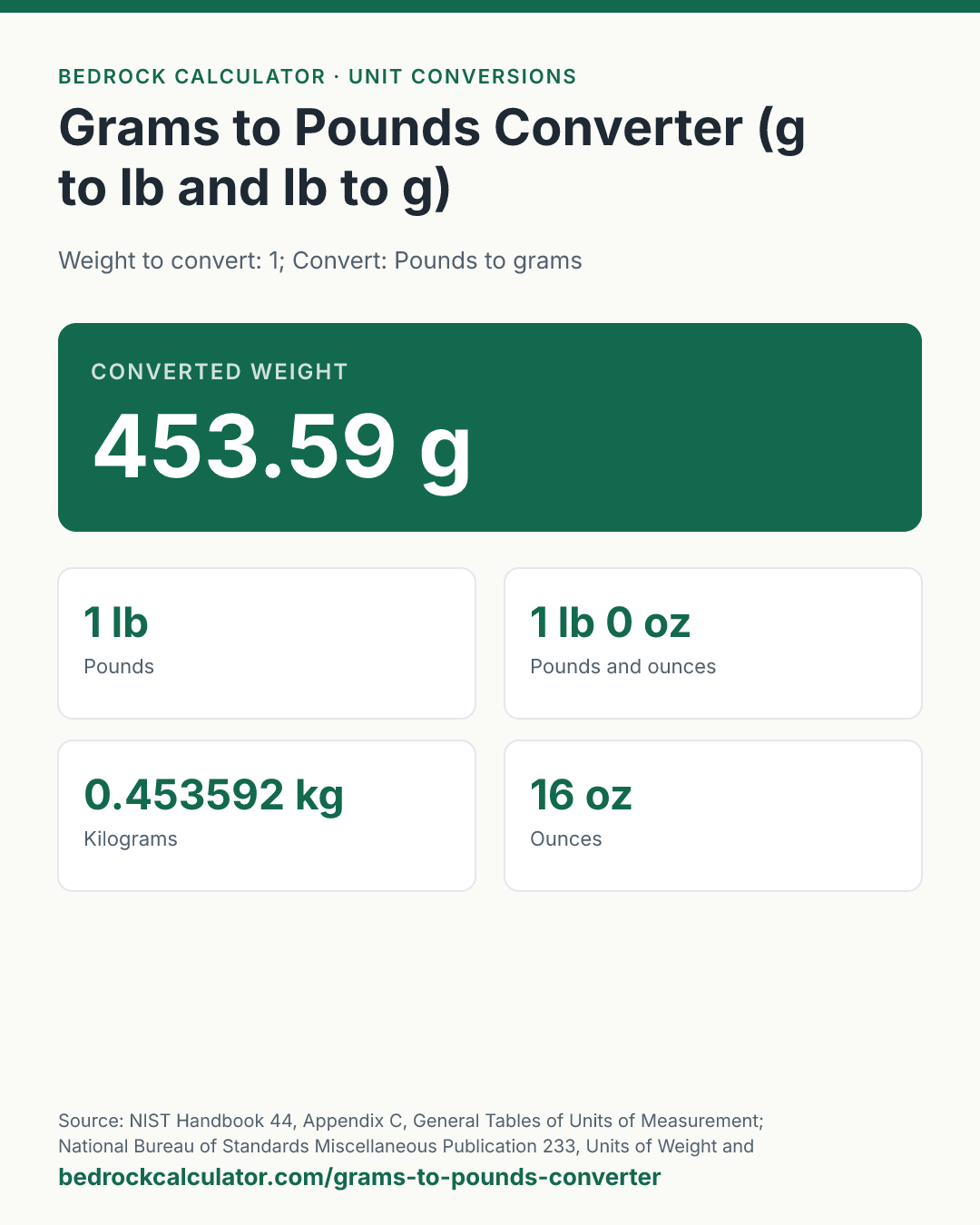
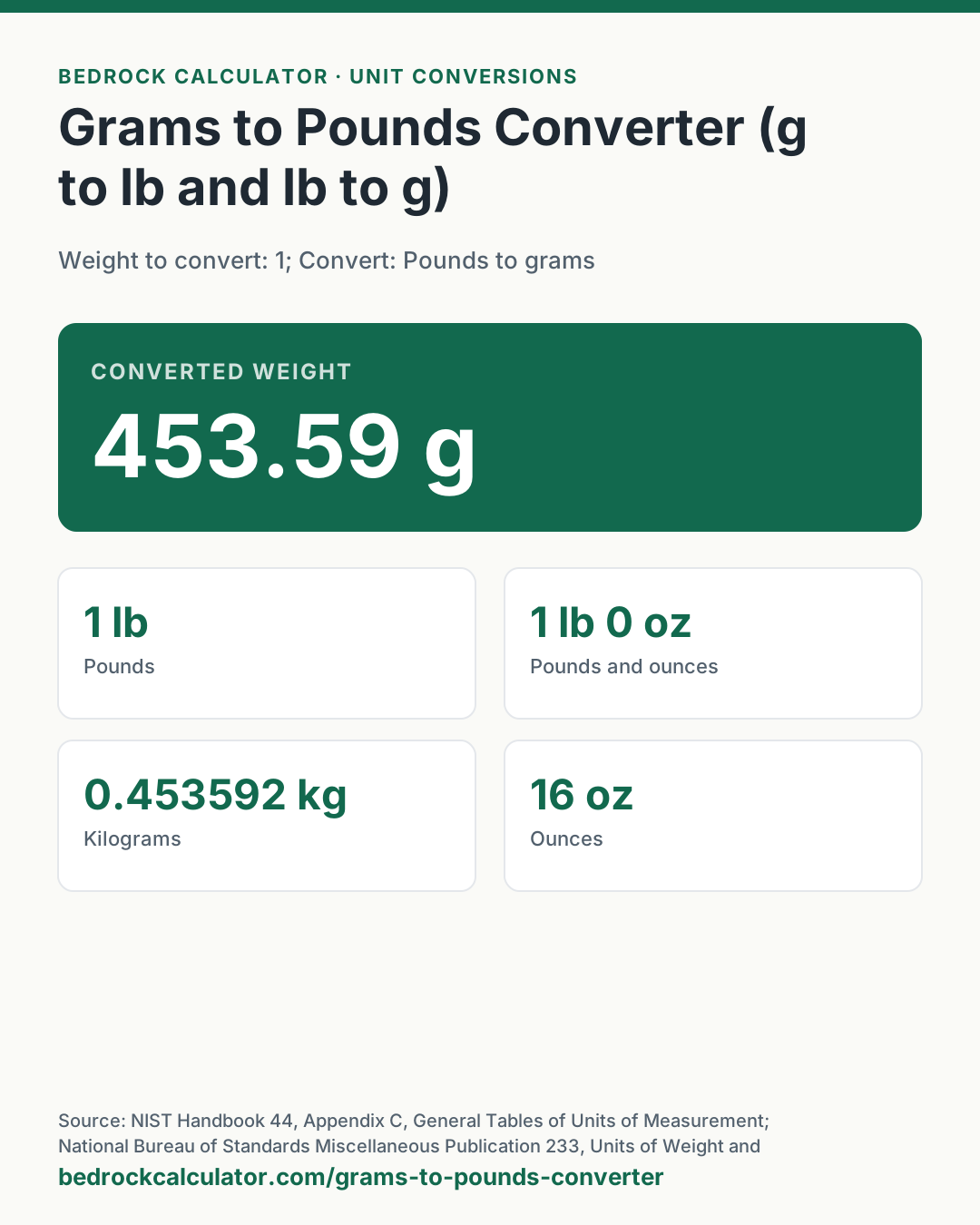
Quick Answer: One pound is 453.59 g (exactly 453.5924 g to four places), so 3 pounds is 1,360.78 g. Going the other way, 500 g is 1.102311 lb, or 1 lb 1.64 oz.
What does this calculator do?
This grams to pounds converter turns grams into pounds and pounds into grams. Choose the direction, type the weight, and it shows the result along with kilograms, ounces, milligrams and the whole-pounds-and-ounces reading you would see on a kitchen scale.
The pound in this converter is the international avoirdupois pound. In 1959 the United States, the United Kingdom and four other Commonwealth countries agreed to define it as exactly 0.45359237 kilograms, which makes it exactly 453.59237 grams. The converter holds that figure in full and only rounds the answer it shows you. That is why a pound comes out as 453.59 g in the headline and 453.5924 g on the grams card: both are the same exact number cut at different places.
Grams are small. A pound holds more than 450 of them, which means a gram is only a couple of thousandths of a pound. That is why the pounds figure runs to six decimal places: fewer would round small amounts to zero.
Using the Grams to Pounds Converter
- Type the weight. Decimals are fine.
- Choose Pounds to grams (the default) or Grams to pounds.
- Read the headline. Grams are given to two decimal places and pounds to six. The cards repeat the weight in decimal pounds, grams to four places, pounds and ounces, kilograms, ounces and milligrams.
The presets load 3 pounds, a single gram and a 500 g pack. Two tables below the converter list common weights in each direction, from a tenth of a pound to 100 pounds and from 1 g to 10 kg, with CSV downloads.
How is this calculated?
- Choose the starting unit. The direction says whether your number is grams or pounds. A negative weight is read as zero.
- Convert through the kilogram. The pound is stored as exactly 0.45359237 kg and the gram as 0.001 kg. Converting multiplies by the size of the starting unit and divides by the size of the target.
grams = pounds × 453.59237; pounds = grams/453.59237
- Split into pounds and ounces. The pound total is cut at the decimal point. The whole part is pounds; the remainder times 16 gives ounces, rounded half up to two places. If the ounces round up to 16, one pound is carried and the ounces read zero.
- Fill in the other units. The same step gives kilograms, avoirdupois ounces (a sixteenth of a pound) and milligrams (a thousandth of a gram).
- Round for display only. The arithmetic runs at 34 significant digits. Pounds and kilograms are shown to six places, grams to two in the headline and four on the card, ounces to four and milligrams to two, all rounded half up with trailing zeros dropped.
Worked Example
The default is 1 pound to grams:
- Grams: 1 × 453.59237 = 453.59 g in the headline, 453.5924 g on the card.
- Kilograms: 0.453592 kg. Ounces: 16. Milligrams: 453,592.37 mg.
3 pounds to grams: 3 × 453.59237 = 1,360.78 g, or 1.360777 kg.
500 grams to pounds: 500 ÷ 453.59237 = 1.102311 lb. On a scale that reads pounds and ounces it is 1 lb 1.64 oz. A 500 g pack is a little more than a pound.
One kilogram: enter 1,000 g and you get 2.204623 lb, or 2 lb 3.27 oz.
Pounds and Grams at a Glance
| Pounds | Grams |
|---|---|
| 0.25 | 113.3981 |
| 0.5 | 226.7962 |
| 1 | 453.5924 |
| 2 | 907.1847 |
| 3 | 1,360.7771 |
| 5 | 2,267.9619 |
| 10 | 4,535.9237 |
| Grams | Pounds | Pounds and ounces |
|---|---|---|
| 100 | 0.220462 | 0 lb 3.53 oz |
| 250 | 0.551156 | 0 lb 8.82 oz |
| 500 | 1.102311 | 1 lb 1.64 oz |
| 750 | 1.653467 | 1 lb 10.46 oz |
| 1,000 | 2.204623 | 2 lb 3.27 oz |
| 2,000 | 4.409245 | 4 lb 6.55 oz |
These rows are from the converter's reference tables, which run further in both directions.
How Many Grams Are in a Pound?
A pound is exactly 453.59237 grams. Many people round it to 454 g, or to "about 450 g" in the kitchen. The rounded figures are close enough for most cooking. They are not close enough for scaling a commercial batch or checking a postage weight near a limit, where the converter's full figure helps.
The reverse question, how many pounds are in a gram, has a small answer: 0.002205 lb to six places. That is why small weights are almost always given in grams or ounces rather than pounds.
Converting Milligrams to Pounds
There is no milligram input, but milligrams are a fixed fraction of a gram, so divide by 1,000 first. A supplement dose of 500 mg is 0.5 g; enter 0.5 in grams to pounds mode. For such small amounts the pound figure will round to a few millionths, which is why milligrams are normally compared with grams, not pounds. Going the other way, the milligrams card shows that a pound is 453,592.37 mg.
What does this calculator not account for?
- Troy pounds. Precious metals use a troy pound of 12 troy ounces, which is lighter than the avoirdupois pound. This converter does not use it.
- Pounds and ounces typed together. There is one input. Convert 2 lb 6 oz as 2.375 lb (6 divided by 16 is 0.375).
- Weight versus mass. Grams and pounds here are both units of mass, which is what scales are calibrated to report. Pounds-force, used in engineering, is a different unit.
- Scale resolution. The conversion is exact. A scale that reads to the nearest 5 g or 0.1 lb sets the real limit on the answer.
What mistakes do people make with this?
- Reading decimal pounds as ounces. 1.102311 lb is 1 lb 1.64 oz, not 1 lb 10 oz. The decimal is a fraction of a pound.
- Using 454 for a big batch. The rounded 454 g pound runs heavy, so a large order converted with it overstates the grams.
- Mixing grams and grains. The grain, an old unit still used for bullets and some medicines, is a fraction of a gram. It is a different unit with a similar name.
- Assuming 500 g is a pound. It is noticeably more, as the worked example shows: 1.102311 lb.
Frequently Asked Questions
How many grams is 3 pounds?
How many pounds are in a gram?
How many grams is half a pound?
How many pounds is 500 grams?
How many grams in a quarter pound?
How many pounds is a kilogram?
Is the US pound the same as the UK pound?
Sources
- NIST Handbook 44, Appendix C, General Tables of Units of Measurement: the avoirdupois pound and ounce. nist.gov/pml/owm/nist-handbook-44-current-edition
- National Bureau of Standards Miscellaneous Publication 233, Units of Weight and Measure (the 1959 refinement of the yard and the pound, 24 FR 5348). nvlpubs.nist.gov/nistpubs/Legacy/MP/nbsmiscellaneouspub233.pdf
- NIST Special Publication 811, Guide for the Use of the International System of Units (2008), Appendix B: conversion factors to SI. nist.gov/pml/special-publication-811