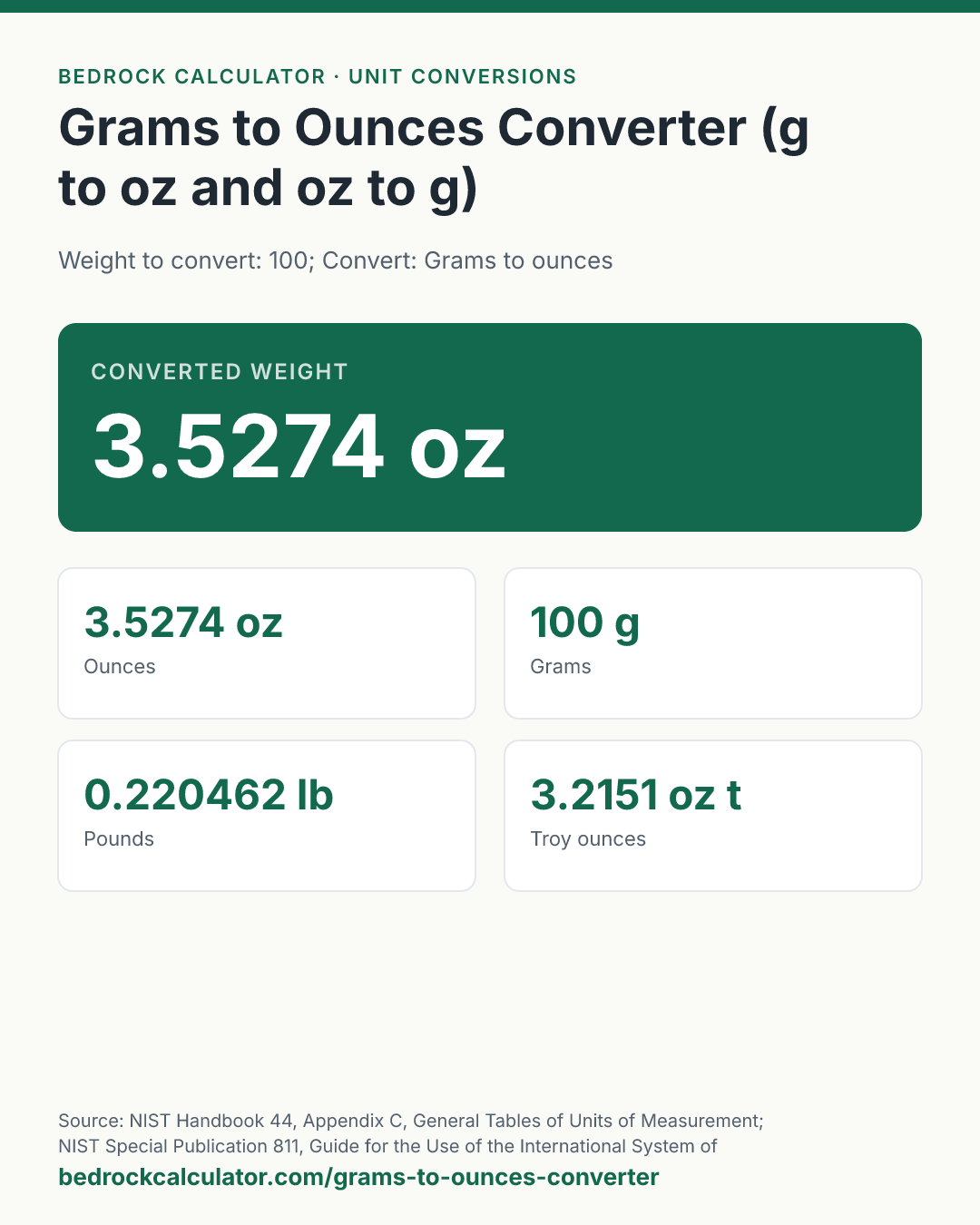
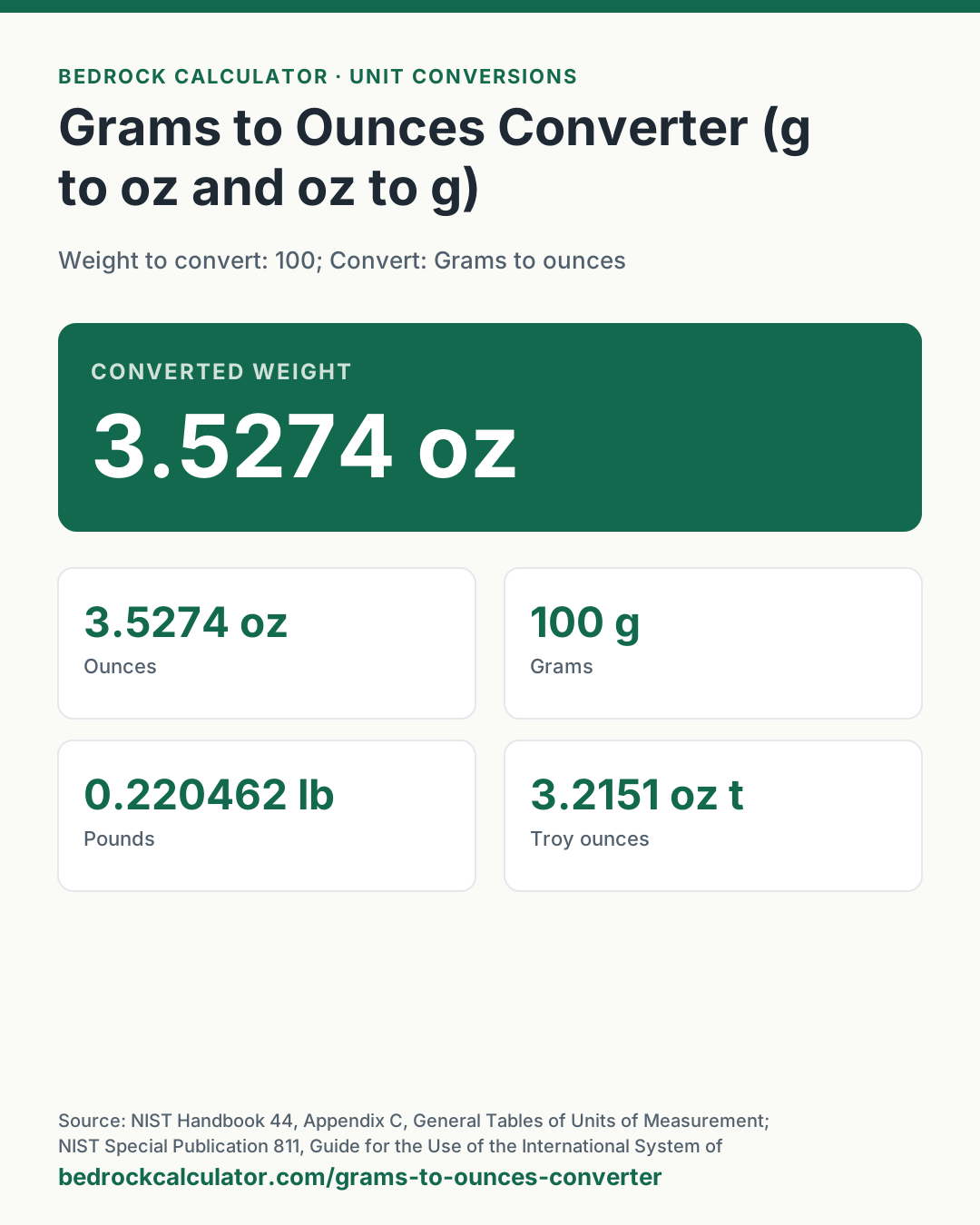
Quick Answer: 100 grams is 3.5274 oz, and one ounce is 28.35 g. An ounce is exactly one sixteenth of the international pound, so to go from grams to ounces you divide by the grams in an ounce, and to go back you multiply.
What does this calculator do?
This grams to ounces converter turns grams into ounces and ounces into grams. It starts at 100 g, the amount nutrition panels and recipes quote most often, and also gives the weight in pounds, as whole pounds and ounces, in kilograms, in troy ounces and in the rounded 28 g ounce printed on US food labels.
The ounce here is the avoirdupois ounce, the one on kitchen scales, food packages and postal rates in the United States. It is one sixteenth of the international pound, and the pound has been defined since 1959 as exactly 0.45359237 kg. So an ounce is exactly 28.349523125 grams. No measurement goes into that number, and the converter uses it in full. Grammes and grams are the same unit; "grammes" is the older British spelling.
People search for grams versus ounces because the two systems sit side by side on almost every package. A can that says 14 oz on the front gives its weight in grams on the side too. This page shows where those numbers come from and how much rounding is in each.
Using the Grams to Ounces Converter
- Type the weight. Decimals are allowed.
- Choose Grams to ounces or Ounces to grams.
- Read the headline: ounces to four decimal places, or grams to two. The cards add grams to four places, pounds, pounds and ounces, kilograms, troy ounces and label ounces.
The presets load one ounce, a 14 oz can and a 250 g pack. Below the converter, one table runs from 1 g to 1,000 g and another from a quarter ounce to 32 oz, each downloadable as CSV.
How is this calculated?
- Choose the starting unit. The direction says whether your number is grams or ounces. A negative weight is read as zero.
- Convert through the kilogram. Every unit is stored as its exact size in kilograms. The ounce is the pound, 0.45359237 kg, divided by 16, which gives 0.028349523125 kg. The gram is 0.001 kg. Converting multiplies by the size of the starting unit and divides by the size of the target.
ounces = grams/28.349523125; grams = ounces × 28.349523125
- Split into pounds and ounces. The total in pounds is cut at the decimal point; the whole part is pounds and the remainder times 16 is ounces, rounded to two places. A remainder that rounds up to 16 ounces carries into the pounds.
- Give the troy and label ounces. The same conversion is run against the troy ounce, defined in NIST Handbook 44 as 480 grains of 64.79891 mg each, which makes it 31.1034768 g. It is also run against the 28 g ounce that 21 CFR 101.9 sets for serving sizes on nutrition labels.
- Round for display only. The arithmetic runs at 34 significant digits and is rounded half up when shown: ounces, troy ounces and label ounces to four places; grams to two in the headline and four on the card; pounds and kilograms to six.
Worked Example
The default, 100 grams to ounces:
- Ounces: 100 ÷ 28.349523125 = 3.5274 oz.
- Pounds: 0.220462 lb, which a kitchen scale reads as 0 lb 3.53 oz.
- Troy ounces: 3.2151 oz t. In label ounces of 28 g: 3.5714.
A 14 oz can in grams: 14 × 28.349523125 = 396.89 g in the headline, 396.8933 g on the card.
A 250 g pack in ounces: 250 ÷ 28.349523125 = 8.8185 oz.
One kilogram: enter 1,000 g and the converter gives 35.274 oz, or 2 lb 3.27 oz.
Grams and Ounces at a Glance
| Grams | Ounces |
|---|---|
| 10 | 0.3527 |
| 25 | 0.8818 |
| 50 | 1.7637 |
| 100 | 3.5274 |
| 125 | 4.4092 |
| 250 | 8.8185 |
| 500 | 17.637 |
| 1,000 | 35.274 |
| Ounces | Grams |
|---|---|
| 0.5 | 14.1748 |
| 1 | 28.3495 |
| 4 | 113.3981 |
| 8 | 226.7962 |
| 14 | 396.8933 |
| 16 | 453.5924 |
All of these come from the converter's reference tables, which list more sizes.
How Many Grams Are in an Ounce?
One avoirdupois ounce is exactly 28.349523125 grams, usually rounded to 28.35. Food labels in the United States go further and round it to 28 g: the nutrition labelling rule in 21 CFR 101.9 says that for labelling purposes an ounce by weight means 28 g. That is why one ounce shows as 1.0125 label ounces on the card.
A label rounding is fine for a serving size; for a recipe or a parcel, use 28.35.
Grams Versus Ounces Versus Troy Ounces
There are three ounces you are likely to meet. The avoirdupois ounce (28.349523125 g) weighs food, people and parcels. The troy ounce (31.1034768 g) prices gold, silver and platinum; it is heavier, so 100 g of gold is 3.2151 troy ounces, not 3.5274. The fluid ounce is a volume, not a weight, and has no fixed number of grams at all.
What does this calculator not account for?
- Fluid ounces. A fluid ounce measures volume. Turning it into grams needs the density of the liquid; the ml to grams converter on this site does that with water and with measured USDA densities.
- Apothecary ounces. Old pharmacy weights used an ounce equal to the troy ounce. They are not shown separately.
- Scale tolerance. The conversion is exact; a kitchen scale that reads to the nearest gram or tenth of an ounce is not.
- Weights written as pounds and ounces. There is one input box. Turn 1 lb 4 oz into 20 oz first, then convert.
What mistakes do people make with this?
- Using 28 instead of 28.35. Fine for one serving, but over a kilogram the label ounce gives 35.7143 oz against the true 35.274.
- Pricing gold in ordinary ounces. Bullion is always quoted per troy ounce. Dividing grams by 28.35 understates the price per gram.
- Weighing a fluid ounce. A recipe that lists "4 fl oz milk" wants a volume. It is close to 4 ounces of weight for milk, but not for oil or honey.
- Rounding before converting. Converting a rounded figure and then rounding again can shift the last digit. Convert first and round once.
Frequently Asked Questions
How many ounces is 100 grams?
How many grams is 4 ounces?
How many grams are in 14 ounces?
How many ounces is a gram?
How many ounces are in a kilogram?
How many grams are in a fluid ounce?
Are grams or ounces more precise?
¿Cuántos gramos tiene una onza?
Sources
- NIST Handbook 44, Appendix C, General Tables of Units of Measurement: the avoirdupois ounce, the grain and the troy ounce. nist.gov/pml/owm/nist-handbook-44-current-edition
- NIST Special Publication 811, Guide for the Use of the International System of Units (2008), Appendix B: conversion factors to SI. nist.gov/pml/special-publication-811
- National Bureau of Standards Miscellaneous Publication 233, Units of Weight and Measure (the 1959 international pound, 24 FR 5348). nvlpubs.nist.gov/nistpubs/Legacy/MP/nbsmiscellaneouspub233.pdf
- eCFR, 21 CFR 101.9(b)(5)(viii), Nutrition labeling of food: "1 oz in weight means 28 g". ecfr.gov/current/title-21/chapter-I/subchapter-B/part-101/subpart-A/section-101.9