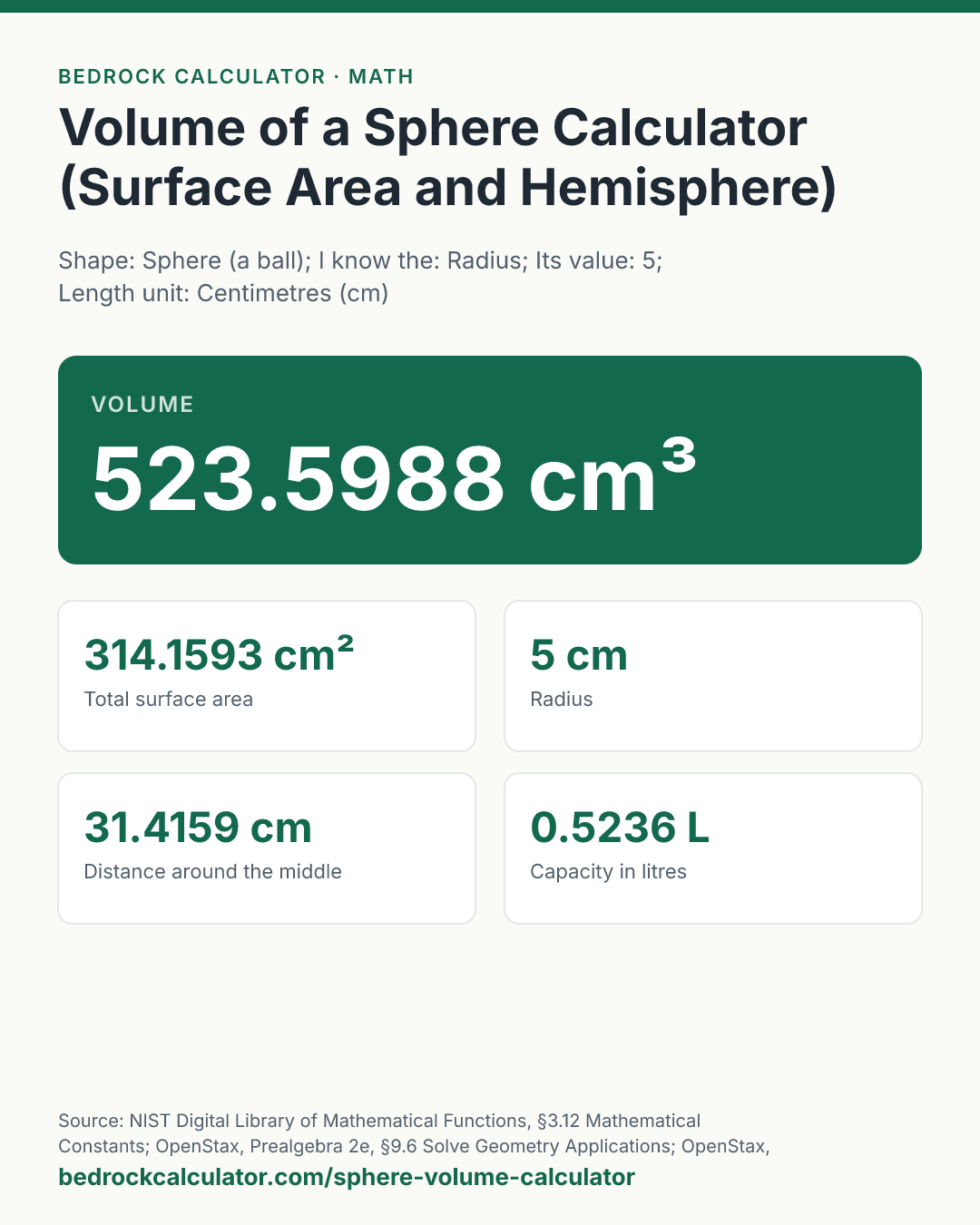
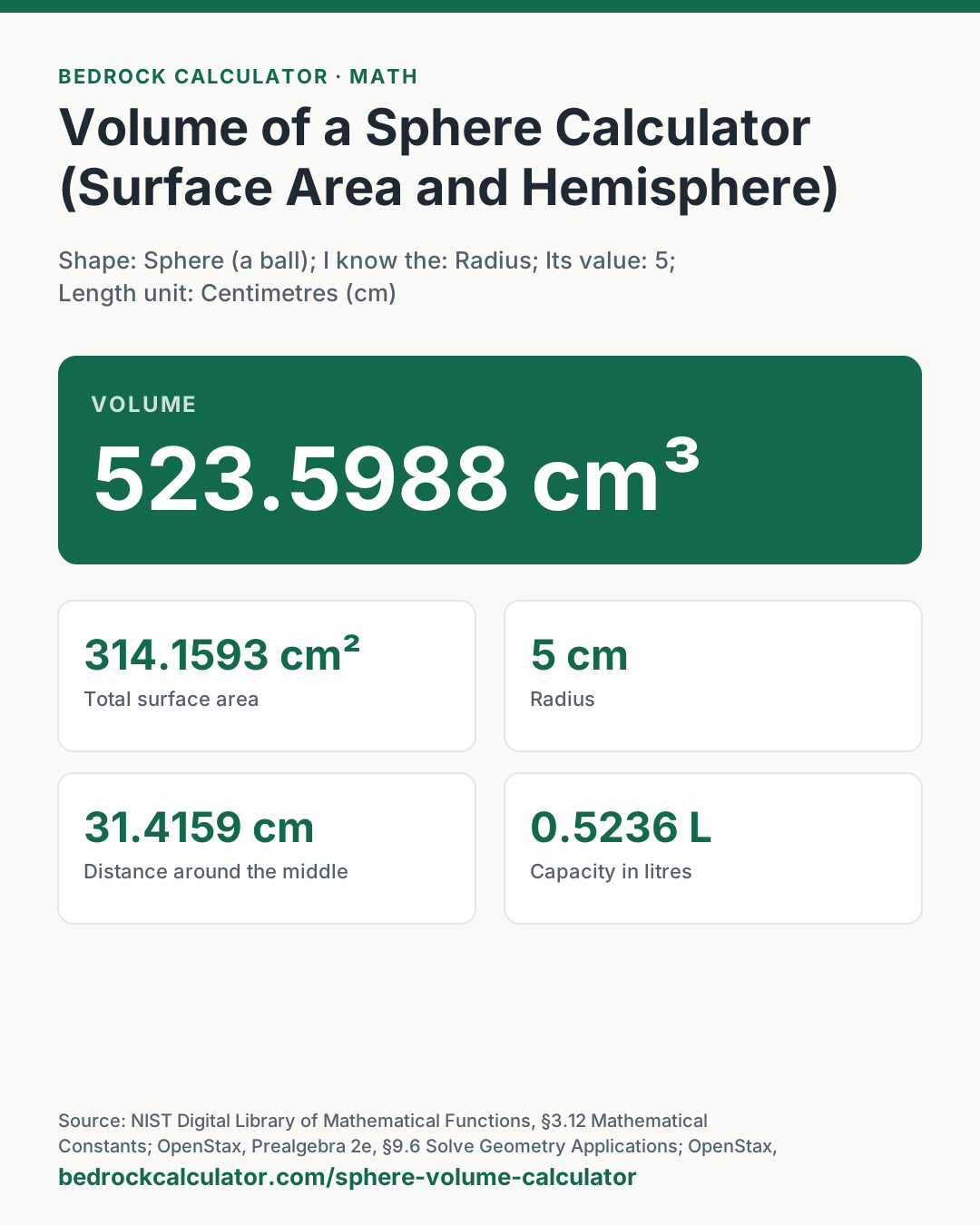
Quick Answer: The volume of a sphere is four thirds of pi times the radius cubed. A sphere with a radius of 5 cm holds 523.5988 cm³, and its surface area, four times pi times the radius squared, is 314.1593 cm².
What does this calculator do?
This calculator finds the volume of a sphere and its surface area, from the radius, the diameter, or, working backwards, from the volume or the surface area itself. It also handles a hemisphere, half a sphere, giving its volume, the area of the curved dome and the total surface with the flat circle underneath.
For any sphere it adds the distance around the middle, which is what a tape measure wrapped round a ball reads, and the capacity in litres and US gallons.
Both formulas go back to Archimedes, who showed that a sphere takes up exactly two thirds of the cylinder that just encloses it and has the same surface area as that cylinder's curved side. The cylinder has radius r and height 2r, so its volume is 2 pi r³ and two thirds of that is four thirds pi r³; its curved side is 2 pi r times 2r, which is 4 pi r².
Lengths can be in any unit. The volume comes back in that unit cubed and the surfaces in that unit squared. Pi is carried to 34 significant digits and the results are rounded to four decimal places for display.
Using the Volume of a Sphere Calculator
- Choose a sphere or a hemisphere.
- Say which measurement you know: radius, diameter, or for a whole sphere its volume or surface area.
- Enter the value and pick the unit. Enter a volume in the unit cubed and a surface area in the unit squared.
The presets load a ball 22 cm across, a hemispherical dome with a radius of 10 m, and the sphere that holds exactly one litre. The table below the calculator lists volume and surface area for radii from 0.5 to 50.
How is this calculated?
- Find the radius. From a diameter, halve it. From a volume, reverse the volume formula with a cube root. From a surface area, reverse the area formula with a square root.
r = d/2; r = ∛(3V/4π); r = √(A/4π)
- Sphere. Volume and surface area from the radius.
V = 4/3πr³; A = 4πr²
- Hemisphere. Half the sphere's volume. The curved dome is half the sphere's surface, and the flat base is a circle of area pi r², so the total is three pi r squared.
V = 2/3πr³; A_dome = 2πr²; A_total = 3πr²
- Around the middle. The great circle has the sphere's radius, so its circumference is 2 pi r.
- Capacity. For units with a cubic form in the unit tables, the volume is converted to litres and US gallons.
- Round for display to four decimal places, half up.
Worked Example
The default is a sphere with a radius of 5 cm.
- Radius cubed: 125. Times four thirds pi gives 523.5988 cm³, about 0.5236 L.
- Surface area: 4 × pi × 25 = 100 pi, 314.1593 cm².
- Around the middle: 10 pi, 31.4159 cm.
A ball 22 cm across has a radius of 11 cm. It holds 5,575.2798 cm³, which is 5.5753 L of air, and its surface is 1,520.5308 cm². A tape round its widest part would read 69.115 cm.
A hemispherical dome with a radius of 10 m encloses 2,094.3951 m³. Painting the curved roof means covering 628.3185 m²; including the floor circle, the total surface is 942.4778 m².
Working backwards, a sphere that holds 1,000 cm³ (one litre) has a radius of 6.2035 cm, so it is 12.407 cm across, with a surface of 483.5976 cm².
How Do You Find the Volume of a Sphere?
Cube the radius, multiply by pi, then multiply by four thirds. If you have the diameter, halve it first; cubing the diameter instead makes the answer eight times too large.
Because the radius is cubed, small changes matter: the table below the calculator shows a radius of 10 giving 4,188.7902 cubic units while a radius of 20 gives 33,510.3216, eight times as much for twice the size.
What Is the Surface Area of a Sphere?
Four times pi times the radius squared, A = 4πr². That is exactly four times the area of the sphere's great circle, the flat circle through its middle. At a radius of 3 the surface area and the volume happen to come out to the same number, 113.0973, though one is in square units and the other in cubic units.
Above that radius the volume grows faster than the surface.
What Is the Formula for the Volume of a Hemisphere?
Two thirds of pi times the radius cubed, V = ⅔πr³, half of the sphere. A hemisphere with a radius of 10 holds 2,094.3951, half of the full sphere's 4,188.7902. Its surface depends on whether the flat side counts: the dome alone is 2πr² and the closed hemisphere 3πr².
What does this calculator not account for?
- Shells and wall thickness. A hollow ball's material is the outer sphere's volume minus the inner one's. Run the calculator twice and subtract.
- Slightly flattened shapes. The Earth, a rugby ball and most real "spheres" are spheroids with different radii in different directions. The formulas here assume a perfect sphere.
- Spherical caps. A slice of a sphere less than half, such as the water in a partly filled round flask, is a spherical cap with its own formula and is not computed here.
- Hemisphere by volume. In hemisphere mode only the radius or diameter can be entered.
- Unit conversion. The calculator does not convert lengths between units.
What mistakes do people make with this?
- Using the diameter as the radius. The radius is cubed, so the volume comes out eight times too large.
- Squaring instead of cubing. Volume needs r³; surface area needs r².
- Dropping the four thirds. Pi r³ alone is three quarters of the true volume.
- Mixing up volume and surface area units. Volume is cubic, surface area is square.
- Measuring around the ball and calling it the diameter. A tape round the middle gives the circumference. Divide by pi for the diameter.
Frequently Asked Questions
What is the volume of a sphere with a radius of 1?
How do I find the radius of a sphere from its volume?
How do I measure the diameter of a ball?
Why is the surface area of a sphere 4 pi r squared?
What is a sphere calculator used for?
Is a hemisphere's surface area half of a sphere's?
Sources
- NIST Digital Library of Mathematical Functions, §3.12 Mathematical Constants: the value of pi. dlmf.nist.gov/3.12
- OpenStax, Prealgebra 2e, §9.6 Solve Geometry Applications: Volume and Surface Area (sphere V = 4/3 πr³, S = 4πr²). openstax.org/books/prealgebra-2e/pages/9-6-solve-geometry-applications-volume-and-surface-area
- OpenStax, Calculus Volume 1, §6.2 Determining Volumes by Slicing (volumes of solids, including the sphere, by integration). openstax.org/books/calculus-volume-1/pages/6-2-determining-volumes-by-slicing
- NIST Handbook 44, Appendix C, General Tables of Units of Measurement (litres and US gallons). nist.gov/pml/owm/nist-handbook-44-current-edition