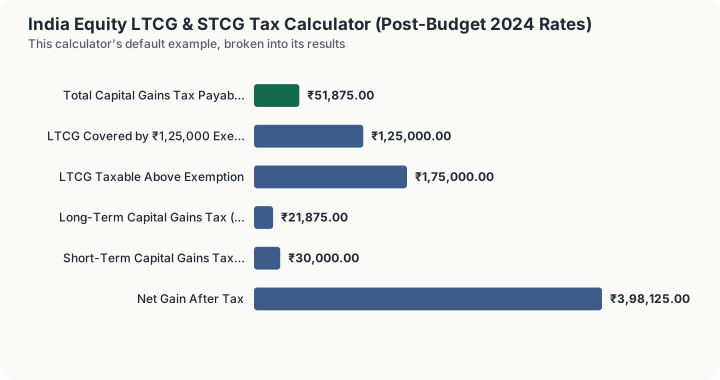
Quick Answer: For an Indian investor with a ₹3,00,000 long-term gain and a ₹1,50,000 short-term gain on listed equity shares or equity mutual funds, the long-term gain is taxed at 12.5% above the ₹1,25,000 annual exemption (₹21,875 tax) and the short-term gain is taxed flat at 20% (₹30,000 tax), for total capital gains tax of ₹51,875 -- an effective rate of about 11.5% on the combined ₹4,50,000 gain.
Overview
This calculator is built for Indian resident investors selling listed equity shares or units of an equity-oriented mutual fund through a recognized stock exchange, with Securities Transaction Tax (STT) paid on the transaction. It is not applicable to US, UK, or other non-Indian markets, and all figures are shown in Indian Rupees (₹).
The Union Budget 2024, enacted through the Finance (No.2) Act 2024, materially changed how these gains are taxed for any transfer on or after 23 July 2024. Short-term capital gains (STCG) on assets held 12 months or less rose from 15% to a flat 20% under Section 111A. Long-term capital gains (LTCG) on assets held more than 12 months rose from 10% to 12.5% under Section 112A, but the annual exemption threshold was simultaneously raised from ₹1,00,000 to ₹1,25,000. These same rates carry forward unchanged into India's new Income-tax Act 2025, which replaced the 1961 Act with effect from 1 April 2026 -- the equivalent provisions are now numbered Section 196 (STCG) and Section 198 (LTCG), covering Tax Year 2026-27 onward. This calculator uses the post-23-July-2024 rates throughout, since they are current law for any sale happening today.
A detail that trips up almost every retail investor: the ₹1,25,000 LTCG exemption is an aggregate annual allowance across all your Section 112A long-term gains for the entire tax year, not a per-transaction or per-stock allowance. If you have already used some or all of it on an earlier sale this year, this calculator lets you enter that amount so the remaining exemption (if any) is applied correctly to the gain you're evaluating now.
How This Is Calculated
Step 1: Classify the holding period. Listed equity shares and equity-oriented mutual fund units held for more than 12 months are long-term; 12 months or less is short-term. (This 12-month threshold is specific to STT-paid listed equity and equity mutual funds -- other asset classes like unlisted shares, debt funds, or property use different holding-period thresholds.)
Step 2: Apply the remaining exemption to the long-term gain.
Step 3: Tax the long-term and short-term gains at their respective flat rates.
Step 4: Sum for total capital gains tax.
No other deductions, indexation, or slab-rate stacking apply to these two categories -- unlike ordinary income, Section 111A/112A gains are taxed at these flat special rates regardless of the investor's income-tax slab.
Worked Example
An investor realizes a ₹3,00,000 long-term gain and a ₹1,50,000 short-term gain on listed equity mutual funds this tax year, having claimed no Section 112A exemption elsewhere.
Step 1: Remaining exemption = ₹1,25,000 − ₹0 = ₹1,25,000.
Step 2: Taxable LTCG = ₹3,00,000 − min(₹3,00,000, ₹1,25,000) = ₹1,75,000.
Step 3: LTCG tax = ₹1,75,000 × 12.5% = ₹21,875. STCG tax = ₹1,50,000 × 20% = ₹30,000.
Step 4: Total tax = ₹21,875 + ₹30,000 = ₹51,875, leaving a net gain after tax of ₹3,98,125 on the combined ₹4,50,000 gain -- an effective rate of 11.53%.
If, instead, this investor had already realized a ₹1,25,000 Section 112A gain earlier in the year on a different stock, the remaining exemption on this sale would be ₹0, so the entire ₹3,00,000 long-term gain would be taxed at 12.5% (₹37,500), a full ₹15,625 more than in the base case -- purely because the exemption is a shared annual bucket, not a per-sale reset.
What This Does Not Account For
This calculator computes the Section 111A/112A special-rate tax only; it does not include the mandatory 4% Health and Education Cess that applies on top of the income-tax amount itself, nor any surcharge (which applies once total income crosses ₹50 lakh, ₹1 crore, ₹2 crore or ₹5 crore thresholds and can push the effective marginal rate meaningfully higher). It assumes STT was actually paid on the transaction, which is the normal case for on-exchange trades but is not automatic for certain off-market or bonus/rights transactions that can lose Section 111A/112A eligibility entirely and fall back to slab-rate or Section 112 taxation instead. It does not model losses -- a capital loss in the same or an earlier year can offset these gains before tax is computed, which this calculator does not simulate (see the separate Tax-Loss Harvesting Calculator concept for that mechanic). It also does not distinguish between resident and non-resident taxation, which can differ on TDS treatment even though the headline rates are the same, and it does not account for unlisted equity shares, debt mutual funds, or international equity funds, all of which are taxed under entirely different provisions with different rates and holding-period definitions.
Common Pitfalls
- Treating the ₹1,25,000 exemption as per-stock. It is a single annual allowance across every Section 112A long-term gain you realize, no matter how many different stocks or funds are involved.
- Assuming pre-2024 rates still apply. Many older articles and even some broker statements still reference the 10%/15% rates and ₹1,00,000 threshold that were withdrawn for any transfer on or after 23 July 2024.
- Forgetting the 12-month threshold is asset-specific. The 12-month long-term threshold applies to STT-paid listed equity and equity mutual funds; other assets like debt mutual funds, gold, or unlisted shares use a 24- or 36-month threshold instead.
- Ignoring cess. Quoted rates of "12.5%" and "20%" are before the 4% Health and Education Cess, which is easy to forget when estimating the actual cash tax due.
- Missing that this exemption doesn't carry forward. An unused portion of the ₹1,25,000 exemption in one tax year cannot be carried forward to reduce next year's gains; it simply resets each tax year.
Frequently Asked Questions
Is the LTCG tax rate on mutual funds after Budget 2024 the same as on individual stocks?
Did the STT-paid condition change in Budget 2024?
What happens if my long-term gain is smaller than the remaining exemption?
Does this calculator apply to gains realized before 23 July 2024?
Is there a difference between STCG tax treatment for a salaried employee and a full-time trader?
Sources
- Finance (No.2) Act 2024, amendments to Section 111A and Section 112A of the Income-tax Act, 1961, effective for transfers on or after 23 July 2024. incometax.gov.in/iec/foportal
Also consulted: Income-tax Act, 2025, Section 196 (short-term capital gains) and Section 198 (long-term capital gains), effective 1 April 2026 (Tax Year 2026-27 onward); Central Board of Direct Taxes (CBDT), FAQs on the new capital gains tax regime proposed in the Union Budget 2024-25 (Press Information Bureau release).