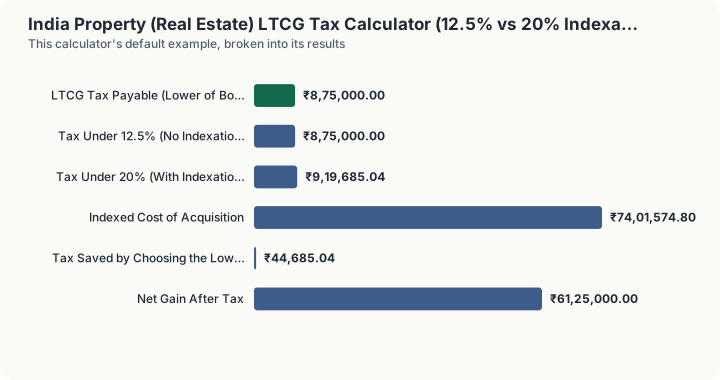
Quick Answer: For a resident individual selling a property bought in FY2015-16 for ₹50,00,000 and sold in FY2025-26 for ₹1,20,00,000, the flat 12.5%-without-indexation method produces ₹8,75,000 of tax versus ₹9,19,685 under the 20%-with-indexation method -- so the taxpayer should elect the flat method and save ₹44,685, exactly as the Finance (No.2) Act 2024's "pay whichever is lower" rule intends.
Overview
This calculator is built for Indian resident individuals and Hindu Undivided Families (HUFs) selling land, a building, or both, and computing long-term capital gains (LTCG) tax under India's current rules. All figures are in Indian Rupees (₹); this is not applicable outside India.
Before 23 July 2024, LTCG on property was taxed at a flat 20% with the benefit of indexation -- adjusting the purchase cost upward for inflation using the Cost Inflation Index (CII) before computing the taxable gain. The Finance (No.2) Act 2024, passed after the July 2024 Union Budget, proposed replacing this with a flat 12.5% rate and no indexation for all long-term asset transfers on or after 23 July 2024. This triggered significant pushback specifically for real estate, because removing indexation on assets often held for decades can -- depending on the specific purchase price, sale price, and holding period -- produce a higher tax bill despite the lower headline rate, since inflation-adjusted cost basis can no longer shrink the taxable gain.
In response, the government amended the Bill to add a transitional dual-computation option: a resident individual or HUF selling land or a building (or both) that was acquired before 23 July 2024 may compute the LTCG tax two ways -- 12.5% without indexation, and 20% with indexation -- and pay whichever produces the lower tax. Property acquired on or after 23 July 2024 does not get this choice; it is taxed only under the new 12.5%-flat rule. Non-resident sellers, companies, and firms also do not get the choice, even for pre-cutoff property. These rules carry forward in substance under the Income-tax Act 2025, which replaced the 1961 Act with effect from 1 April 2026.
How This Is Calculated
Step 1: Compute the flat method. No indexation is applied.
Step 2: If eligible, compute the legacy indexed method. Only for a resident individual/HUF selling property acquired before 23 July 2024.
Step 3: Choose the lower of the two. If not eligible for the dual option, only the flat method applies.
The Cost Inflation Index is published annually by the CBDT with a base year of 2001-02 (CII = 100); this calculator's CII table is verified through Tax Year 2026-27 (CII = 384, notified by CBDT Notification No. 85/2026 dated 15 July 2026) and falls back to that latest notified value for any later year CBDT has not yet notified.
Worked Example
Case A -- flat rate wins. A resident individual bought a flat in FY2015-16 (CII 254) for ₹50,00,000 and sells it in FY2025-26 (CII 376) for ₹1,20,00,000.
- Flat: gain = ₹1,20,00,000 − ₹50,00,000 = ₹70,00,000; tax = ₹70,00,000 × 12.5% = ₹8,75,000.
- Indexed: indexed cost = ₹50,00,000 × 376 ÷ 254 = ₹74,01,574.80; indexed gain = ₹1,20,00,000 − ₹74,01,574.80 = ₹45,98,425.20; tax = ₹45,98,425.20 × 20% = ₹9,19,685.04.
- The flat method is cheaper by ₹44,685.04, so the taxpayer elects it.
Case B -- indexation wins. A different resident individual bought land in FY2003-04 (CII 109) for ₹20,00,000 and sells it in FY2025-26 (CII 376) for ₹35,00,000 -- a much longer holding period with comparatively modest appreciation.
- Flat: gain = ₹35,00,000 − ₹20,00,000 = ₹15,00,000; tax = ₹15,00,000 × 12.5% = ₹1,87,500.
- Indexed: indexed cost = ₹20,00,000 × 376 ÷ 109 = ₹68,99,082.57, which exceeds the sale price entirely, so the indexed gain floors at zero -- tax = ₹0.
- Here indexation wins decisively, saving the full ₹1,87,500.
These two cases illustrate exactly why the transitional choice exists: whether the flat rate or indexation wins depends heavily on how long the property was held relative to how much it appreciated, not on a fixed rule of thumb.
What This Does Not Account For
This calculator computes the base LTCG special-rate tax only; it excludes the 4% Health and Education Cess and any applicable surcharge, both of which apply on top of whichever tax figure is computed here. It does not model Section 54, 54EC, or 54F exemptions (reinvestment of the gain into another residential property, into specified capital-gains bonds, or into a new residential house from the sale of any long-term asset), all of which can substantially reduce or eliminate the tax shown here if the seller reinvests appropriately within the prescribed time limits. It assumes the original cost figure already reflects the full acquisition cost including stamp duty and registration; it does not add brokerage, legal fees, or transfer costs, which should be added to cost before indexation for a fully precise figure. It uses the standard base-year-2001-02 CII table and does not model the alternative Fair Market Value election available for property acquired before 1 April 2001. Finally, it does not model TDS under Section 194-IA (1% TDS on property sales above ₹50 lakh, deducted by the buyer), which affects cash flow timing but not the ultimate tax liability computed here.
Common Pitfalls
- Assuming the 20%-with-indexation option is automatically available. It is available only for resident individuals/HUFs selling property acquired before 23 July 2024; property bought after that date, and non-resident/company/firm sellers, get only the flat 12.5% computation.
- Forgetting indexation uses the sale year's CII, not a fixed multiplier. The indexed cost changes every year simply because the sale-year CII changes, even if nothing else about the transaction does.
- Not comparing both methods. Taxpayers sometimes assume the "new" 12.5% rate is automatically better because the percentage is lower; as this calculator's second scenario shows, a long holding period can make indexation dramatically cheaper despite the higher headline rate.
- Confusing this property rule with the equity LTCG rule. Listed equity and equity mutual funds are taxed under an entirely separate provision (Section 112A / Section 198) with a ₹1,25,000 annual exemption and no indexation choice at all -- the two rules are easy to conflate but are legally distinct.
- Ignoring reinvestment exemptions. A seller who reinvests the gain under Sections 54, 54EC, or 54F can reduce the taxable gain well below what a pure rate-comparison calculator like this one shows; always check eligibility for those sections before finalizing a tax estimate.
Frequently Asked Questions
Does the 20%-with-indexation option still exist after Budget 2024?
How do I know which method is cheaper for my property?
What Cost Inflation Index year do I use if my property was purchased before FY2001-02?
Is this dual-option rule permanent?
Can companies or non-resident sellers use the indexation option too?
Sources
- Finance (No.2) Act 2024, proviso to Section 112(1) of the Income-tax Act, 1961 (transitional dual-computation option for resident individuals/HUFs on pre-23-July-2024 property). incometax.gov.in/iec/foportal
Also consulted: Central Board of Direct Taxes (CBDT), Cost Inflation Index notifications (base year 2001-02 = 100; FY2025-26 = 376; Tax Year 2026-27 = 384 per Notification No. 85/2026-Income Tax dated 15 July 2026, issued under Section 72(8)(a) of the Income-tax Act, 2025); Income-tax Act, 2025, effective 1 April 2026, carrying forward the capital-gains framework introduced by the Finance (No.2) Act 2024.