Quick Answer: An LLC's entire net profit is subject to the 15.3% self-employment tax, while an S-Corp owner only pays FICA on the "reasonable salary" portion they're paid as W-2 wages, so electing S-Corp status can save real money once profit meaningfully exceeds that salary.
Overview
Every profitable small business owner eventually runs into this comparison. As a default LLC, sole proprietorship, or partnership, all of your net business profit flows onto your personal return and is subject to self-employment tax, a combined 15.3% covering both the Social Security and Medicare shares that an employer and employee would normally split. You can't get around this by simply not taking a "salary," because there's no salary concept at all: the whole profit is treated as self-employment earnings.
Elect S-Corp tax treatment and the picture changes. An S-Corp owner who materially participates in the business is generally required to pay themselves a "reasonable salary" as a W-2 employee, subject to ordinary payroll FICA taxes, exactly like any other employee. Any additional profit beyond that salary, though, can be distributed to the owner as a shareholder distribution, and shareholder distributions are not subject to either self-employment tax or FICA. That gap, between the SE tax rate applied to 100% of LLC profit and the FICA rate applied to only the salary portion of S-Corp profit, is the entire basis of the widely discussed "S-Corp tax savings" strategy, and this calculator quantifies it precisely for your own numbers rather than relying on a rule of thumb.
How This Is Calculated
LLC / sole proprietorship scenario. The calculator runs your full net business profit through the same Schedule SE self-employment tax calculation used throughout this platform: net profit is first reduced to 92.35% of its face value (a statutory adjustment reflecting that an employer's matching share of payroll tax is never itself taxed), then 12.4% Social Security tax applies up to the annual wage base, and 2.9% Medicare tax applies with no cap, plus 0.9% Additional Medicare Tax above the filing-status threshold.
S-Corp scenario. Your entered "reasonable salary" is treated as W-2 wages the corporation pays you, capped at whatever your total net profit actually is (a corporation cannot pay a salary larger than the money it has). FICA applies to that salary at the standard employee rate (6.2% Social Security up to the wage base, 1.45% Medicare) and the corporation itself pays a matching employer share at the same rates. Whatever profit remains after salary is a shareholder distribution, taxed as ordinary income on your personal return but carrying no SE tax or FICA burden at all.
The comparison. The calculator adds together both the employee and employer FICA shares in the S-Corp scenario, since as the owner you effectively bear both (the employer share is a real cost to the business you own), and compares that combined figure against the LLC's total self-employment tax on the same total profit. The difference is your estimated SE tax savings from electing S-Corp treatment.
An important detail the calculator makes visible rather than hides: because the 92.35% statutory reduction only applies to self-employment income, not to W-2 wages, setting your S-Corp salary equal to (or close to) your entire business profit eliminates the SE-tax benefit and can actually make the S-Corp structure slightly more expensive than staying an LLC, since W-2 FICA applies to the full salary with no comparable haircut.
Worked Example
The standard case: $150,000 profit, $70,000 salary
A single-filer consultant nets $150,000 before paying themselves anything, and would set a $70,000 reasonable salary if they elected S-Corp treatment.
Step 1 -- Net earnings from self-employment, LLC side. $150,000 x 92.35% = $138,525.00
Step 2 -- Social Security portion. $138,525 is below the $184,500 wage base, so $138,525 x 12.4% = $17,177.10
Step 3 -- Medicare portion. $138,525 x 2.9% = $4,017.23. Net earnings stay below the $200,000 single threshold, so no Additional Medicare Tax.
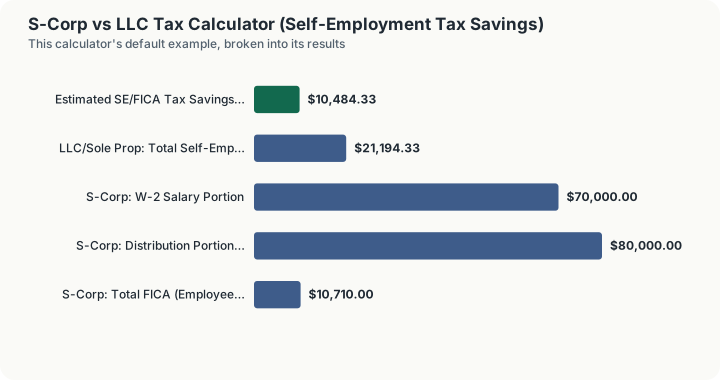
Step 4 -- Total LLC self-employment tax. $17,177.10 + $4,017.23 = $21,194.33
Step 5 -- Split the profit under an S-Corp election. Salary $70,000.00, distribution $150,000 - $70,000 = $80,000.00
Step 6 -- Employee FICA on the salary. $70,000 x 7.65% = $5,355.00
Step 7 -- Employer FICA on the same salary. $70,000 x 7.65% = $5,355.00
Step 8 -- Combined FICA the owner effectively bears. $5,355.00 + $5,355.00 = $10,710.00
Step 9 -- The saving. $21,194.33 - $10,710.00 = $10,484.33
The $80,000 distribution is what does the work. It is still ordinary income on the 1040, and the marginal federal bracket on this profit is 24% either way, so income tax is untouched by the election. What changes is that $80,000 of profit stopped being self-employment earnings.
The case where the election backfires
A leaner year: $50,000 of profit, and the owner still wants the $70,000 salary.
Step 10 -- The salary is capped. A corporation cannot pay more than it earned, so the salary becomes $50,000.00 and the distribution is $0.00
Step 11 -- LLC self-employment tax on the same profit. $50,000 x 92.35% = $46,175, taxed at 15.3% = $7,064.78
Step 12 -- S-Corp combined FICA. $50,000 x 7.65% x 2 = $7,650.00
Step 13 -- The result. $7,064.78 - $7,650.00 = -$585.22
The S-Corp costs $585.22 more. The reason is the 92.35% haircut: self-employment earnings are reduced before the 15.3% is applied, and W-2 wages are not. With no distribution to shelter, the election buys nothing and pays for the privilege. In effect the break-even is not a profit level but a spread -- there has to be daylight between reasonable salary and total profit.
A larger practice: $400,000 profit, $160,000 salary
Step 14 -- Net earnings from self-employment. $400,000 x 92.35% = $369,400.00
Step 15 -- Social Security, now capped. $184,500 x 12.4% = $22,878.00
Step 16 -- Medicare, uncapped. $369,400 x 2.9% = $10,712.60
Step 17 -- Additional Medicare above the $200,000 threshold. ($369,400 - $200,000) x 0.9% = $1,524.60
Step 18 -- Total LLC self-employment tax. $22,878.00 + $10,712.60 + $1,524.60 = $35,115.20
Step 19 -- S-Corp combined FICA on the salary. $160,000 x 7.65% x 2 = $24,480.00
Step 20 -- The saving. $35,115.20 - $24,480.00 = $10,635.20
Note how little the saving grew: $10,484.33 at $150,000 of profit and $10,635.20 at $400,000, on a distribution that went from $80,000 to $240,000. That is because both structures run out of Social Security tax at the wage base, and above it the only spread left is the 2.9% Medicare rate plus the 0.9% surtax on the sheltered distribution. The headline saving from an S-Corp is largely earned in the band of profit below the wage base, which is exactly the band where salary is hardest to argue down.
What This Does Not Account For
This calculator does not model the added cost and complexity of running an S-Corp: payroll processing and payroll tax filings, a separate corporate tax return (Form 1120-S), state-level S-Corp franchise or entity-level taxes that some states impose, and the ongoing burden of substantiating that the chosen salary is genuinely "reasonable" under IRS scrutiny, since paying an artificially low salary purely to maximize the SE-tax gap is exactly the pattern the IRS looks for and has successfully challenged in court. It does not model the Qualified Business Income deduction, which interacts with this decision in a more nuanced way than a simple side-by-side comparison, since W-2 wages paid by the business can affect a shareholder's own QBI limitation calculation while distributions and salary receive different QBI treatment. It does not model state income tax differences between entity types, or state-specific reasonable-compensation enforcement. It does not model retirement plan contribution limits, which are frequently based on W-2 salary for S-Corp owners and on net self-employment earnings for sole proprietors, changing how much you can defer either way. Finally, it assumes the entire net profit shown is available to be split between salary and distribution in the current year, without modeling multi-year cash flow, reinvestment needs, or the S-Corp election's own eligibility requirements (a domestic corporation with no more than 100 shareholders, generally individuals, with only one class of stock).
Common Pitfalls
- Setting salary too low relative to duties performed. The IRS has a substantial body of case law establishing that "reasonable salary" must reflect what a similarly situated employee would actually be paid for comparable work, not the smallest number that minimizes tax.
- Setting salary equal to (or above) total profit. As shown in the second worked example, this eliminates the entire SE-tax advantage of the S-Corp structure and can make it marginally more expensive than staying an LLC.
- Forgetting the added administrative cost. Payroll processing, a separate business tax return, and potential state-level entity taxes all cost real money and time, and can offset a modest SE-tax savings for a smaller business.
- Ignoring how the comparison changes at different profit levels. The dollar savings from an S-Corp election generally grow as profit grows relative to a fixed reasonable salary, meaning the strategy is far more compelling for a $400,000 practice than a $60,000 side business.
- Treating this purely as a tax question and ignoring corporate formalities. An S-Corp requires observing actual corporate formalities (a real payroll, actual distributions, proper documentation) to hold up if ever examined; simply filing an election without changing how the business actually operates day to day is a real audit risk.
Frequently Asked Questions
How do I decide what a "reasonable salary" actually is?
At what profit level does an S-Corp election typically start making sense?
Does electing S-Corp status change my income tax, not just my SE tax?
Can I switch an existing LLC to S-Corp tax treatment without changing its legal structure?
What is the biggest risk of underpaying myself a salary to maximize the SE-tax savings?
Sources
- Social Security Administration, 2026 COLA Fact Sheet (FICA rates and Social Security wage base), ssa.gov/news/press/factsheets/colafacts2026.pdf
- Internal Revenue Service, Revenue Procedure 2025-32 (2026 federal income tax brackets), irs.gov/pub/irs-drop/rp-25-32.pdf
- Internal Revenue Service, Self-Employed Individuals Tax Center and Schedule SE instructions, irs.gov/businesses/small-businesses-self-employed/self-employed-individuals-tax-center
- Internal Revenue Service, "S Corporation Compensation and Medical Insurance Issues" (reasonable compensation guidance), and Revenue Ruling 74-44. irs.gov