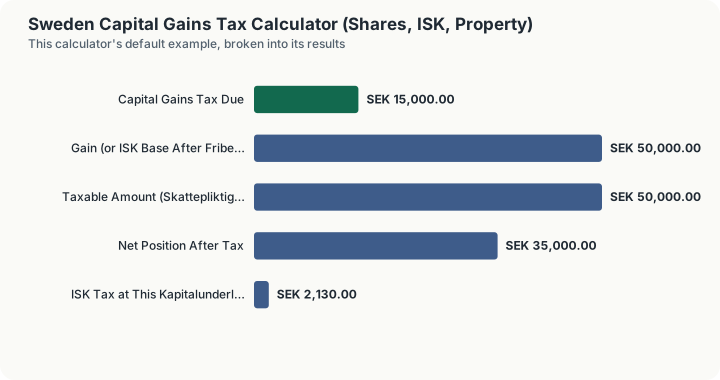
Quick Answer: Sweden taxes capital income at a flat 30%, but the base differs by account. A SEK 50,000 gain on listed shares in a depå costs SEK 15,000. An ISK is not taxed on the sale: instead a deemed 3.55% return above the SEK 300,000 fribelopp is taxed, SEK 2,130 on a SEK 500,000 ISK for 2026. Private residences are taxed on 22/30 of the gain.
Overview
Almost every explanation of Swedish capital gains tax starts and stops at "30%", and almost every one of them is misleading. The 30% rate is real and it is genuinely flat -- there is no progressive scale, no holding-period discount, and no annual exempt amount on a normal share sale. But the rate is the least interesting part of the system. What actually determines your bill is which taxable base the 30% lands on, and Sweden has three quite different answers.
A conventional securities account (a depå, or aktie- och fonddepå) works the way most people expect: you realize a gain, you pay 30% of it, in the year you sell. An investeringssparkonto (ISK) does something that surprises nearly everyone coming from another tax system -- it does not tax your gains or your dividends at all. Instead it taxes a deemed annual return (a schablonintäkt) computed from how much money is in the account, and that charge falls due whether the account went up 40%, went down 40%, or you never touched it. A private residence (privatbostad) uses a third mechanism again: only 22/30 of the gain is taxable, which at the 30% rate produces the familiar 22% effective rate.
This calculator covers all three because they are the same rate applied to three different bases, and because the choice between them -- specifically depå versus ISK -- is a live decision for anyone investing in Sweden. It reports the ISK comparison in every mode, so you can see the break-even point without switching.
How This Is Calculated
1. Listed shares or funds in a depå. The full realized gain is taxed at the flat capital-income rate.
2. ISK (investeringssparkonto). Nothing about your trades enters the calculation. The deemed-return percentage (procentsats) is set fresh each year as statslåneräntan on 30 November of the prior year plus one percentage point, with a statutory floor of 1.25%. For income year 2026, statslåneräntan on 30 November 2025 was 2.55%, so the procentsats is 3.55%.
Because both steps are multiplications, the all-in ISK charge is a single small percentage of the taxable capital base: 30% × 3.55% = 1.065% for income year 2026. The fribelopp (tax-free allowance) is SEK 300,000 from 1 January 2026 and is subtracted from the kapitalunderlag before the percentage is applied, so an account at or below SEK 300,000 pays nothing.
3. Private residence (privatbostad). The gain is kvoterad -- quoted down -- before the rate is applied.
The two-step form matters even though it collapses to a flat 22%, because it is the taxable gain -- not the tax -- that appears in the capital-income section of your declaration and that interacts with any other capital income or losses you have that year.
Worked Example
A standard share sale from a depå
1,000 shares bought at SEK 100 and sold at SEK 150, with no courtage entered.
Step 1 -- Omkostnadsbelopp. 1,000 x SEK 100 = SEK 100,000
Step 2 -- Försäljningspris. 1,000 x SEK 150 = SEK 150,000
Step 3 -- The realized gain. SEK 150,000 - SEK 100,000 - SEK 0 = SEK 50,000
Step 4 -- The tax. SEK 50,000 x 30% = SEK 15,000
Step 5 -- Net position. SEK 50,000 - SEK 15,000 = SEK 35,000, an effective rate of 30.000%
There is no band, taper or annual allowance here. A depå share sale is taxed at 30.000% of the gain at every size, which is what makes it so easy to compare against the ISK's fixed annual charge.
The same money in an ISK, income year 2026
Step 6 -- The procentsats. Statslåneräntan on 30 November 2025 was 2.55%, plus 1.00 percentage point = 3.55%, comfortably above the 1.25% statutory floor
Step 7 -- The taxable capital base. SEK 500,000 kapitalunderlag - SEK 300,000 fribelopp = SEK 200,000
Step 8 -- The schablonintäkt. SEK 200,000 x 3.55% = SEK 7,100
Step 9 -- The tax. SEK 7,100 x 30% = SEK 2,130
Step 10 -- The all-in rate. 30% x 3.55% = 1.065% of the taxable base, or 0.426% measured against the whole SEK 500,000 including the tax-free portion
Nothing in steps 6 through 9 asks what you sold. The SEK 2,130 is owed if you traded every day of the year and owed if you touched nothing, and it is owed in a year the account fell in value, since an ISK loss is not deductible at all.
Where the two cross
Step 11 -- The break-even realized gain. Both mechanisms are taxed at 30%, so they cost the same when the realized gain equals the schablonintäkt: SEK 7,100 at this kapitalunderlag
Step 12 -- Testing it against step 3. The SEK 50,000 depå gain is seven times the break-even, so on that sale the depå costs SEK 15,000 against the ISK's SEK 2,130 -- SEK 12,870 more
Step 13 -- What halving the fribelopp does. At a SEK 150,000 allowance the base becomes SEK 350,000, the schablonintäkt SEK 12,425 and the tax SEK 3,727.50, lifting the break-even gain to SEK 12,425
Step 13 is worth noting because the fribelopp doubled to SEK 300,000 on 1 January 2026. That change alone cut this account's annual charge from SEK 3,727.50 to SEK 2,130, and it shifted the break-even point at which a depå stops being cheaper down by SEK 5,325 of realized gain.
A private residence sale
A home sold for SEK 4,000,000, bought for SEK 3,000,000 including qualifying improvements, with SEK 100,000 of mäklararvode.
Step 14 -- The gain. SEK 4,000,000 - SEK 3,000,000 - SEK 100,000 = SEK 900,000
Step 15 -- Kvotering. SEK 900,000 x 22/30 = SEK 660,000 of taxable gain
Step 16 -- The tax. SEK 660,000 x 30% = SEK 198,000, an effective 22.000% of the gain
Step 17 -- Net proceeds of the gain. SEK 900,000 - SEK 198,000 = SEK 702,000
Step 18 -- Uppskov headroom. The gain sits inside the deferral bounds, so up to SEK 900,000 could be rolled into a new primary home in the EU/EES -- deferred, not forgiven, and reversing at whatever rate applies then
The two-step form in steps 15 and 16 collapses to a flat 22%, but it is the SEK 660,000 rather than the SEK 198,000 that appears in the capital-income section of the declaration, and that is the figure any other capital losses in the year are set against.
A depå sale at a loss
Step 19 -- The loss. SEK 60,000 - SEK 100,000 = -SEK 40,000, and the tax due is SEK 0
Step 20 -- What the loss is worth. It offsets other listed-share gains in full, SEK 40,000, but any excess is only 70% deductible against other capital income: SEK 40,000 x 70% = SEK 28,000, worth at most SEK 28,000 x 30% = SEK 8,400 of relief
A gain is taxed on 100% of itself and a stranded loss relieves only 70% of itself. That asymmetry is why matching realizations within the same year matters so much on a Swedish depå, and it is one more thing the ISK sidesteps entirely -- by refusing to recognise either side.
What This Does Not Account For
- The uppskov reversal is deliberately not projected. A deferred residence gain is not forgiven -- it comes back into tax when you eventually sell without reinvesting, and it is taxed at whatever rate is in force at that future time, not the 22% in force when you sold. Sweden's residence-gain quotient has been changed by legislation before and can be changed again. This calculator reports how much you could defer and stops there, because any number it produced for a future reversal would be a guess about future law dressed up as arithmetic. Treat an uppskov as a real, open, unquantified liability rather than as tax saved.
- The interest-free status of uppskov is current law, not permanent law. The uppskovsränta -- an annual charge levied on the deferred amount -- was abolished from income year 2021 onward. A future government could reinstate it, which would change the economics of deferring substantially.
- Loss offsetting is reported but not netted across your whole return. The calculator tells you what a loss is worth under the 100%/70% rules, but it does not know your other capital income, so it cannot compute your actual final capital-income position.
- Nothing here computes your kapitalunderlag for you. For an ISK, the kapitalunderlag is the sum of the account value at the start of each of the four quarters plus every deposit made during the year, all divided by four. Your bank calculates and reports this figure; enter the one they give you rather than your year-end balance, which will usually be the wrong number.
- Unlisted and qualified holdings are out of scope. Shares in a fåmansföretag under the 3:12 rules, unlisted shares, and foreign-account arrangements all use their own quotients and rules, none of which are modeled here. This calculator assumes ordinary listed shares and funds.
- Investeringssparkonto is not the only schablon-taxed wrapper. A kapitalförsäkring (endowment insurance) uses a similar deemed-return mechanic with different details; this calculator models the ISK specifically.
- Foreign withholding tax on dividends inside an ISK, and the partial credit available against the schablonintäkt tax, are not modeled.
- Currency effects on foreign-listed holdings held in a depå -- where the gain is computed in SEK and so includes any exchange-rate movement -- are not separated out.
Common Pitfalls
- Assuming an ISK is tax-free. It is not, and the surprise is usually unpleasant. The schablonintäkt falls due in a year the account lost 30% just as surely as in a year it gained 30%. The ISK is a bet that your long-run return beats the deemed return, not an exemption.
- Reading the ISK rate off the wrong year. This is the single most common source of confusion, and it is worth being precise about. See the FAQ below.
- Entering a year-end ISK balance as the kapitalunderlag. The kapitalunderlag is a four-quarter average that also adds back every deposit made during the year. In a year you paid money in, it will be meaningfully higher than any single balance you can see in your app.
- Forgetting selling costs. Courtage on a share sale and mäklararvode on a property sale both reduce the gain. On a property sale the agent fee is often large enough to move the tax by tens of thousands of kronor.
- Expecting the full value of a loss. A share loss offsets share gains one-for-one, but once you run out of gains to offset, the remainder is only 70% deductible against other capital income -- so at a 30% rate it is worth at most 21% of the loss. A private-residence loss is worse still at 50% deductible, worth at most 15%.
- Treating an uppskov as tax avoided. It is tax postponed, with an unknown future rate attached. People who took uppskov in the past have watched the rules around it change more than once.
- Assuming the 22% residence rate is a separate rate. It is not a rate in the statute at all -- it is 30% applied to 22/30 of the gain. That distinction matters when the taxable gain interacts with your other capital income and losses.
Frequently Asked Questions
Why do I see a different ISK percentage on other Swedish sites?
Is an ISK always better than a depå?
Can I deduct a loss inside an ISK?
How does the SEK 300,000 fribelopp work if I have several ISKs?
What exactly does "22/30 of the gain" mean on a house sale?
If I defer my residence gain with an uppskov, how much tax will I eventually pay?
Does Sweden have a lower rate for long-held assets?
Sources
- Skatteverket: kvittning and kvotering guidance for aktier och fonder -- the flat 30% capital-income rate on a realized gain, and the rule that a loss on listed shares and funds offsets listed gains 100% while any excess is deductible against other capital income at 70%. skatteverket.se
Also consulted: Skatteverket: investeringssparkonto (ISK) guidance -- the schablonintäkt mechanism, the procentsats defined as statslåneräntan on 30 November of the prior year plus one percentage point with a 1.25% floor, and the SEK 300,000 fribelopp applying from 1 January 2026; Carnegie: published note on the income-year-2026 ISK rate, confirming statslåneräntan of 2.55% at 30 November 2025 and the resulting 3.55% procentsats; Skatteverket: kapitalvinst guidance on the sale of a privatbostad -- the 22/30 kvotering producing a 22% effective rate, the 50% deductibility of a privatbostad loss, and the uppskov bounds of SEK 50,000 minimum and SEK 3,000,000 maximum, interest-free from income year 2021 onward.