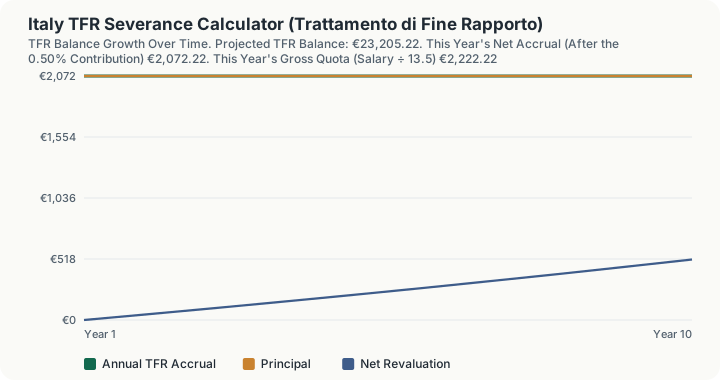
Quick Answer: An employee earning €39,000 gross per year, projected forward 3 years at an assumed 2% annual ISTAT inflation rate, accumulates a TFR (Trattamento di Fine Rapporto) balance of €8,284.58 -- €8,081.67 in net accrual plus €202.91 in net revaluation after the 17% substitute tax.
Overview
TFR is Italy's statutory severance-pay fund: a mandatory deferred-compensation accrual that every employer sets aside for every employee, year by year, and pays out in full when employment ends -- whether through resignation, dismissal, or retirement. It is not a bonus and not discretionary; Article 2120 of the Codice Civile fixes exactly how much accrues each year and exactly how the accumulated balance is revalued over time.
Two mechanics matter, and this calculator models both precisely: the accrual formula (how much each year of work adds to the pot) and the revaluation formula (how the previously-accrued balance grows, net of a substitute tax, while it sits with the employer until payout).
How This Is Calculated
Step 1 -- Annual accrual (Art. 2120, Codice Civile):
The 13.5 divisor reflects 12 ordinary monthly payments plus a 13th-month payment, adjusted by a long-standing historical coefficient. It works out to 7.407% of salary.
Step 1b -- the 0.50% contribution (L. 297/1982, art. 3). The employer pays a 0.50% contribution to INPS on the same salary base and recovers it by deducting it from your quota, so what actually lands in your TFR is the difference:
That takes the effective accrual from 7.407% of salary down to about 6.907%. Every figure below is the net amount credited to you.
Step 2 -- Annual revaluation. Every 1 January, the balance accrued through the end of the prior year (not the current year's own new accrual, which hasn't had a chance to sit yet) is revalued at:
where the ISTAT FOI index is the year-on-year Italian consumer price index for blue-collar and white-collar worker households, excluding tobacco. A 17% imposta sostitutiva (substitute tax) applies to the revaluation increment only -- never to the accrued principal itself:
Worked Example
Using the calculator's default inputs -- €39,000 gross annual salary, projected 3 years, 2% assumed ISTAT inflation, no starting balance:
- Gross quota = €39,000 ÷ 13.5 = €2,888.89 every year. Less the 0.50% contribution of €39,000 × 0.5% = €195.00, the net annual accrual is €2,693.89.
- Year 1: no prior balance exists yet, so no revaluation applies. Ending balance = €2,693.89.
- Year 2: the prior €2,693.89 is revalued at 1.5% + (0.75 × 2%) = 3.0%. Gross revaluation = €80.82; substitute tax (17%) = €13.74; net revaluation = €67.08. New balance = €2,693.89 + €67.08 + €2,693.89 = €5,454.86.
- Year 3: the prior €5,454.86 is revalued at the same 3.0% rate. Gross revaluation = €163.65; tax = €27.82; net = €135.83. New balance = €5,454.86 + €135.83 + €2,693.89 = €8,284.58.
Over the 3 years: €8,081.67 in net accrual, plus €202.91 in net revaluation, minus €41.56 withheld as substitute tax along the way -- reconciling exactly to the final €8,284.58 balance. Had the 0.50% contribution been ignored, the same three years would have shown €8,884.27, overstating the balance by €599.69.
What This Does Not Account For
- "Tassazione separata" at payout. When TFR is finally paid out (on termination), the accumulated principal is taxed using a completely separate mechanism: an average of the employee's marginal IRPEF rates over roughly the preceding five years, applied via "tassazione separata" -- a materially different (and often more favorable) calculation than applying current-year IRPEF brackets. This calculator only models the accrual and revaluation, not the final payout tax.
- Whether your employment is one of those subject to the 0.50% contribution. The deduction applies to relationships covered by the contribution, which is the ordinary case for private-sector employees, and the calculator applies it to every projection. A few categories sit outside it; if yours does, read the gross quota line instead of the net accrual line.
- "Retribuzione utile" is not always your headline gross. Article 2120 computes the quota on the remuneration due for the year including payments in kind, but a collective agreement (CCNL) can exclude specific items from that base. Where your CCNL narrows the base, the correct input is the narrowed figure, not your total gross.
- Advances (anticipazioni) on TFR. Employees with 8+ years of tenure can request an advance of up to 70% of their accrued TFR for specific purposes (medical expenses, first-home purchase, parental leave); withdrawing an advance reduces the base available for future revaluation, which this projection does not model.
- Diverting TFR to a supplementary pension fund (previdenza complementare). Employees can elect to redirect ongoing TFR accrual into a private pension fund instead of leaving it with the employer -- a different (and often better) growth and tax profile than the employer-held revaluation formula modeled here.
- Mid-year hires, terminations, or salary changes. This projection assumes a constant gross annual salary held for full calendar years; a raise, part-year employment, or a mid-year termination changes both the accrual and the revaluation dates in ways this simplified year-by-year model does not capture precisely.
- Company size differences. Employers with fewer than 50 employees retain the full TFR fund themselves; larger employers must transfer newly-accrued TFR to INPS's Fondo di Tesoreria, which changes who holds and revalues the balance (though the accrual and revaluation formulas themselves are unchanged either way).
Common Pitfalls
- Revaluing the wrong year's accrual. Only the balance that existed at the END of the prior year gets revalued each January -- the current year's own new accrual is added afterward, without revaluation, in its own year.
- Forgetting the 17% substitute tax applies only to the revaluation increment, not to the underlying TFR principal -- the accrued capital itself is never touched by this particular tax; it's taxed separately (and differently) only when finally paid out.
- Assuming a fixed 3% revaluation rate every year. The rate moves with actual ISTAT inflation data each year (1.5% fixed plus 75% of that year's specific rate) -- 2% ISTAT inflation happens to produce exactly 3.0%, but a different inflation year produces a different rate entirely.
- Confusing TFR with a 13th-month bonus (tredicesima). The 13.5 divisor's structure reflects an accounting convention tied to 13 monthly payments, but TFR itself is a deferred severance fund paid only at the end of employment -- not an annual bonus paid during it.
- Not accounting for advances already taken. If you've withdrawn an anticipazione, your actual current TFR balance is lower than a straight accrual-since-hire calculation would suggest -- enter your actual current balance as the "existing accrued TFR balance" input rather than assuming none was ever taken.
Frequently Asked Questions
How is TFR calculated in Italy?
What is the TFR revaluation formula?
Is TFR taxed the same way as regular income?
Can I access my TFR before I leave my job?
Should I leave my TFR with my employer or move it to a pension fund?
Does company size affect how my TFR is calculated?
What happens to my TFR if I'm laid off versus if I resign?
Sources
- Italian Revenue Agency (Agenzia delle Entrate), the official authority for the national tax authority this calculator relates to. agenziaentrate.gov.it
Caveat: the "tassazione separata" average-rate mechanism applied to the TFR principal at final payout was not modeled or independently re-derived this session -- it requires a taxpayer's specific 5-year IRPEF history and is disclosed above as out of scope for this calculator.
Also consulted: L. 297/1982, art. 3, ultimo comma: the 0.50% contribution on the retribuzione imponibile previdenziale, which the employer pays to INPS and deducts from the employee's TFR accantonamento. INPS circolare 70/2007 states the arithmetic directly, multiplying useful pay by 7.41% and deducting the 0.50% contribution from it. Implemented 2026-08-28, taking the effective accrual to about 6.907% of salary; Article 2120, Codice Civile: statutory TFR gross quota formula (salary ÷ 13.5) and the annual revaluation mechanism (1.5% fixed + 75% of ISTAT), confirmed via multiple concordant 2026 sources (fiscoinvestimenti.it, dipendenti.it, calcolatorifiscali.it, centrofiscale.com), all independently agreeing on both formulas; 17% imposta sostitutiva on the annual revaluation increment: confirmed via the same concordant sources above.