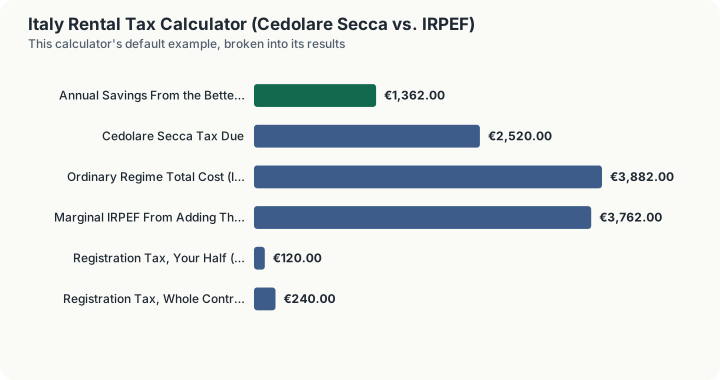
Quick Answer: On €12,000 of annual rent under a free-market (canone libero) lease, stacked on €30,000 of other income (33% marginal bracket), cedolare secca costs €2,520 versus €3,882 under ordinary IRPEF taxation plus the landlord's half of the registration tax -- a €1,362 annual saving by electing the flat-rate option.
Overview
Italian landlords renting out residential property face a genuine choice on how their rental income gets taxed: cedolare secca, a flat substitute tax that replaces IRPEF, registration tax, and stamp duty on that income entirely, or ordinary taxation, where 95% of gross rent is added to your other IRPEF-taxable income and taxed at your marginal rate, on top of a separate registration tax on the lease contract.
Cedolare secca comes in two rates: 21% for standard "canone libero" (free-market) leases, and a reduced 10% for "canone concordato" (agreed-rent) contracts negotiated under a territorial landlord-tenant accord -- available in comuni ad alta tensione abitativa and comuni capoluogo. This calculator computes both paths side by side in euros, using your actual rent and income, so you can see exactly which one costs less for your situation.
How This Is Calculated
Cedolare secca (flat substitute tax):
Ordinary IRPEF taxation (Art. 37 TUIR): 95% of gross rent (a flat 5% forfeit deduction for expenses) is added to your other taxable income, and taxed at Italy's ordinary progressive rates:
Ordinary taxation also requires paying imposta di registro (registration tax) on the lease -- 2% of the annual canone. Canone concordato contracts get a 30% cut in the taxable base, so the 2% runs on 70% of the rent:
The €67 statutory minimum binds on the contract's first annuity only. Later annual payments are a straight 2%, however small:
That charge falls on the contract, not on the landlord alone. L. 392/1978 art. 8 splits it equally between the two parties, so only half of it is yours:
Cedolare secca wins whenever its flat tax is lower than this ordinary total.
Worked Example
Using the calculator's default inputs -- €12,000 annual rent, canone libero, €30,000 of other taxable income:
- Cedolare secca: €12,000 × 21% = €2,520.00.
- Ordinary -- taxable rental income: €12,000 × 95% = €11,400.
- Ordinary -- IRPEF with rent: on €41,400 total taxable income (€30,000 + €11,400) = €6,440 (23% bracket) + €4,422 (33% bracket) = €10,862.
- Ordinary -- IRPEF without rent: on €30,000 alone = €6,440 + €660 = €7,100.
- Marginal IRPEF from the rent alone: €10,862 − €7,100 = €3,762.00.
- Registration tax on the contract: max(€67, €12,000 × 2%) = €240.00, of which your statutory half is €120.00.
- Ordinary total cost to you: €3,762.00 + €120.00 = €3,882.00.
- Cedolare secca (€2,520.00) beats ordinary taxation (€3,882.00) by €1,362.00.
Now compare a smaller, agreed-rent (canone concordato) case: €6,000 annual rent at the 10% cedolare secca rate against €15,000 of other income (still inside the 23% bracket). Cedolare secca = €600.00. Ordinary: taxable rental €5,700, IRPEF on €20,700 total = €4,761.00, IRPEF on €15,000 alone = €3,450.00, marginal IRPEF = €1,311.00. The concordato registration base is €6,000 × 70% = €4,200, so the contract charge is max(€67, €84) = €84.00 and your half is €42.00, giving an ordinary total of €1,353.00 -- cedolare secca still wins, by €753.00.
The €67 floor changes the picture only in the first year of a small contract. A €2,000 garage let to someone with no other income pays max(€67, €40) = €67 on first registration, your half being €33.50 and the cedolare secca saving €50.50. From the second annuity the floor lifts, the charge is a straight €40, your half €20.00, and the saving narrows to €37.00.
What This Does Not Account For
- A lease that departs from the statutory 50/50 split. The calculator charges you half the registration tax, which is what L. 392/1978 art. 8 gives you absent any agreement. Parties may agree otherwise, and a landlord who has contracted to bear the whole charge should read the "whole contract" figure rather than the "your half" one. A clause pushing the entire charge onto the tenant is void, so the split never moves the other way.
- Imposta di bollo (stamp duty). Ordinary taxation also requires a separate stamp duty (commonly cited around €16 per four pages/100 lines of the contract) that cedolare secca eliminates entirely -- a minor, largely fixed, one-time cost this calculator does not add to the euro comparison.
- The comune-eligibility requirement for canone concordato. The 10% rate is only available for genuinely agreed-rent contracts in comuni ad alta tensione abitativa or comuni capoluogo -- this calculator assumes you've correctly determined your eligibility for the rate you select.
- Loss of expense deductions. Ordinary taxation's 5% forfeit deduction is a fixed simplification either way -- but cedolare secca electors also permanently give up the ability to deduct any actual higher expenses (repairs, condo fees passed through, etc.) against that rental income for as long as the option is active.
- Impact on other benefits. Cedolare secca income is excluded from "reddito complessivo" for some purposes but still counts for ISEE and certain other means-tested calculations -- the interaction with other benefits/deductions tied to total income is not modeled here.
- ISTAT rent-adjustment waiver. Electing cedolare secca requires the landlord to waive the right to request annual ISTAT inflation adjustments to the rent for the duration of the option -- a real economic trade-off not captured in this year-by-year euro comparison.
- Short-term rentals ("affitti brevi"). This calculator covers ordinary residential leases, not short-term/vacation rentals under 30 days, which are governed by a separate regime (21% for one unit, 26% for a second, and additional rules) that the Legge di Bilancio 2026 specifically revised.
Common Pitfalls
- Assuming cedolare secca is always better. In this simplified model it very often is, because Italy's lowest ordinary IRPEF bracket (23%) already exceeds even the higher 21% cedolare secca rate once the 5% expense forfeit is applied -- but real-world advantages/disadvantages (deduction loss, ISTAT waiver, ISEE effects) can shift the true comparison for your specific circumstances.
- Using the wrong cedolare secca rate. Canone concordato's 10% rate applies only to genuinely agreed-rent contracts under a territorial accord in an eligible comune -- using it for an ordinary free-market lease is not permitted and would understate the tax due.
- Forgetting the 5% forfeit deduction under ordinary taxation. Only 95% of gross rent is taxable under the ordinary regime -- taxing the full 100% overstates the ordinary-regime cost.
- Carrying the €67 floor into later years. For very small rentals (a garage, a single room) the 2%-of-rent calculation falls below €67, and on first registration the statutory minimum applies. It applies to that first annuity only. Later annual payments are a straight 2% with no floor, which is why this calculator asks whether you are in the contract's first year.
- Paying the whole registration tax yourself. The law splits it equally between landlord and tenant. Landlords routinely absorb the full amount out of habit or because the lease says nothing about it, which is a real cost that was never theirs to carry. Settle who pays which half in the contract before registration.
- Comparing cedolare secca against the wrong marginal rate. Ordinary taxation stacks rental income ON TOP of your other income -- its cost depends on your marginal bracket, not a flat "average" rate on the rent alone.
Frequently Asked Questions
What is cedolare secca?
When does cedolare secca make sense?
What's the difference between canone libero and canone concordato?
Does cedolare secca replace registration tax and stamp duty too?
Are there any downsides to choosing cedolare secca?
Did the 2026 budget law change cedolare secca rates?
Can any landlord choose canone concordato's 10% rate?
Sources
- Agenzia delle Entrate, "Registrazione di un nuovo contratto -- Quanto si paga (regime ordinario)": registration tax of 2% of the annual rent with a €67 minimum on first registration, the minimum falling away for subsequent annual payments, the 2% applied to 70% of the rent for subsidised contracts, and the statutory 50/50 split of the charge between landlord and tenant with joint liability to the Agenzia for the whole. Re-verified 2026-08-28. agenziaentrate.gov.it
Caveat: the imposta di bollo (stamp duty) figure is mentioned qualitatively only and is not included in the euro comparison.
Also consulted: D.Lgs. 23/2011, art. 3: cedolare secca framework, 21% standard rate and 10% reduced rate for canone concordato contracts, confirmed unchanged for 2026 via multiple concordant sources (idealista.it, fiscoetasse.com, ipsoa.it, fiscomania.com, cedolaresecca.net); Art. 37, TUIR (Testo Unico delle Imposte sui Redditi): 5% forfeit expense deduction for ordinarily-taxed rental income; Legge di Bilancio 2026: the second IRPEF bracket (€28,000 to €50,000) cut from 35% to 33% with effect from tax period 2026, with the benefit neutralised above €200,000 of total income by a €440 reduction in certain deductions. The neutralisation above €200,000 is not modeled by this calculator.