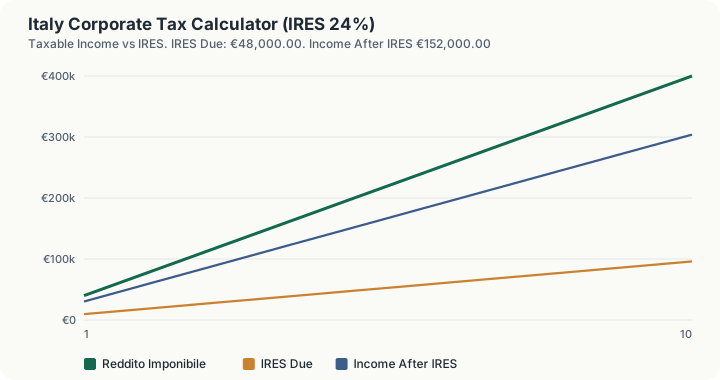
Quick Answer: A company with €200,000 of taxable income owes €48,000.00 in IRES, at the flat rate of 24%. Unlike Spain, the Netherlands or the UK, Italy has no small-company band: the rate is 24% at €50,000 and at €5,000,000 alike. IRAP is charged separately and is not included here.
What does this calculator do?
IRES, imposta sul reddito delle società, is Italy's corporate income tax, charged at a flat 24% on taxable income. There is no banding, no threshold and no reduced rate for small companies, so the effective and marginal rates are identical at every level.
That makes it unusual among its neighbours. Spain bands at €50,000 and €1 million, the Netherlands at €200,000, and the UK operates a Marginal Relief taper. An Italian company with €50,000 of income pays the same rate as one with €5 million.
Two important things are not in this figure, and both are disclosed rather than estimated. IRAP, the regional tax on productive activities, is charged separately on a different base and varies by region and sector. And the conditional "IRES premiale" reduced rate of 20% is not applied.
How is this calculated?
IRES = 0.24 × reddito imponibile
Taxable income is the statutory accounting profit adjusted for fiscal purposes: non-deductible costs added back, and specific deductions applied. This calculator starts from that adjusted figure.
Because the rate is flat, the effective rate is always exactly 24% and the income remaining after IRES is always exactly 76% of the taxable base.
Worked Example
An SRL closes its year with €200,000 of reddito imponibile after fiscal adjustments.
Step 1: The rate. Flat IRES, so r = 24%
Step 2: The tax. €200,000 x 24% = €48,000.00
Step 3: What remains. €200,000.00 - €48,000.00 = €152,000.00
Step 4: Express that as a share of the base. €152,000.00 / €200,000.00 = 76.00%, which is 1 minus the rate and always will be
Step 5: The effective rate. €48,000.00 / €200,000.00 = 24.00%, identical to the marginal rate
Nothing above depends on the size of the company, and that is the whole finding. Repeat the exercise two orders of magnitude apart:
Step 6: A small company on €50,000. €50,000 x 24% = €12,000.00, leaving €38,000.00 and an effective rate of 24.00%
Step 7: A large one on €5,000,000. €5,000,000 x 24% = €1,200,000.00, leaving €3,800,000.00 and an effective rate of 24.00%
Step 8: The spread between them. 24.00% - 24.00% = zero. In Spain, the Netherlands or the UK the same two companies would face different rates; in Italy no threshold exists to cross.
What the €48,000 does not include is IRAP, which is assessed separately on a wider base and is excluded from every figure above.
The Sweep, and the Two Rates It Cannot Show
The ten-row table below the calculator moves reddito imponibile from €40,000 to €400,000 in €40,000 steps, and it is the flattest sweep in this corpus. IRES runs from €9,600.00 on the first row to €96,000.00 on the last, with €48,000.00 at the €200,000 default. Every row divides to 24.00%.
There is no threshold here, and that is the finding rather than an omission. Spain steps at €50,000 and €1,000,000, the Netherlands at €200,000, the UK tapers between £50,000 and £250,000. Italy has no band, so this sweep contains no edge to walk. The practical consequence is that the classic cross-border question, "should this profit sit in the Italian subsidiary or the Dutch one", has no answer in Italian rate structure at all: it turns entirely on IRAP, on the base, and on withholding, none of which this calculator computes.
Marginal cost of the next unit. Each additional €1,000 of taxable income costs €240.00 of IRES. Raising the default from €200,000 to €201,000 moves the tax from €48,000.00 to €48,240.00. Each additional €100,000 costs €24,000.00, at €50,000 of income and at €5,000,000 alike.
The reverse question, which is really a deduction question. Because the rate is constant, every euro of deductible cost recognised is worth exactly 24 cents of IRES. A €50,000 fiscal adjustment moves the tax by €12,000.00 whether the company earns €200,000 or €5,000,000; the calculator confirms this by returning €12,000.00 on a €50,000 base and €1,200,000.00 on a €5,000,000 base. That is the whole of Italian corporate rate planning, and it is why the arguments in an Italian tax review are almost always about the base and almost never about the rate.
The two rates this page cannot give you. IRAP is charged separately on a wider base at a rate that varies by region and sector, and the conditional IRES premiale rate of 20% turns on a reinvestment and employment test. Neither could be confirmed for 2026 from a primary source, so neither is in the engine and neither appears in any row of the table. Every figure on this page is a 24% figure; the calculator has no input that would let you select the 20% rate and no code path that applies it. If your company qualifies, the €48,000.00 shown is an upper bound, and the calculator will not tell you by how much.
What does this calculator not account for?
- IRAP. The regional tax on productive activities is charged on a broader base than IRES, at a standard rate that varies by region and by sector, with banks and insurers taxed at higher rates. Its rate could not be confirmed for 2026 from a primary source and is therefore excluded rather than estimated. Any real-world total corporate burden in Italy must add it.
- The "IRES premiale" reduced rate of 20%. Introduced by the 2025 budget law, it is conditional on reinvesting at least 30% of retained earnings in new instrumental assets and on maintaining employment levels. Whether it applies for 2026 as well as 2025, and on what conditions, was not established from a primary source, so it is deliberately not modelled.
- Determining taxable income. Depreciation, interest deductibility limits under the ROL rule, provisions and non-deductible costs all sit upstream of the figure entered here.
- The ACE / NID allowance and its successors, which reduce the taxable base for equity-funded companies.
- Patent box and R&D credits.
- Consolidato fiscale, under which a group is taxed on a combined base.
- Loss carry-forward rules, including the 80% limitation on offsetting prior-year losses.
- Pillar Two top-up tax for groups above €750 million of revenue.
- Acconti, the advance payments made during the year.
What mistakes do people make with this?
- Treating 24% as the total corporate burden. IRAP sits on top, on a different and generally wider base, so the combined burden is materially higher than IRES alone.
- Looking for a small-company rate. There is none. IRES is flat, which surprises anyone arriving from the Spanish, Dutch or UK systems.
- Assuming the IRES premiale applies automatically. It is conditional on reinvestment and employment tests, and this calculator does not apply it. Check current eligibility before relying on 20%.
- Entering accounting profit rather than taxable income. Fiscal adjustments can move the two apart substantially.
- Forgetting the 80% loss limitation. Carried-forward losses generally cannot shelter more than 80% of taxable income in a year.
- Ignoring acconti. Advance payments during the year mean the balance due on filing is usually far smaller than the full liability.
Frequently Asked Questions
What is the IRES rate?
Is there a lower rate for small companies?
What about the 20% IRES premiale?
Does this include IRAP?
Why is my effective rate exactly 24%?
Do I enter accounting profit or taxable income?
Sources
- Agenzia delle Entrate: "Imposta sui redditi delle società (IRES), che cos'è", standard rate 24%. agenziaentrate.gov.it/portale/imposta-sui-redditi-societa-ires/infogen-imposta-sui-redditi-societa-ires
Also consulted: Agenzia delle Entrate: "Imprese, Imposte sui redditi (Irpef, Ires)"; IRES rate verified on 30 August 2026. The IRES premiale reduced rate and the IRAP rate were NOT verified from a primary source and are excluded from the calculation rather than estimated.