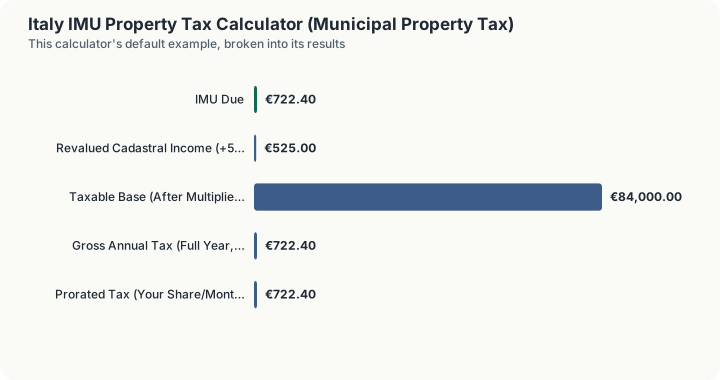
Quick Answer: A property with a €500 cadastral income (rendita catastale), in an ordinary residential category, taxed at the commonly-cited national base rate of 0.86%, owes €722.40 in annual IMU (Imposta Municipale Propria).
Overview
IMU is Italy's municipal property tax -- the main recurring tax on real estate ownership, collected by each comune (municipality) rather than the national government. Unlike a US-style property tax based on market value, IMU is built on the rendita catastale (cadastral income), a government-assessed figure tied to each property's registered cadastral category, then run through a fixed statutory revaluation and a category-specific multiplier before the comune's own rate is applied.
Since 2020's IMU/TASI unification (L. 160/2019), IMU is the single recurring municipal property tax (the old separate TASI service tax was folded in). Ordinary primary residences are exempt outright; only luxury-category homes and non-primary properties (second homes, rentals, commercial buildings, garages) pay. This calculator walks through the full statutory formula end to end, in euros, using your property's actual cadastral data.
How This Is Calculated
IMU is charged on a cadastral income figure rather than a market price, and the multiplier that converts it into a taxable base is fixed nationally by cadastral category, so a shop and an apartment of the same rendita catastale carry very different bases. Only the final rate is set locally. Three steps produce the taxable amount:
Step 1 -- Revalue the cadastral income by the statutory 5%:
Step 2 -- Apply the category-specific multiplier (fixed by national law; comuni cannot change these):
| Cadastral Category Group | Multiplier |
|---|---|
| Housing A/2-A/9 (excl. A/10) + garages/cellars/sheds (C/2, C/6, C/7) | 160 |
| Group B (colleges, hospitals) + workshops/gyms/labs (C/3, C/4, C/5) | 140 |
| A/10 offices + D/5 banks/insurance | 80 |
| Group D industrial/commercial (excl. D/5) | 65 |
| C/1 shops | 55 |
Step 3 -- Apply your comune's rate and prorate for partial-year possession and any co-ownership share:
Primary residences: an ordinary residential primary home (categories A/2 through A/9, excluding the luxury categories below) is fully exempt from IMU -- set the rate to 0% for that case. Only luxury primary residences -- A/1 (stately homes), A/8 (villas), and A/9 (castles/palaces of historic or artistic value) -- remain taxable when used as your habitual home, at a reduced rate (commonly cited around 0.5%, comune-set) with a deduction of up to €200 subtracted from the final bill.
Worked Example
Using the calculator's default inputs:
- Rendita Catastale: €500
- Category: Housing (multiplier 160)
- Municipal Rate: 0.86% (the commonly-cited national base rate)
- Ownership Share: 100%, held the full 12 months
Step by step:
- Revalued rendita = €500 × 1.05 = €525.00.
- Taxable base = €525.00 × 160 = €84,000.00.
- Annual tax = €84,000.00 × 0.86% = €722.40.
- Full ownership and a full year of possession mean no proration is needed: IMU due = €722.40.
Now compare a luxury primary residence: €800 rendita catastale, category A/1, at a 0.5% rate with the full €200 deduction. Revalued rendita = €840.00; taxable base = €840.00 × 160 = €134,400.00; annual tax = €134,400.00 × 0.5% = €672.00; after the €200 deduction, IMU due = €472.00 -- even though it's the owner's own home, because A/1 is a luxury category.
A third case: a C/1 shop with €1,200 rendita catastale, held at 50% ownership for only 6 months, at a 1.06% rate. Revalued rendita = €1,260.00; taxable base (multiplier 55) = €69,300.00; full-year tax = €734.58; prorated for 50% ownership and 6/12 months = €183.65.
What This Does Not Account For
- Agricultural land and farm buildings, which use a different revaluation (25%, not 5%) and different multipliers entirely -- this calculator only covers residential, office, and commercial building categories.
- Your specific comune's exact current-year rate. Municipal IMU rates change annually by comune resolution and were not individually re-verified against each comune's official delibera for this calculator -- always confirm your actual rate against your comune's published IMU regulation or your F24 payment notice before filing.
- TARI (waste collection tax) and other local levies, which are billed separately from IMU and not included here.
- The "assimilazione" rules that can extend the primary-residence exemption to certain non-resident owners (e.g., some pensioners residing abroad, or one spouse living elsewhere for work) under specific comune-level or national provisions -- this calculator assumes a straightforward owner-occupier or non-primary-residence scenario.
- Multiple co-owners with different possession periods or shares in the same year (e.g., a mid-year sale where the buyer and seller each owe a different prorated amount) -- run the calculator once per owner/period if your situation is more complex than a single share and a single possession window.
Common Pitfalls
- Forgetting the 5% revaluation step. The cadastral income printed on your visura catastale is not the taxable base -- it must first be increased by 5%, then multiplied by the category coefficient, before any rate is applied.
- Using the wrong multiplier. Housing (160) and shops (55) are the two most commonly confused -- a C/1 shop uses 55, not 160, producing a materially smaller taxable base for the same rendita catastale.
- Assuming all primary residences are exempt. Only ordinary categories (A/2-A/9, excluding A/1, A/8, A/9) qualify for the blanket exemption -- luxury-category primary residences still owe IMU, just at a reduced rate with a deduction.
- Applying a full year's tax to a partial-year purchase or sale. IMU is prorated by full calendar months of possession -- buying a property in July means owing roughly half a year's tax, not the whole year's amount.
- Using last year's municipal rate. Comuni can and do change their aliquota comunale from year to year; always check your comune's current-year delibera rather than reusing a prior year's figure.
Frequently Asked Questions
How is IMU calculated in Italy?
Is my primary residence exempt from IMU?
What is the "rendita catastale" and where do I find it?
Why does the multiplier vary so much between categories (55 to 160)?
Can my comune set any IMU rate it wants?
Do I owe IMU if I only owned the property for part of the year?
Is IMU the same as TASI?
Sources
- Italian Revenue Agency (Agenzia delle Entrate), the official authority for the national tax authority this calculator relates to. agenziaentrate.gov.it
Caveat: the exact legal floor/ceiling of the comune-set rate band, and any specific comune's current-year deliberated rate, were not independently re-verified against each comune's official delibera or against a primary Normattiva/Gazzetta Ufficiale text this session -- always confirm your comune's actual current rate before filing.
Also consulted: D.L. 201/2011, art. 13, and L. 160/2019 (IMU/TASI unification): governing framework for the tax, its cadastral-income basis, the 5% revaluation, and the category-multiplier mechanism; Cadastral multiplier table cross-verified across two independently-concordant 2026 sources (fiscoinvestimenti.it, imu-online.it), which list an identical set of coefficients (160 / 140 / 80 / 65 / 55); Primary-residence exemption and luxury-category (A/1, A/8, A/9) treatment, including the reduced rate and up-to-€200 deduction: corroborated via current 2026 guidance (fiscoinvestimenti.it).