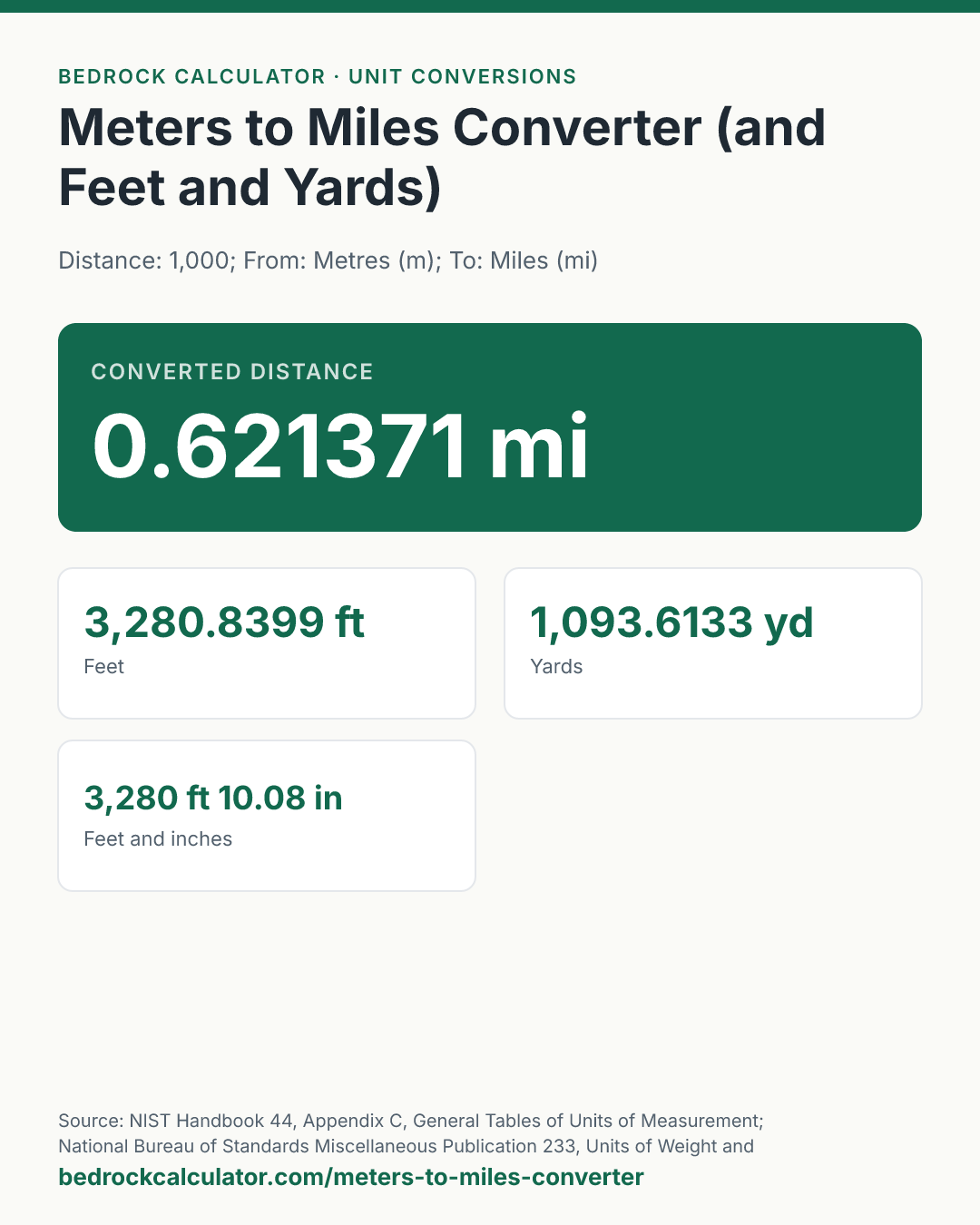

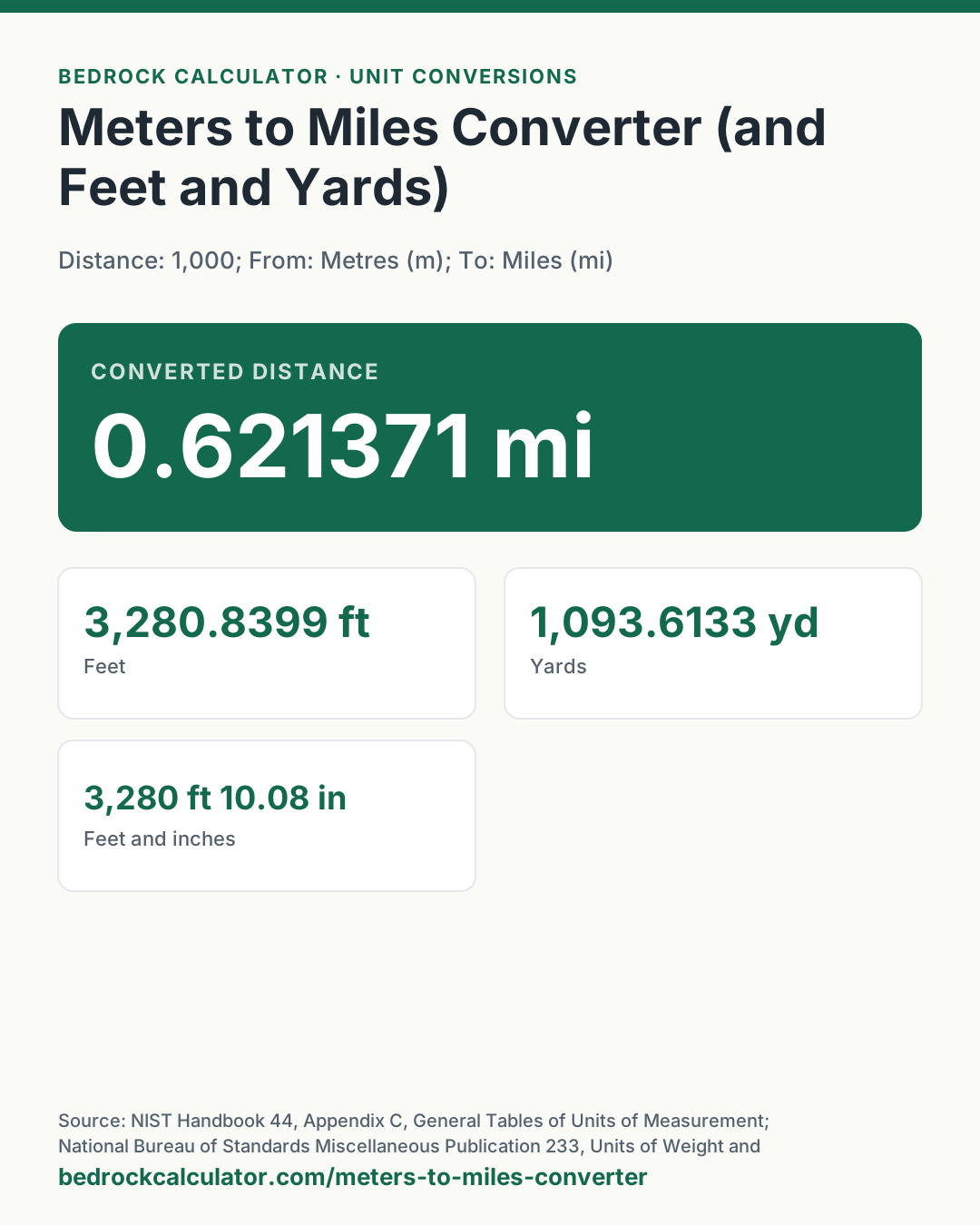
Quick Answer: 1,000 metres is 0.621371 mi, or 3,280.8399 feet. One mile is exactly 1,609.344 metres, 3 m is 9.8425 feet, and 100 yards is 91.44 m.
What does this calculator do?
This meters to miles converter moves a distance between metres, feet, yards and miles in any direction. Choose the unit you have and the unit you want, type the number, and the answer appears with every other unit listed below it, including the length in feet and inches.
Metres and the customary units meet at one fixed point: since 1959 the international yard has been exactly 0.9144 metres. A foot is a third of that, 0.3048 m, and a mile is 1,760 yards, which makes it exactly 1,609.344 m. Because those are definitions, the conversion has no measuring error. The only rounding is in the display: miles to six decimal places, everything else to four.
Track distances, swimming pools, building plans and sports fields are where the question usually comes up. A 400 m track lap is close to a quarter mile but not the same, and a 100 yard football field is shorter than 100 m. The tables below the converter set those side by side.
Using the Meters to Miles Converter
- Type the distance. Decimals are fine.
- Choose the unit you have in From and the one you want in To.
- Read the converted distance at the top. The cards show miles, metres, feet, yards, and feet and inches.
The preset buttons load 3 m in feet, 1 m in miles, a 100 yard field in metres, and one mile in metres.
How is this calculated?
- Choose the units. The From unit says what your number means; the To unit picks the headline. A negative distance is read as zero.
- Convert through the metre. The metre is the base unit. The yard is stored as exactly 0.9144 m, the foot as 0.3048 m and the mile as 1,760 yards, 1,609.344 m. The converter multiplies your number by the size of the unit you started in and divides by the size of the unit you want.
miles = metres/1609.344; feet = metres/0.3048; metres = yards × 0.9144
- Split into feet and inches. The length in feet is cut at the decimal point: the whole number is the feet, and the fraction left over is turned into inches and rounded half up to two decimal places, with a carry into the next foot if it reaches 12.
- Round for display only. Miles are shown to six decimal places; metres, feet and yards to four, rounded half up with trailing zeros dropped.
Worked Example
The default, 1,000 metres to miles:
- Miles: 1,000 ÷ 1,609.344 = 0.6213711..., shown as 0.621371 mi.
- Feet: 1,000 ÷ 0.3048 = 3,280.8399 ft, or 3,280 ft 10.08 in.
- Yards: 1,093.6133 yd.
3 metres in feet: 3 ÷ 0.3048 = 9.8425 ft, which is 9 ft 10.11 in.
One metre in miles: 1 ÷ 1,609.344 = 0.000621 mi. One metre is also 3.2808 ft and 1.0936 yd.
100 yards to metres: 100 × 0.9144 = 91.44 m exactly.
One mile to metres: 1,609.344 m, exactly.
Track and Field Distances
| Metres | Miles | Feet | Yards |
|---|---|---|---|
| 100 | 0.062137 | 328.084 | 109.3613 |
| 200 | 0.124274 | 656.168 | 218.7227 |
| 400 | 0.248548 | 1,312.336 | 437.4453 |
| 800 | 0.497097 | 2,624.6719 | 874.8906 |
| 1,500 | 0.932057 | 4,921.2598 | 1,640.4199 |
| 1,609.344 | 1 | 5,280 | 1,760 |
| 3,000 | 1.864114 | 9,842.5197 | 3,280.8399 |
| 5,000 | 3.106856 | 16,404.1995 | 5,468.0665 |
| 10,000 | 6.213712 | 32,808.399 | 10,936.133 |
The 1,500 m race is often called the metric mile, but it is 0.932057 of a real mile.
Yards to Metres
| Yards | Metres |
|---|---|
| 1 | 0.9144 |
| 10 | 9.144 |
| 25 | 22.86 |
| 50 | 45.72 |
| 100 | 91.44 |
| 220 | 201.168 |
| 440 | 402.336 |
| 1,760 | 1,609.344 |
Old British races were run in yards: the 220 yard dash was 201.168 m and the 440 was 402.336 m, a quarter mile.
How Many Miles Is 1,000 Metres?
1,000 metres, which is one kilometre, is 0.621371 miles. That is the familiar 0.62 that runners use to turn kilometres into miles. For longer metric distances in kilometres, the km to miles converter shows more race distances and odometer readings.
How Many Metres Are in a Mile?
Exactly 1,609.344. The mile is 5,280 feet, and 5,280 × 0.3048 = 1,609.344. A 400 m track lap is 0.248548 miles, so four laps fall a little short of a mile; the 1,609.344 m row in the table shows the full mile.
What does this calculator not account for?
- Nautical miles. The nautical mile used at sea is 1,852 m. The km to miles converter shows it as an output.
- Survey feet. US land records once used a survey foot slightly longer than the international foot. NIST retired it at the end of 2022; this page uses the international foot.
- Track lanes. A 400 m lap is measured in the inside lane. Outer lanes are longer per lap, which is why races in lanes use staggered starts.
- Inches as an input. For inch measurements, use the inches to cm converter.
What mistakes do people make with this?
- Treating a metre as a yard. A metre is 1.0936 yards, so 100 m is 109.3613 yards. The gap grows in proportion to the distance.
- Using 0.62 for long distances. It is close for a kilometre but undercounts slightly, and the error grows with the distance.
- Reading 9.8425 ft as 9 ft 8 in. The decimal is a fraction of a foot, not inches. The Feet and inches card gives 9 ft 10.11 in.
- Swapping the direction. The mile figure is always much smaller than the metre figure for the same distance.
Frequently Asked Questions
How many miles is 1 metre?
How many feet is 3 metres?
How many metres is 100 yards?
How many miles is 5,000 metres?
Is a 400 m lap a quarter mile?
How do I convert metres to miles?
How many yards is a metre?
Sources
- NIST Handbook 44, Appendix C, General Tables of Units of Measurement: the foot, yard and mile. nist.gov/pml/owm/nist-handbook-44-current-edition
- National Bureau of Standards Miscellaneous Publication 233, Units of Weight and Measure (revised to the 1959 refinement of the yard and the pound announced in the Federal Register, 24 FR 5348). nvlpubs.nist.gov/nistpubs/Legacy/MP/nbsmiscellaneouspub233.pdf
- BIPM, The International System of Units (SI Brochure, 9th edition, 2019): the metre. bipm.org/en/publications/si-brochure
- NIST, The US Survey Foot: retirement of the survey foot at the end of 2022. nist.gov/pml/us-surveyfoot