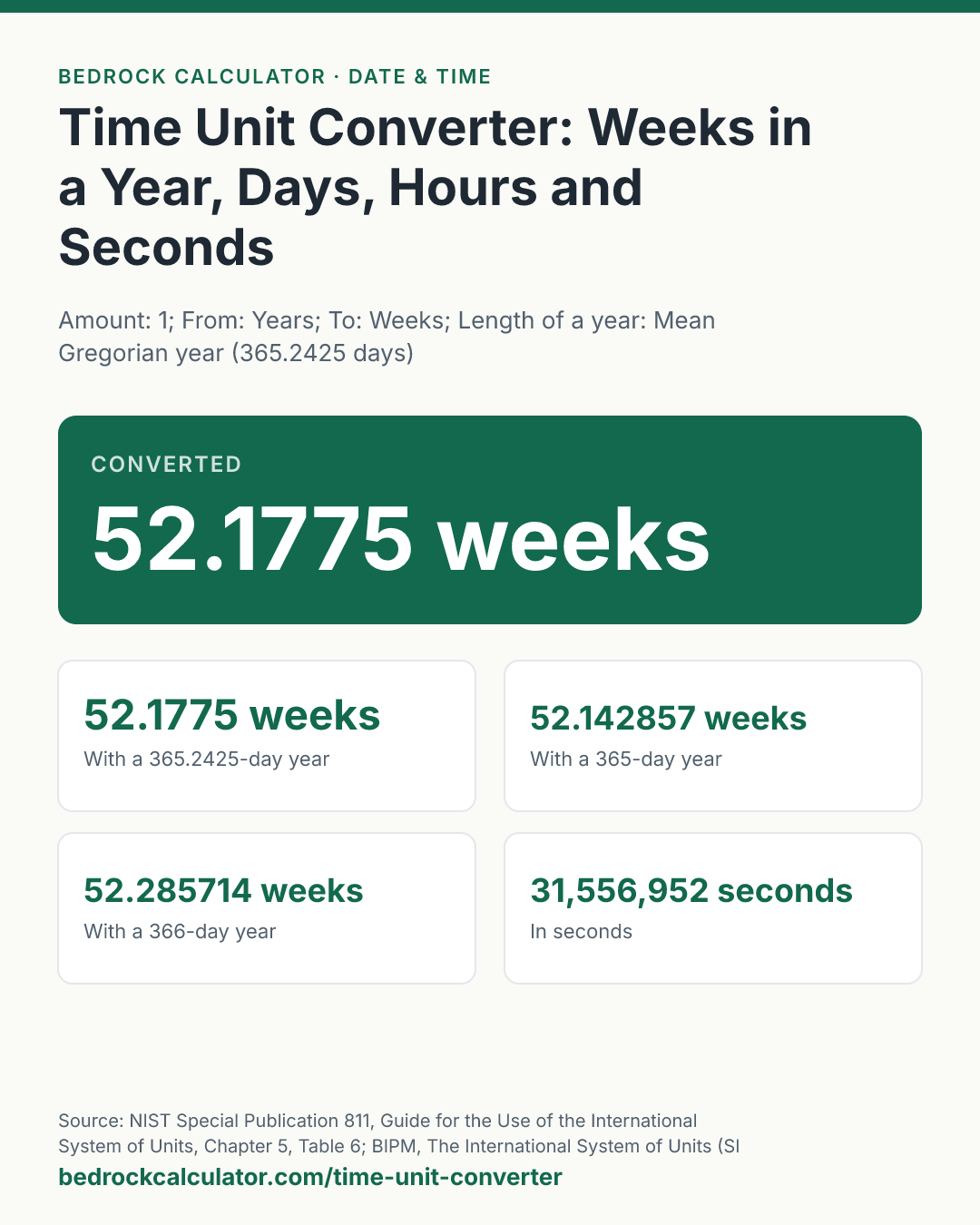

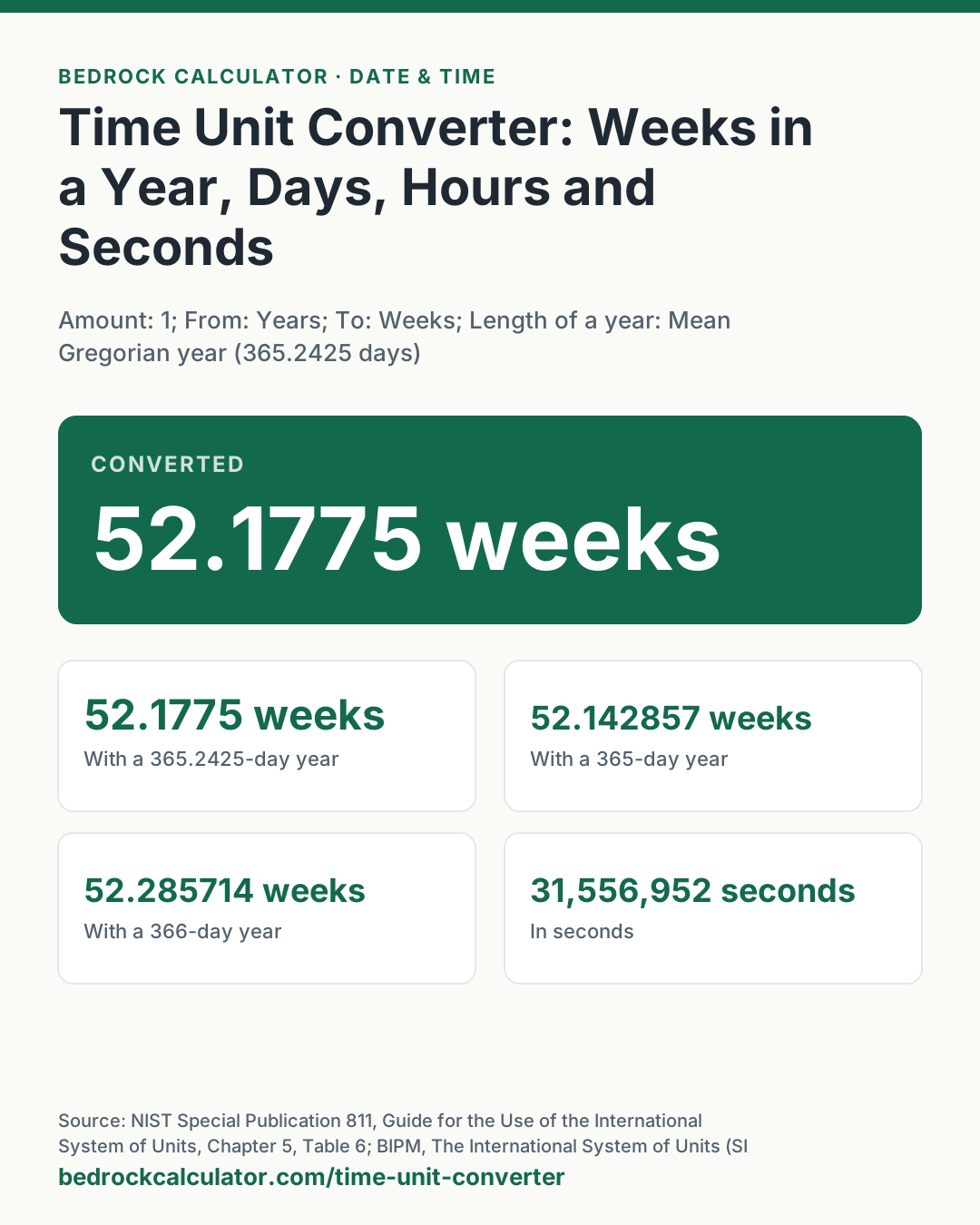
Quick Answer: A year has 52.1775 weeks on the mean Gregorian year of 365.2425 days. A 365-day year has 52.142857 weeks and a 366-day leap year has 52.285714.
What does this calculator do?
This time unit converter changes any amount of time between milliseconds, seconds, minutes, hours, days, weeks, months, years, decades and centuries. Pick the unit you have, the unit you want and, when months or years are involved, which length of year to use.
That last choice is why time conversions disagree from one website to the next. Seconds, minutes, hours, days and weeks have fixed sizes: a minute is 60 seconds, an hour 3,600 seconds, a day 86,400 seconds and a week 7 days. A year does not. A calendar year is 365 days, or 366 in a leap year, and over the 400-year cycle of the Gregorian calendar the average is 365.2425 days. "How many weeks are in a year?" therefore has three honest answers, and this converter shows all three side by side so you can pick the one your question needs.
A month is treated as one twelfth of the year you choose, which on the mean year is 30.436875 days. Real calendar months run from 28 to 31 days, so a conversion to months is an average month. For a real date a number of months away, use the date calculator, which steps through actual calendar months.
Using the Time Unit Converter
- Enter the Amount. Decimals are allowed, such as 2.5 hours.
- Choose the unit in From and the unit in To.
- If either unit is a month, year, decade or century, choose the Length of a year: the mean Gregorian year, a common year of 365 days, or a leap year of 366 days.
- Read the answer at the top. The cards show the year length used, the same conversion with each of the three year lengths, and the amount in seconds and in days.
The presets cover five frequent questions: weeks in a year, seconds in an hour, 60 months in years, 180 days in months, and 2,000 hours in days.
How is this calculated?
- Express both units in seconds. The second is the SI base unit of time. A millisecond is 0.001 s, a minute 60 s, an hour 3,600 s, a day 86,400 s and a week 604,800 s, all exact.
- Size the year. The year is 365.2425 days for the mean Gregorian year, 365 for a common year or 366 for a leap year, times 86,400 seconds. A month is that year divided by 12, a decade 10 years and a century 100 years.
- Convert. Multiply the amount by the size of the unit you have, and divide by the size of the unit you want. The arithmetic is done in decimal at 34 significant digits, so nothing is lost before display.
answer = amount × (seconds per from unit)/(seconds per to unit)
- Round for display. Answers are rounded half up to six decimal places with trailing zeros dropped. An answer smaller than 0.001 is shown to six significant figures instead, so a millisecond in centuries does not read as zero.
Worked Example
How many weeks are in a year, the default:
- A mean Gregorian year is 365.2425 × 86,400 = 31,556,952 seconds.
- A week is 604,800 seconds.
- 31,556,952 ÷ 604,800 = 52.1775 weeks.
- On a 365-day year the same steps give 52.142857 weeks, which is 52 weeks and 1 day. On a 366-day year, 52.285714 weeks, or 52 weeks and 2 days.
180 days in months on the mean year: a month is 30.436875 days, so 180 days is 5.913879 months, a little under six. On a 365-day year it is 5.917808 months.
2,000 hours in days: 2,000 ÷ 24 = 83.333333 days. No year is involved, so the year setting makes no difference.
How Many Weeks Are in a Year?
52.1775 on average, which is 52 weeks and about one and a quarter days. A common year of 365 days is 52 weeks and 1 day, and a leap year of 366 days is 52 weeks and 2 days.
The leftover day or two is why a date falls one weekday later each year, and two weekdays later after February 29.
How Many Days Are in a Year?
365 in a common year and 366 in a leap year. The Gregorian calendar adds February 29 in years divisible by 4, but skips it in century years unless they are divisible by 400, so 2000 had one and 2100 will not. Over 400 years that averages 365.2425 days, the figure the converter uses by default.
How Many Seconds Are in an Hour?
3,600. An hour is 60 minutes and a minute is 60 seconds, both fixed. A day is 86,400 seconds and a second is 1,000 milliseconds.
How Many Years Is 60 Months?
Exactly 5 years, because a month is defined here as one twelfth of a year, whatever the year's length. In the same way 48 months is 4 years and 12 months is 1 year. Going the other way is different: 1,000 days is 2.737907 mean years, and 100 days is 3.285488 average months.
What does this calculator not account for?
- Real calendar months. Every month here is the same length. February is shorter and July is longer, so "3 months from today" in days depends on which months they are. The date calculator handles that.
- Leap seconds. Since 1972, a second has occasionally been added to Coordinated Universal Time to keep it close to the Earth's rotation. A specific year can therefore contain one more second than this converter counts.
- Daylight saving time. A clock day can be 23 or 25 hours long when the clocks change. This converter uses the 24-hour day of 86,400 seconds.
- Astronomical years. The tropical year, from one March equinox to the next, is close to but not the same as the Gregorian average, and the Julian year of 365.25 days is used in astronomy. Neither is offered here.
- Working time. A working year or a working month in hours depends on your contract, not on the calendar.
What mistakes do people make with this?
- Using four weeks for a month. Four weeks is 28 days, but an average month is 30.436875 days, or 4.348125 weeks. Twelve four-week months only cover 336 days.
- Mixing year lengths in one calculation. If you convert with a 365-day year and then convert back with the mean year, the answer drifts. Keep one setting for a whole problem.
- Reading decimal hours as minutes. 83.333333 days is 83 days and one third of a day, which is 8 hours, not 83 days and 33 hours.
- Rounding too early. Round once, at the end. Rounding a month to 30 days and then multiplying by 12 gives 360 days, not a year.
- Confusing mean and calendar answers. "How long is 180 days" in months is just under 6, but 180 days from a given date can land more than or less than 6 calendar months later.
Frequently Asked Questions
How many weeks are in 12 months?
How many months are in 12 weeks?
How many hours are in 4 days?
How many days is 300 hours?
How many hours are in a year?
How many milliseconds are in a second?
Why does the converter show three answers?
Sources
- NIST Special Publication 811, Guide for the Use of the International System of Units, Chapter 5, Table 6: the minute, hour and day accepted for use with the SI and their values in seconds. nist.gov/pml/special-publication-811/nist-guide-si-chapter-5-units-outside-si
- BIPM, The International System of Units (SI Brochure, 9th edition): the definition of the second. bipm.org/en/publications/si-brochure
- NIST Time and Frequency Division, Time and Frequency from A to Z, Leap Year: the Gregorian leap year rule behind the 365.2425-day mean year. nist.gov/pml/time-and-frequency-division/popular-links/time-frequency-z/time-and-frequency-z-l
- NIST Time and Frequency Division, Leap Seconds FAQs: what leap seconds are and when they began. nist.gov/pml/time-and-frequency-division/leap-seconds-faqs