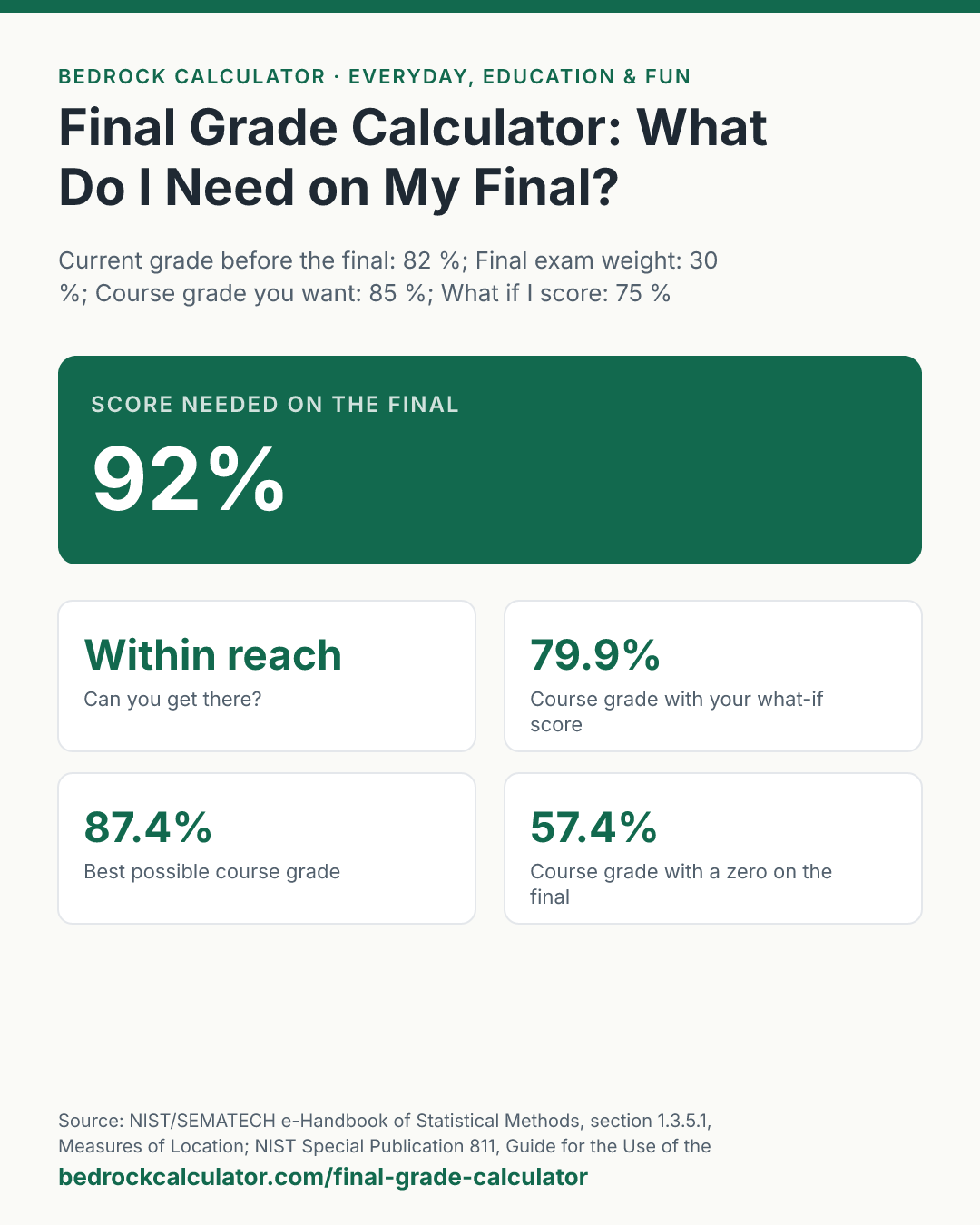

Quick Answer: With an 82% average so far and a final worth 30% of the course, you need 92% on the final to finish with 85%. The best you can finish with is 87.4%, and a zero on the final would leave you at 57.4%.
What does this calculator do?
This final grade calculator works backwards from the course grade you want to the score you need on the final exam. You enter three numbers from your syllabus and gradebook: your current grade, how much the final is worth, and the grade you are aiming for.
It returns the exam score that gets you there, says whether that score is possible, and shows the best and worst course grade the final can still produce.
There is also a what-if box. Type a score you think you might get, say 75%, and the calculator shows the course grade it would give. Between the two, you can see both what you need and what a realistic result would mean.
The calculator does not know your school's letter-grade scale. One school's A starts at 90%, another's at 93%, and some courses curve or round. So the target is a percentage you choose. Look up the cutoff for the letter grade you want, enter it as the target, and the answer is exact for that cutoff.
Using the Final Grade Calculator
- Enter your Current grade before the final, as a percentage. This is your average on everything else in the course, as your gradebook shows it.
- Enter the Final exam weight, the share of the whole course grade the final counts for. It is usually in the syllabus, for example "Final exam 30%".
- Enter the Course grade you want.
- Read the score you need at the top, and whether it is within reach.
- Optionally, put a likely score in What if I score to see the course grade it would give.
The presets show four situations: the example in this article, an A that needs more than 100%, a B with plenty of room, and a heavy final worth 40%.
How is this calculated?
- Split the course into two parts. The final is worth w of the course and everything else is worth the rest, 1 minus w. Your current grade is the average of the rest. This is the standard weighted average of two parts.
course grade = current × (1 − w) + final × w
- Solve for the final. Rearranging gives the final exam score that produces the target course grade.
final needed = (target − current × (1 − w))/w
- Judge whether it is possible. If the score needed is above 100%, the target cannot be reached without extra credit. If it is zero or below, the target is already secured. Otherwise it is within reach.
- Show the range. The best possible course grade puts 100% into the first formula; the course grade with a zero on the final puts in 0. The what-if result puts in the score you typed.
- Round for display. All the arithmetic is exact in decimal. Results are shown to two decimal places, rounded half up, with trailing zeros dropped.
Worked Example
The default: a current grade of 82%, a final worth 30%, and a target of 85%.
- Everything except the final is worth 70% of the course, and you hold 82% on it: 82 × 0.7 = 57.4 points of the course are already yours.
- You need 85 points in total, so the final must supply 85 − 57.4 = 27.6 points.
- The final is worth 30 points of the course, so you need 27.6 ÷ 0.3 = 92% on it.
- A perfect final gives 57.4 + 30 = 87.4%. A zero leaves 57.4%.
- If you score 75% on the final, the course grade is 57.4 + 22.5 = 79.9%.
What Grade Do I Need on My Final to Get an A?
It depends on where your school puts the A and how much the final weighs. With 85% so far and a final worth 25%, a 90% course grade needs 105% on the final, which is out of reach without extra credit. The same student needs only 65% to keep an 80%.
The table below runs the default student through targets from 95% down to 60%.
How Do You Calculate a Semester Grade With a Final?
Multiply the grade you have by the share of the course it covers, multiply the final exam score by its share, and add. With 74% going into a final worth 40% and a 64% on the final, the semester grade is 74 × 0.6 + 64 × 0.4 = 70%, which is what the heavy-final preset shows.
When the final is one of several remaining items, use the weighted grade calculator for the full set.
What does this calculator not account for?
- Your school's grading scale. Letter-grade cutoffs, plus and minus grades, and rounding rules differ between schools and between teachers. Enter the exact percentage cutoff you need.
- Curves and drops. If your course curves the final, drops the lowest test, or replaces a test score with the final score, the simple weighted formula no longer describes it.
- Other work still to come. The current grade is taken as final for everything except the exam. If homework or a project is still to be graded, the answer changes once it is.
- Points-based courses. Some courses add up points rather than weighting categories. Convert the final's points into its share of the total to use this calculator, or use the points mode of the weighted grade calculator.
- Minimum exam rules. Some courses require a passing score on the final whatever your average. That rule is not built in.
What mistakes do people make with this?
- Using the wrong current grade. If your gradebook shows a running total that already counts the final as zero, it will look far lower than your real average. Use the average of the work done so far.
- Entering the weight as a fraction. A final worth 30% is entered as 30, not 0.3.
- Assuming the gradebook rounds up. An 89.5% may or may not become a 90% at your school. Aim at the unrounded cutoff unless you know the rule.
- Treating 100% as the ceiling for the target. If the required score shows above 100%, the target is out of reach on this exam alone, even if it looks close.
- Forgetting the weight of everything else. A heavy final can lift a grade a long way, and a light one barely moves it. With a final worth 30%, every 10 points on the exam moves the course grade by 3.
Frequently Asked Questions
What do I need on my final to keep a B?
What if the calculator says I need more than 100%?
How much will my final exam affect my grade?
Is this the same as a grading calculator for finals that teachers use?
What if my final is worth 100%?
What if my final is worth 0%?
Can my grade go down after the final?
Sources
- NIST/SEMATECH e-Handbook of Statistical Methods, section 1.3.5.1, Measures of Location: the mean, of which a weighted grade is the weighted form. itl.nist.gov/div898/handbook/eda/section3/eda351.htm
- NIST Special Publication 811, Guide for the Use of the International System of Units, section 7.10.2: the percent sign as the number 0.01. nist.gov/pml/special-publication-811/nist-guide-si-chapter-7-rules-and-style-conventions-expressing-values