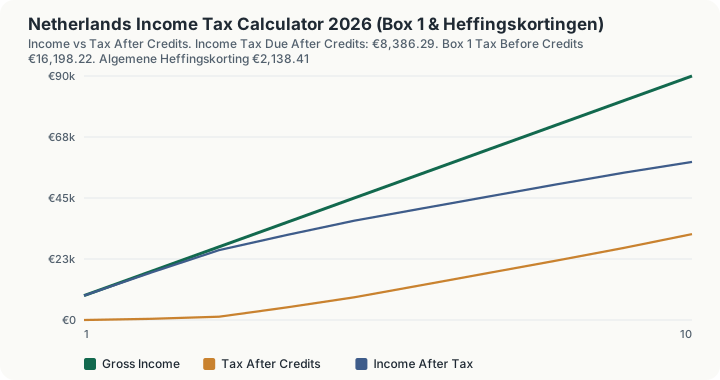
Quick Answer: A €45,000 salary attracts €8,386.29 of Dutch income tax in 2026. The box 1 charge is €16,198.22, but two credits remove €7,811.93 of it: an algemene heffingskorting of €2,138.41 and an arbeidskorting of €5,673.52. The effective rate is 18.64% after credits against 36.00% before them: roughly half the Dutch system is delivered through credits rather than rates.
What does this calculator do?
Dutch income tax looks punishing if you read only the rates. Box 1 starts at 35.75% from the first euro, with no tax-free allowance at all, and reaches 49.50% above €78,426.
Then two large credits are deducted from the tax. The algemene heffingskorting is available to everyone, and the arbeidskorting is available on income from work. Together they are worth €7,811.93 at a €45,000 salary, which turns a 36.00% headline into an 18.64% effective rate.
Both are withdrawn as income rises, and that withdrawal is what actually shapes the Dutch marginal rate curve. The arbeidskorting in particular is a four-band function that rises steeply, plateaus near €45,592, then falls, so modelling it as a flat maximum is wrong at every income except the peak.
How is this calculated?
Step 1: Box 1 tax on the whole of your income, with no allowance:
- 35.75% up to €38,883
- 37.56% from €38,883 to €78,426
- 49.50% above €78,426
Step 2: Algemene heffingskorting. €3,115 in full, withdrawn at 6.398% of income above €29,736, reaching nil at €78,426:
AHK = max(0, 3,115 − 0.06398 × max(0, Income − 29,736))
Step 3: Arbeidskorting, on income from work only, across four bands:
- up to €11,965: 8.324% of income
- to €25,845: €996 + 31.009% of the excess over €11,965
- to €45,592: €5,300 + 1.950% of the excess over €25,845
- to €132,920: €5,685 − 6.510% of the excess over €45,592
- above €132,920: nil
Step 4: Deduct the credits. They are non-refundable, so they can reduce the charge to zero but never below it.
Worked Example
€45,000 salary:
- Box 1: €38,883 × 35.75% = €13,900.67, plus €6,117 × 37.56% = €2,297.55 → €16,198.22
- Algemene heffingskorting: €3,115 − 6.398% × €15,264 = €2,138.41
- Arbeidskorting: €5,300 + 1.950% × €19,155 = €5,673.52
- Tax due: €16,198.22 − €7,811.93 = €8,386.29
- Income after tax: €36,613.71
- Effective rate 18.64%, against 36.00% before credits
€90,000 salary:
- Above €78,426, so the general credit is fully withdrawn and the 49.50% top rate applies
- Tax due: €31,688.11
The same €45,000 as pension income:
- Pension does not qualify for the arbeidskorting, so only the general credit applies
- Tax due: €14,059.81, some €5,673 more than the identical amount earned from work
Where the Real Marginal Rate Diverges From the Bracket Rate
Box 1 has three statutory rates, but the heffingskortingen taper as income rises, so the rate a euro of extra income actually faces is higher than the bracket table says. Both effects are in the calculator, and walking the two edges shows the size of the gap.
The first edge, at €38,883. At €38,800 of gross income the tax is €5,783.29 and the marginal rate output reads 35.75%. At €38,900 it is €5,823.80 and the marginal rate output reads 37.56%. Those €100 of income cost €40.51, which is a real marginal rate of 40.5%, not 35.75% and not 37.56%. The extra comes from the algemene heffingskorting, which falls from €2,535.09 to €2,528.69 across the same €100 as it tapers away.
The second edge, at €78,426. At €78,400 the tax is €25,192.58 with a marginal rate output of 37.56%; the algemene heffingskorting has shrunk to €1.48. At €78,500 the tax is €25,246.96, the algemene heffingskorting reaches €0.00 and the marginal rate output reads 49.50%. Those €100 cost €54.38, a real marginal rate of 54.4% as the arbeidskorting continues tapering on top of the 49.50% band.
Each additional €1,000 of gross income costs €454.66 at the baseline. Raising income from €45,000 to €46,000 moves the tax from €8,386.29 to €8,840.95, which is 45.5% of the extra euro even though the statutory band is 37.56%. That gap is the arbeidskorting tapering down from €5,673.52 to €5,658.44 while the algemene heffingskorting falls from €2,138.41 to €2,074.43.
What the credits are worth, switched off. Turn the credit selector to "no" at the €45,000 baseline and the tax rises from €8,386.29 to €16,198.22, the full box 1 charge. The credits are worth €7,811.93, and the effective rate moves from 18.64% to 36.00%. Close to half of what a Dutch taxpayer at this income keeps is delivered through credits rather than through rates.
What the arbeidskorting alone is worth. Switch the income type to pension or benefit income, which does not qualify, and the tax rises to €14,059.81 at an effective 31.24%. The arbeidskorting is therefore worth €5,673.52 at this income, and it is the single largest line in the Dutch personal tax system at a mid-range salary.
Credits are non-refundable, and the schedule shows the floor. Row 1 of the ten-row table prices €9,000 of income at €0.00 of tax. The credits computed at that income exceed the charge, and the engine clamps the excess rather than paying it out, so nothing negative ever appears.
What does this calculator not account for?
- Box 2 and box 3. Substantial shareholding income and wealth are taxed separately. The dedicated box 3 calculator covers the latter.
- The 30% ruling for qualifying incoming employees, which exempts part of salary from tax.
- AOW-age taxpayers, who face lower combined rates in the first bracket and different credit amounts. This models those below AOW age.
- Mortgage interest deduction (eigenwoningforfait and hypotheekrenteaftrek), which has its own calculator.
- Toeslagen (zorgtoeslag, huurtoeslag, kinderopvangtoeslag and kindgebonden budget) which are benefits rather than tax and are means-tested separately.
- The inkomensafhankelijke combinatiekorting and other smaller credits for specific circumstances.
- Zelfstandigenaftrek and MKB-winstvrijstelling for the self-employed, which reduce taxable profit before any of this.
- Employer social contributions, which are not deducted from your salary.
What mistakes do people make with this?
- Reading the rates without the credits. A 35.75% starting rate sounds brutal, but the credits are worth €7,811.93 at €45,000. Judging Dutch tax on rates alone overstates it by roughly half.
- Treating the arbeidskorting as a flat €5,685. It is a four-band function. At €20,000 it is €3,487.57, at €45,000 it is €5,673.52, and at €60,000 it has fallen to €4,747.04.
- Expecting a tax-free allowance. There is none. Box 1 taxes the first euro at 35.75%; the equivalent of an allowance is delivered through the general credit instead.
- Applying the arbeidskorting to pension income. It is available on income from work only, and the difference is over €5,600 at a typical income.
- Missing the credit withdrawal in the marginal rate. Between €29,736 and €78,426 the general credit is being withdrawn at 6.398% on top of the statutory rate, so the true marginal rate is meaningfully higher than the bracket suggests.
- Assuming the credits are refundable. They are not. They cannot produce a repayment beyond reducing the charge to zero.
Frequently Asked Questions
Is there a tax-free allowance in the Netherlands?
What is the arbeidskorting worth?
Why is my effective rate so much lower than the bracket rate?
Do pensioners get the arbeidskorting?
What happens above €78,426?
Are the credits refundable?
Sources
- Belastingdienst: "Voorlopige aanslag 2026: gebruikte tarieven en heffingskortingen", box 1 brackets of 35.75%, 37.56% and 49.50% at €38,883 and €78,426. belastingdienst.nl/wps/wcm/connect/nl/voorlopige-aanslag/content/voorlopige-aanslag-tarieven-en-heffingskortingen
All figures verified on 30 August 2026
Also consulted: Belastingdienst: "Tabel algemene heffingskorting 2026", maximum €3,115, withdrawal of 6.398% above €29,736, nil at €78,426; Belastingdienst: "Tabel arbeidskorting 2026", the four bands and the €5,685 maximum for those below AOW age.