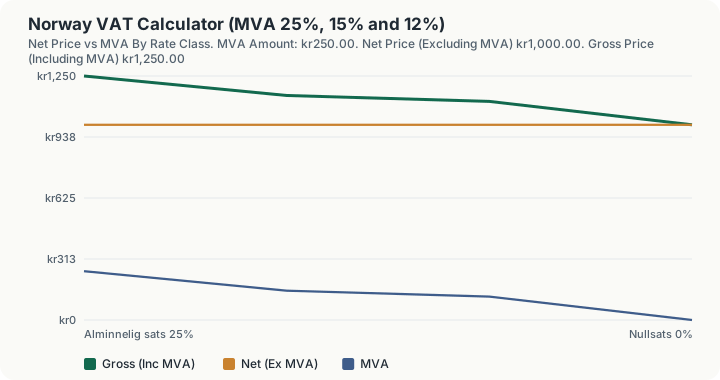
Quick Answer: Adding the alminnelig sats of 25% to a net price of 1,000 kr gives 250 kr of MVA and a gross price of 1,250 kr. Note the asymmetry that catches people out: MVA is 25% of the net price but only 20.0000% of the gross price, so a 1,000 kr price that already includes MVA contains 200 kr of tax, not 250 kr.
What does this calculator do?
Norwegian merverdiavgift (MVA) has one standard rate and two reduced rates, and the two reduced rates are the wrong way round compared with most of Europe. Food sits at the higher reduced rate of 15%, while passenger transport, hotel rooms, cinema tickets and sporting events sit at the lower one of 12%. Getting a supply into the wrong class is not a rounding error: on a 1,000 kr net price it is worth 100 kr between the standard rate and the food rate, and 130 kr between the standard rate and the transport rate.
The calculator does two things. It converts between net and gross at any of the four rate classes, in either direction, and it checks a rolling-12-month turnover figure against the 50,000 kr registration threshold.
The direction matters more than it looks. Adding MVA multiplies the net price by the rate. Removing MVA cannot simply multiply the gross price by the rate, because the tax is a fraction of a total that already contains it. The correct operation is the VAT fraction, r / (1 + r). At 25% that fraction is exactly one fifth, which is why Norwegian standard-rated prices are unusually easy to work backwards from: the tax is always a fifth of what the customer pays.
How is this calculated?
Adding MVA to a net price:
MVA = N × r; Gross = N × (1 + r)
Removing MVA from a gross price:
MVA = G × r/(1 + r); Net = G − MVA
The rate $r$ is taken from a fixed table: 0.25 standard, 0.15 for naeringsmidler and vann- og avlopstjenester, 0.12 for persontransport and overnatting, and 0 for nullsats supplies.
Step 1: Read the rate for the class you selected.
Step 2: Apply the add or the remove formula above, depending on the direction.
Step 3: Compute the share of the gross price. This is r / (1 + r) reported as a percentage, and it is the number you need when working backwards from a till receipt.
Step 4: Re-price the same net amount at all four rate classes. The comparison table always starts from the net figure, whether you supplied it directly or the calculator derived it by removing MVA from a gross price.
Step 5: Compute the two class gaps. The gross price at 25% minus the gross price at 15%, and the gross price at 25% minus the gross price at 12%, on that same net amount.
Step 6: Test the turnover figure against the threshold. Registration in the Merverdiavgiftsregisteret is compulsory once rolling-12-month taxable turnover exceeds 50,000 kr. The comparison is strict, so exactly 50,000 kr does not trigger it. Leave the field at zero and the calculator reports the check as not assessed rather than guessing.
Worked Example
A net price of 1,000 kr, standard rated, adding MVA.
Step 1: Take the standard rate. Alminnelig sats = 25%
Step 2: Compute the MVA. 1,000 x 0.25 = 250 kr
Step 3: Compute the gross price. 1,000 + 250 = 1,250 kr
Step 4: Express the MVA as a share of that gross price. 250 / 1,250 = 20.0000%
Step 5: Price the same 1,000 kr net as foodstuffs at 15%. 1,000 x 1.15 = 1,150 kr gross
Step 6: The standard-versus-food gap. 1,250 - 1,150 = 100 kr
Step 7: Price the same 1,000 kr net as transport or accommodation at 12%. 1,000 x 1.12 = 1,120 kr gross
Step 8: The standard-versus-transport gap. 1,250 - 1,120 = 130 kr
Now run the same figure the other way. A gross price of 1,000 kr, standard rated, removing MVA.
Step 9: Apply the VAT fraction. 1,000 x 0.25 / 1.25 = 200 kr of MVA
Step 10: Back out the net price. 1,000 - 200 = 800 kr
The 250 kr and the 200 kr are both correct answers to different questions, and confusing them is the single most common MVA arithmetic error.
What does this calculator not account for?
Skatteetaten's English-language pages have served stale figures. The 2026 personal-tax rate pages at skatteetaten.no/en were verified as still showing 2025 values while the Norwegian pages with an explicit year selection showed 2026 ones. The MVA rates here were read off both language editions of the satser page and agreed, but treat the English site as the less current of the two: if a figure differs, check the Norwegian page before concluding this calculator is wrong.
The calculator applies the rate you choose; it does not decide which rate is correct. Classification is the hard part of Norwegian MVA and none of it is modelled. Food served for consumption on the premises is standard rated while the same food sold to take away is not, and this calculator cannot tell the two apart.
Nullsats eligibility is not modelled. The 0% class is selectable, but nothing here tests whether an export, a newspaper or an electric vehicle actually qualifies, or applies the statutory value limit on zero-rated EV sales.
The 11.11% rate sometimes quoted for the first-hand sale of raw fish is deliberately absent. It does not appear on Skatteetaten's own 2026 satser table in either language edition, and the underlying module carries no figure it cannot quote from a primary source.
The registration check tests one number against one threshold. It does not know your entity structure (one threshold applies per VAT subject), does not handle the separate rules for charities and public bodies, does not model forhandsregistrering (advance registration), and does not track when in the twelve months you crossed the line.
Nothing about returns, input MVA or payment. There is no netting of input against output tax, no reporting periods, no due dates and no penalties.
What mistakes do people make with this?
Multiplying a gross price by 25% to find the MVA inside it. That overstates the tax by 25%. Use the fraction: 1,000 kr gross contains 200 kr, not 250 kr.
Assuming food gets the lowest rate. In Norway it does not. Groceries are 15% while a hotel night or a bus ticket is 12%.
Forgetting that water and wastewater services share the food rate. Vann- og avlopstjenester sit at 15%, not at the standard rate.
Reading the threshold as a calendar-year test. It is any rolling twelve-month window. A business that stays under 50,000 kr in each calendar year can still cross the threshold in a twelve-month period spanning a year end.
Thinking the invoice that crosses the threshold is still outside the system. Liability arises from the moment turnover passes 50,000 kr, so that invoice is itself inside the MVA system.
Treating the threshold as a per-activity allowance. It applies per legal entity, not per side project.
Frequently Asked Questions
How much MVA is on 1,000 kr in Norway?
Why is MVA 20% of the gross price when the rate is 25%?
What is Norway's VAT rate on food?
What rate applies to hotels and transport?
When must I register for MVA in Norway?
Can I just charge 15% because I sell food online?
Sources
- Skatteetaten, merverdiavgiftssatser (Norwegian edition): skatteetaten.no/satser/merverdiavgift
- Skatteetaten, value added tax rates (English edition): skatteetaten.no/en/rates/value-added-tax
- Skatteetaten, register, change or delete in the Value Added Tax Register (50,000 kr rolling-12-month threshold): skatteetaten.no/en/business-and-organisation/vat-and-duties/vat/register-change-delete