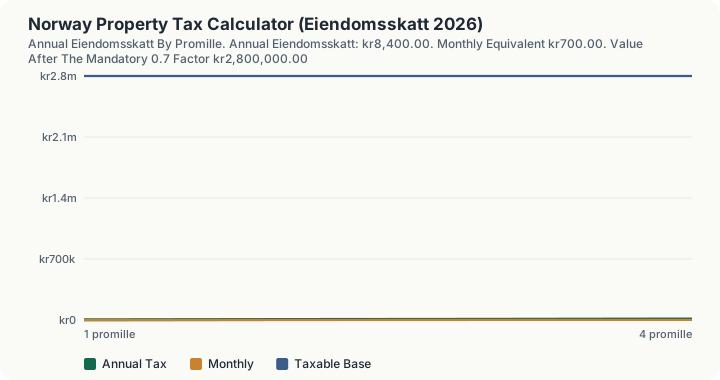
Quick Answer: A home with a boligverdi of 4,000,000 kr in a municipality levying 3 promille pays 8,400 kr a year of eiendomsskatt, or 700 kr a month. The statutory 0.7 factor in eigedomsskattelova section 8 A-2 cuts the tax base to 2,800,000 kr first, so a "3 promille rate" is really 0.2100% of the property's value. Both the rate and the bunnfradrag are municipal decisions with no national default, and a large minority of municipalities levy no property tax at all.
What does this calculator do?
The single most important fact about Norwegian property tax is that there is no national rate and no national obligation. Eigedomsskattelova section 2 leaves it to each kommunestyre: "Kommunestyret avgjer om det skal skrivast ut eigedomsskatt i kommunen." Many municipalities vote no. Any calculator that presents one municipality's promille as "the Norwegian property tax rate" is wrong by construction, which is why the rate here is a user input with no defensible default and why the correct answer in a great many municipalities is zero.
What is national is the tax base. Section 8 A-2 states that "Skattegrunnlaget for bustader og fritidsbustader vert sett til verdet multiplisert med 0,7." The tax base for dwellings and holiday homes is 70% of the assessed value, mandatory and nationwide, not a municipal choice. Commercial and industrial property does not get it and is taxed on the full takst.
That factor is why the headline promille misleads. Three promille sounds like 0.3% of your house. It is 0.3% of 70% of your house, which is 0.21%. This calculator reports both figures so the gap is visible.
The statutory bounds are section 11: 1 to 7 promille generally, and no more than 4 promille on bustader and fritidsbustader. Rates above the ceiling for the property type are clamped here and flagged, rather than computing a tax no municipality could lawfully levy.
How is this calculated?
base = max(0, V × f × (1 − ℓ) − B); tax = base × p/1000
where $V$ is the assessed value, $f$ is 0.7 for dwellings and holiday homes and 1 for other property, ℓ is any additional municipal reduction, $B$ is the bunnfradrag and $p$ is the promille.
Step 1: Take the assessed value. This is the full estimated market value the municipality assesses on: either its own takst, or the boligverdi Skatteetaten calculates under skatteloven section 4-10.
Step 2: Clamp the rate to the statutory ceiling for the property type: 4 promille for bustader and fritidsbustader, 7 promille for everything else. The result flags when the clamp bit.
Step 3: Apply the mandatory 0.7 factor, but only to dwellings and holiday homes. Commercial and other property is taxed on the full value.
Step 4: Apply any additional municipal reduction factor to the figure from step 3. This is purely local, with no statutory value.
Step 5: Deduct the bunnfradrag, capped at the reduced value. A bunnfradrag larger than the base produces a zero bill, never a refund.
Step 6: Apply the promille by multiplying the base by the rate and dividing by 1,000.
Step 7: Divide by twelve for the monthly equivalent, though most municipalities bill in two to four instalments rather than monthly.
Step 8: Express the tax as a share of the full assessed value, which is the figure people actually compare across countries.
Step 9: Recompute without the bunnfradrag to isolate what it is worth.
The section 13 phase-in limits are reported alongside as information and are not applied to the computed tax. The rate you enter is the rate resolved for the year in question, not a starting rate to be phased in.
Worked Example
A home with a boligverdi of 4,000,000 kr in a municipality levying 3 promille, no bunnfradrag, no additional local reduction.
Step 1: Assessed value. 4,000,000 kr
Step 2: Statutory ceiling check. 3 promille is at or below the 4 promille residential ceiling in section 11, so it stands: 3 promille
Step 3: Apply the mandatory 0.7 factor. 4,000,000 kr x 0.7 = 2,800,000 kr
Step 4: Additional municipal reduction. None entered: 0 kr
Step 5: Bunnfradrag. None granted: 0 kr
Step 6: Taxable base (skattegrunnlag). 2,800,000 kr - 0 kr - 0 kr = 2,800,000 kr
Step 7: Annual eiendomsskatt. 2,800,000 kr x 3 / 1,000 = 8,400 kr
Step 8: Monthly equivalent. 8,400 kr / 12 = 700 kr
Step 9: Effective rate on the full property value. 8,400 kr / 4,000,000 kr = 0.2100%
Step 9 is the number to carry away. The municipality voted 3 promille. The property owner pays 2.1 promille of what the house is actually worth, because 30% of the value never enters the base.
Step 10: The same property at the 4 promille residential ceiling. 2,800,000 kr x 4 / 1,000 = 11,200 kr
Step 11: The same property with a 500,000 kr bunnfradrag at 3 promille. 2,800,000 kr - 500,000 kr = 2,300,000 kr of base 2,300,000 kr x 3 / 1,000 = 6,900 kr The bunnfradrag is worth 1,500 kr a year here, and it is worth exactly 1,500 kr to every home in the municipality regardless of value, which is what makes it steeply progressive in effect.
Step 12: The same valuation as commercial property at 6 promille. No 0.7 factor applies, so the base is the full 4,000,000 kr 4,000,000 kr x 6 / 1,000 = 24,000 kr
Step 13: A municipality that levies nothing. 0 promille on any base: 0 kr
What does this calculator not account for?
- No rate is supplied and none could be. Section 2 makes the levy optional per municipality, and section 11 gives only bounds. You must look up your kommune's current-year budget vedtak. Enter 0 if it levies none.
- The bunnfradrag has no statutory amount at all. Section 11 permits the kommunestyre to grant one per self-contained dwelling unit and sets no figure. Many municipalities grant none.
- The additional municipal reduction factor is likewise purely local. Leave it at zero unless your municipality publishes one.
- The section 13 phase-in is informational only. A municipality introducing eiendomsskatt may charge at most 1 promille in the first year and raise it by at most 1 promille a year (3 for bare land; 2 in a year it introduces a bunnfradrag). This calculator reports the fastest lawful path to the ceiling and does not apply it to your figure.
- Multiple dwelling units are not modelled. The bunnfradrag is granted per self-contained bustaddel, so a duplex or a house with an approved separate unit may receive more than one. This page applies a single deduction.
- Valuation disputes are outside scope. Whether your boligverdi or municipal takst is correct is a matter for the municipality's own appeal process, and this calculator takes the number you give it.
- Sections 7 and 5 exemptions are not tested. Municipalities may exempt newly built homes, historic buildings, and property belonging to charitable institutions, and certain property is exempt by law.
- Only the property tax is computed. Formuesskatt (wealth tax), documentavgift on transfer, and income tax on letting are all separate and absent.
- A single tax year, single property. No indexation, no revaluation cycle and no arrears.
What mistakes do people make with this?
Entering the formuesverdi instead of the boligverdi. This is the most damaging error available on this page. For a primary home the formuesverdi shown on your wealth-tax return is only about 25% of the boligverdi. Using it here understates the tax by roughly a factor of four. Section 8 C-1 values on the calculated market value under skatteloven section 4-10, not on the wealth-tax figure derived from it.
Reading the promille as a percentage of your home's value. It is a percentage of 70% of it. Three promille is 0.21%, not 0.3%.
Assuming your municipality levies the tax. A large minority do not. Section 2 makes it a local decision taken annually, and the honest answer where the kommunestyre has voted no is zero.
Applying the 0.7 factor to commercial property. Section 8 A-2 confines it to "bustader og fritidsbustader". Applying it to a shop or a warehouse understates the tax by 30%, and the calculator will not do it: select the commercial property type and the full takst is used, with a 7 promille ceiling instead of 4.
Entering a rate above the ceiling. More than 4 promille on a home is unlawful under section 11. The calculator clamps it and says so rather than computing a figure no municipality could levy.
Expecting a large bunnfradrag to produce a refund. It is capped at the reduced value. The bill floors at zero.
Using last year's rate. The kommunestyre votes annually, and rates move. Check the current budget vedtak.
Frequently Asked Questions
What is the property tax rate in Norway?
Why is 3 promille only 0.21% of my home's value?
Which value do I enter?
What is a bunnfradrag worth?
Is the tax higher on a holiday home?
My municipality just introduced the tax. Can it charge 4 promille immediately?
Sources
- Lov om eigedomsskatt til kommunane (eigedomsskattelova), LOV-1975-06-06-29, read on lovdata.no 2026-08-31: lovdata.no/dokument/NL/lov/1975-06-06-29
- Norwegian Tax Administration (Skatteetaten), the official authority for the national tax authority this calculator relates to. skatteetaten.no
Also consulted: Section 2, "Kommunestyret avgjer om det skal skrivast ut eigedomsskatt i kommunen": the levy is optional, municipality by municipality; Section 8 A-2, "Skattegrunnlaget for bustader og fritidsbustader vert sett til verdet multiplisert med 0,7": the mandatory 30% haircut, confined to dwellings and holiday homes; Section 8 C-1, valuation from the wealth-tax formuesgrunnlag, which most municipalities now use for ordinary housing rather than a local takst, applying the same 0.7 factor. The base under 8 C-1 is the calculated market value (the boligverdi under skatteloven section 4-10), not the formuesverdi on the wealth-tax return; Section 11: "Eigedomsskatten skal vera minst kr 1 og ikkje meir enn kr 7 for kvar kr 1 000 av takstverdet. For bustader og fritidsbustader kan eigedomsskatten likevel ikkje vera meir enn kr 4 for kvar kr 1 000 av takstverdet." Also the power to set a botnfradrag "for alle sjolvstendige bustaddelar", with no statutory amount; Section 13: 1 promille in the first year, then at most 1 promille a year of increase; Skatteloven section 4-10, the boligverdi calculation, referenced by section 8 C-1.
Full quoted provisions are recorded in engine/primitives/norway-property-tax.ts. Because the Act sets no rate and no bunnfradrag, both are user inputs on this page, and no national default is asserted anywhere in the code.