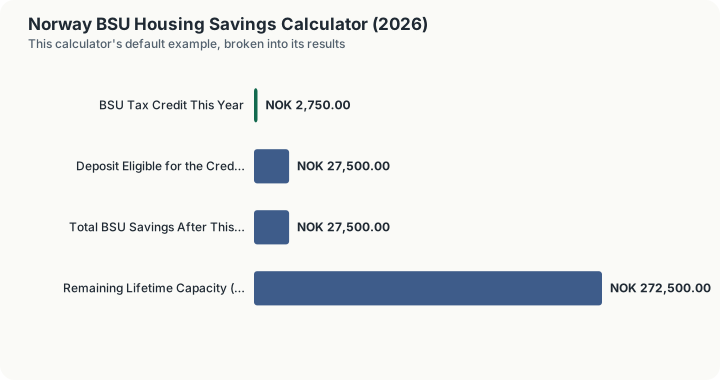
Quick Answer: A 22-year-old depositing the maximum NOK 27,500 into a BSU account this year, with no prior BSU savings, is eligible for a NOK 2,750 tax credit (10% of the deposit) and has NOK 272,500 of remaining lifetime BSU capacity, out of the NOK 300,000 total cap.
Overview
BSU (Boligsparing for ungdom -- "housing savings for young people") is a Norwegian tax-advantaged savings scheme designed to help people under 34 build a deposit for their first home. It works differently from a typical tax-advantaged account: rather than tax-free growth or a deduction against income, BSU gives savers a direct tax credit -- a krone-for-krone reduction in tax owed, not just taxable income -- equal to 10% of the amount deposited each year, up to an annual deposit cap, and only up to a lifetime total savings cap.
The mechanic that trips people up is that BSU has two independent caps working at once: an annual deposit cap (how much you can contribute -- and therefore how much credit you can earn -- in any single year) and a separate lifetime savings cap (the total balance across all years combined, after which no further deposits earn any credit at all, even if you're well under the annual limit). This calculator applies both caps correctly, whichever binds first, and also enforces the age cutoff that ends BSU eligibility for the tax credit.
How This Is Calculated
- Check age eligibility. BSU deposits qualify for the tax credit only through the year the saver turns 33. From the year they turn 34, no further deposits earn the credit.
- Determine remaining lifetime capacity. Subtract whatever has already been saved in the account from the NOK 300,000 lifetime cap.
- Cap the eligible deposit at the lesser of three figures: the amount you actually plan to deposit, the NOK 27,500 annual deposit cap, and whatever lifetime capacity remains.
- Apply the 10% tax credit to the eligible deposit only. Any portion of a planned deposit above whichever cap binds first earns no additional credit (though it may still be deposited into the account, subject to the bank's own terms, if a lifetime-cap approach allows it).
Worked Example
Using the calculator's default inputs -- a planned NOK 27,500 deposit, no prior BSU savings, and an age of 22:
- Age check: 22 is well under the age-33 cutoff -- eligible
- Remaining lifetime capacity: 300,000 - 0 = NOK 300,000
- Eligible deposit: min(27,500, 27,500, 300,000) = NOK 27,500 (the annual cap and the planned deposit coincide exactly here)
- Tax credit: 10% x 27,500 = NOK 2,750
- New total saved: 0 + 27,500 = NOK 27,500
- Remaining lifetime capacity after: 300,000 - 27,500 = NOK 272,500 (about 10 more years of maximum deposits to reach the lifetime cap)
Now consider a saver who is 25 years old, has already saved NOK 285,000, and plans to deposit NOK 30,000 this year. Remaining lifetime capacity is only 300,000 - 285,000 = NOK 15,000 -- lower than both the planned deposit and the NOK 27,500 annual cap. The eligible deposit is capped at NOK 15,000, earning a credit of just NOK 1,500 (not the NOK 2,750 a full annual deposit would otherwise earn), and the account reaches its NOK 300,000 lifetime cap this year -- no further BSU deposits will earn any credit afterward, regardless of age.
What This Does Not Account For
- The requirement that you not own any home (in whole or in part, primary or secondary) to claim the tax credit. This calculator computes the mechanical credit and cap arithmetic; it does not check or enforce the underlying home-ownership eligibility rule, which is a hard disqualifier regardless of the numbers.
- The requirement to have paid enough total tax to actually use the credit. A BSU tax credit reduces tax owed, but if your total tax liability for the year is lower than the calculated credit, you cannot receive more credit than you owe in tax -- a genuine constraint for very low-income savers that this calculator does not check against your other income.
- Interest earned on the BSU account itself, which is separately taxable as ordinary capital income (part of alminnelig inntekt) like any other bank interest, and is not part of the tax-credit mechanic modeled here.
- What happens to the account after the lifetime cap is reached, or after the saver turns 34. Savings can typically remain in the account and continue earning interest, but no further BSU-eligible deposits (i.e., ones earning the tax credit) can be made past either cap.
- Using BSU funds for anything other than a qualifying home purchase. Norway's rules require BSU savings to go toward buying or building a home (or in some cases home improvement); withdrawing for other purposes can trigger repayment of credits already received. This calculator does not model withdrawal or claw-back scenarios.
- Contract-specific terms from individual banks (interest rates, account fees, or minimum balance rules), which vary by provider and are not part of the statutory tax-credit calculation.
Common Pitfalls
- Assuming the tax credit is 20% of the deposit. It was 20% before 1 January 2023; the rate was halved to 10% starting with the 2023 income year and remains 10% for 2026. Using an old 20% figure roughly doubles the expected credit and is one of the most common outdated assumptions.
- Confusing the annual deposit cap with the lifetime savings cap. NOK 27,500 is how much you can deposit (and earn credit on) in a single year; NOK 300,000 is the total account balance across all years combined. Depositing the maximum every year for over a decade is what it actually takes to reach the lifetime cap.
- Not noticing the lifetime cap can bind before the annual cap. As this calculator's "near the lifetime cap" scenario shows, a saver close to NOK 300,000 total can only add a partial deposit and get a proportionally smaller credit that year, even though NOK 27,500 would otherwise be available.
- Assuming you can keep contributing indefinitely regardless of age. The credit stops after the year you turn 33 -- there is no partial-year proration or grace period once that year has passed.
- Forgetting that owning any home at all disqualifies you from the credit, even a small inherited share of a property, even if you've never lived in it -- a rule with real practical bite for young people who've inherited partial property interests.
Frequently Asked Questions
How much is the BSU tax credit in 2026?
What's the difference between the annual cap and the lifetime cap?
Until what age can I use BSU?
Can I still get the tax credit if I already own a home?
Was the BSU credit always 10%?
What happens if I deposit more than NOK 27,500 in a year?
Sources
- Skatteetaten (Norwegian Tax Administration), Skatte-ABC handbook, "B-19 Boligsparing for ungdom (BSU)" (skatteetaten.no/en/rettskilder/type/handboker/skatte-abc/2025/b-19-boligsparing-for-ungdom-bsu/) -- confirms the 10% credit rate and the age-33/34 cutoff. skatteetaten.no
Also consulted: Forbrukerrådet (Norwegian Consumer Council) via ung.no -- confirms the NOK 27,500 annual deposit cap, the NOK 300,000 lifetime cap, and the 20%-to-10% credit-rate reduction effective the 2023 income year.