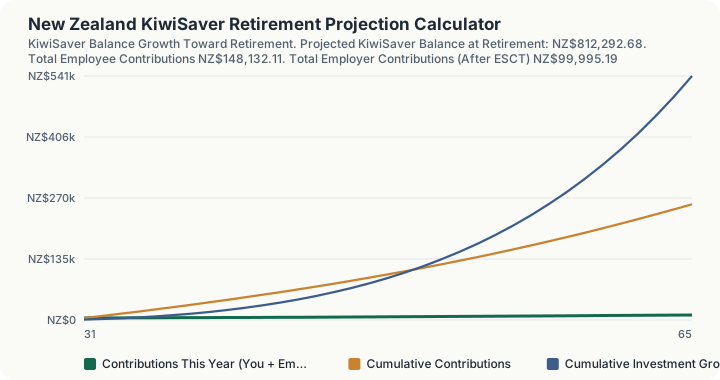
Quick Answer: For a 30-year-old New Zealander earning NZ$70,000 today, growing salary 3% a year, contributing the current 3.5% default KiwiSaver rate (matched by a 3.5% employer contribution) with a NZ$15,000 starting balance and a 6% assumed annual return, the KiwiSaver account projects to roughly NZ$812,292.68 by age 65 -- built from about NZ$148,132.11 of your own contributions, NZ$99,995.19 of net employer contributions (after tax), NZ$8,343.04 of Government contributions, and around NZ$540,822.34 of compounded investment growth.
Overview
This calculator is built specifically for New Zealand's KiwiSaver retirement savings scheme and reports every figure in New Zealand dollars (NZ$). It is not a US 401(k), UK pension, or Australian superannuation calculator -- it models KiwiSaver's specific three-way funding structure: your own contribution, your employer's matching contribution (reduced by Employer Superannuation Contribution Tax, ESCT, before it reaches your account), and the Government's annual "member tax credit," which is unique to KiwiSaver among comparable retirement schemes worldwide.
Where many retirement calculators just compound "contributions plus growth," this one keeps each funding source separate so you can see exactly where a KiwiSaver balance actually comes from -- including the two pieces most calculators skip entirely: the ESCT tax bite on the employer's side, and the annually capped, income-tested Government contribution.
How This Is Calculated
Step 1 -- employee contribution. Every year, your KiwiSaver deduction is your chosen contribution rate (3.5%, 4%, 6%, 8%, or 10% of gross pay -- 3.5% is the current default minimum, effective 1 April 2026) applied to that year's projected salary, which itself grows at your assumed annual salary growth rate.
Step 2 -- employer contribution, net of ESCT. Your employer contributes at least 3.5% of your gross salary (the current statutory minimum). Before this reaches your account, it is taxed via Employer Superannuation Contribution Tax (ESCT) at a flat rate determined by your total remuneration band (salary plus the employer contribution itself). The ESCT bands are set out in Inland Revenue's IR340 deduction tables and are NOT the personal income tax thresholds: IRD grosses them up to $18,720, $64,200, $93,720 and $216,000 so that an employer contribution is not taxed more heavily than the employee's own pay. A higher salary means a higher ESCT rate on the employer's contribution, not just a higher personal tax rate on your own pay.
Step 3 -- Government contribution ("member tax credit"). For every dollar you personally contribute in the relevant contribution year, the Government adds 25 cents, up to a maximum of NZ$260.72 a year (meaning you need to contribute at least NZ$1,042.88 yourself to receive the full match). Members with taxable income of NZ$180,000 or more receive no Government contribution at all -- it is a hard income test, not a gradual phase-out.
Step 4 -- compounding. Each year's total deposit (employee + net employer + Government contribution) is added to the running balance, which then compounds at your assumed annual investment return for the following year -- consistent with how this platform models other multi-decade contribution-and-growth accounts (e.g. the Solo 401(k) and India EPF calculators).
Step 5 -- projection to your target age. The projection runs from your current age to your chosen retirement age (KiwiSaver funds are generally accessible from age 65, when NZ Superannuation eligibility also begins), one year at a time, with salary, contributions, ESCT, and the Government contribution all recalculated each year as salary grows.
Worked Example
Consider Mere, age 30, earning NZ$70,000 today, expecting 3% annual salary growth, contributing the 3.5% KiwiSaver default (matched at 3.5% by her employer), starting with a NZ$15,000 balance, assuming a 6% average annual return, and continuing to age 65 (35 years).
Year 1: Employee contribution = NZ$70,000 × 3.5% = NZ$2,450. Employer gross contribution = NZ$2,450. ESCT base (salary + employer contribution) = NZ$72,450, which falls in the 30% band, so ESCT = NZ$2,450 × 30% = NZ$735.00, leaving a net employer contribution of NZ$1,715.00. Government contribution: 25% of her NZ$2,450 employee contribution = NZ$612.50, capped at NZ$260.72 -- so she receives the full annual maximum. Total year-1 deposit: NZ$2,450 + NZ$1,715.00 + NZ$260.72 = NZ$4,425.72, added to her NZ$15,000 opening balance and compounded at 6% for the following year.
Over 35 years, as salary rises 3% annually (increasing both the employee and net employer contributions each year, while the Government contribution stays capped at NZ$260.72 once her own contribution exceeds NZ$1,042.88, which happens almost immediately), the account compounds to approximately NZ$812,292.68 by age 65 -- comprising roughly NZ$148,132.11 of her own contributions, NZ$99,995.19 of net employer contributions, NZ$8,343.04 of Government contributions, and about NZ$540,822.34 of investment growth.
Carrying Into Year Two
Step 1 -- Opening balance for year two. NZ$15,000.00 opening balance plus the NZ$4,425.72 year-one deposit and NZ$900.00 of first-year growth = NZ$20,325.72
Step 2 -- Year two deposit, after a 3% pay rise. Salary moves to NZ$72,100, and the total deposit becomes NZ$4,550.67 -- NZ$124.95 more than year one, all of it from the pay rise, because the Government contribution is already pinned at its NZ$260.72 maximum.
Step 3 -- Contributions accumulated after two years. NZ$4,425.72 + NZ$4,550.67 = NZ$8,976.39
Step 4 -- Closing balance at age 32. NZ$26,095.93, of which NZ$2,119.54 is investment growth.
Step 5 -- The year the market out-contributes the household. At age 42 the fund earns NZ$6,172.30 in that single year against a deposit of NZ$5,924.31. That is the first year growth exceeds everything Mere, her employer and the Government put in combined, and it happens on a balance of NZ$114,968.19.
Step 6 -- Where it lands at 65. NZ$812,292.68, from NZ$256,470.34 of lifetime contributions and NZ$540,822.34 of growth.
Two thirds of the final balance is money nobody deposited. The twelve years before age 42 are the ones that buy that, which is why the deposit rate matters far more in your thirties than in your fifties.
What This Does Not Account For
- The Government contribution's own "contribution year." The member tax credit is assessed on a 1 July - 30 June cycle, not the 1 April - 31 March tax year used for PAYE and income tax. This calculator applies the rule on a simple annualized basis rather than modeling the misaligned cycle exactly, which is a reasonable approximation for a multi-year projection but not precise for a single transition year.
- Fund type and fees. Actual returns depend heavily on which KiwiSaver fund type you're in (Conservative, Balanced, Growth, Aggressive) and the provider's fees, both of which vary significantly and are not modeled here beyond the single annual return rate you enter.
- Withdrawals before retirement. First-home withdrawals, significant financial hardship withdrawals, and permanent emigration withdrawals are not modeled; this projects one continuous, uninterrupted account to your chosen retirement age.
- Employment gaps and self-employment. Periods without an employer (unemployment, self-employment, overseas work, parental leave without contributions) are not modeled -- the projection assumes continuous salaried employment and continuous contributions at the stated rates every year.
- Temporary contribution rate reductions and contribution holidays. Members can apply to temporarily reduce their rate to 3% for 3-12 months; this is not modeled, and the calculator assumes your selected rate applies for the entire projection.
- Tax on investment returns (PIE tax). KiwiSaver funds are Portfolio Investment Entities (PIEs) and investment returns are taxed within the fund at your Prescribed Investor Rate before being reflected in unit prices; this calculator's assumed annual return rate should be read as an after-PIE-tax return, consistent with how KiwiSaver balances are actually reported to members.
Common Pitfalls
- Assuming the employer's contribution is dollar-for-dollar with yours. ESCT quietly reduces the employer's contribution before it reaches your account -- a higher-earning member can lose a third or more of their employer's nominal contribution to ESCT.
- Overestimating the Government contribution at higher incomes. Some assume the 25-cents-per-dollar match scales with income; it is capped at NZ$260.72 regardless of income (as long as you're under the income test), and vanishes completely at NZ$180,000+ taxable income rather than tapering off.
- Confusing the 3.5% "default" with a ceiling. 3.5% is the current default and statutory minimum, not a cap -- members can choose 4%, 6%, 8%, or 10% instead, meaningfully changing the projected balance shown here.
- Forgetting the scheduled rate increases. Both the employee default and employer minimum are legislated to rise again, to 4%, from 1 April 2028 -- a projection built entirely on today's 3.5% may understate a real future balance if that increase isn't accounted for separately.
- Ignoring fund type risk and return variability. A single assumed annual return rate is a simplification; real KiwiSaver returns vary year to year and by fund type, and a Conservative fund's realistic long-run return differs substantially from a Growth or Aggressive fund's.
Frequently Asked Questions
What is the current default KiwiSaver contribution rate?
How much is the Government KiwiSaver contribution?
Why is my employer's contribution smaller than 3.5% of my salary when it hits my account?
At what age can I access my KiwiSaver savings?
Does this calculator account for KiwiSaver fund fees?
Can self-employed people get the Government KiwiSaver contribution?
Sources
- Inland Revenue (IRD), "KiwiSaver changes" (ird.govt.nz/kiwisaver-changes) -- 2026 and 2028 contribution rate schedule, Government contribution rate/cap/income test effective 1 July 2025. ird.govt.nz
Also consulted: Inland Revenue (IRD), "What rate do you need to contribute" (employee contributions section, ird.govt.nz/kiwisaver) -- employee contribution rate options (3.5%/4%/6%/8%/10%); Inland Revenue (IRD), "Employer superannuation contribution tax (ESCT)" -- ESCT mechanics; Inland Revenue (IRD), "IR340 -- Weekly and fortnightly PAYE deduction tables", April 2026 edition (tax year 1 April 2026 to 31 March 2027), page 4 -- the ESCT rate table: $0-$18,720 at 10.5%, $18,721-$64,200 at 17.5%, $64,201-$93,720 at 30%, $93,721-$216,000 at 33%, $216,001 upwards at 39%. Verified 31 August 2026.