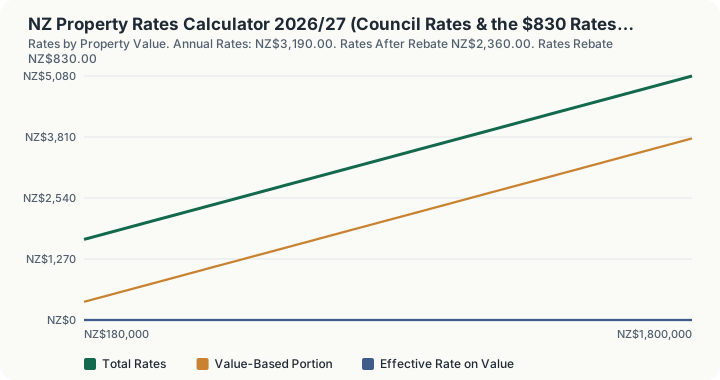
Quick Answer: A NZ$900,000 rating valuation, rated at 0.0021 in the dollar with a NZ$500 Uniform Annual General Charge and NZ$800 of targeted rates, produces NZ$3,190.00 a year, payable as four quarterly instalments of NZ$797.50. That is 0.3544% of the valuation, and 40.75% of it is fixed charges. A household on NZ$40,000 with one dependant qualifies for the full NZ$830 rates rebate.
What does this calculator do?
New Zealand does not tax property the way most countries do. There is no national land tax, no stamp duty on a house purchase, and no general capital gains tax. The only recurring charge on owning a home is the local authority rate, levied under the Local Government (Rating) Act 2002 by each of the country's 78 territorial and regional authorities.
That single fact makes a "New Zealand property tax rate" impossible to quote nationally. Every council sets its own rate in the dollar and its own fixed charges in its annual plan, and the two move independently. Two houses with identical rating valuations in different districts routinely pay bills that differ by a factor of two.
This calculator therefore takes the council's settings as inputs and does what a single percentage cannot: it separates the value-based portion of the bill from the fixed portion, reports the effective rate you actually pay on your rating valuation, and applies the national rates rebate on top. It also shows the same council settings across a ladder of property values, so the regressivity built into fixed charges is visible as a falling percentage rather than merely asserted.
How is this calculated?
The bill is the sum of three statutory components, and the rebate is a separate national calculation applied to the total.
Rates = (V × r) + UAGC + Targeted
Rebate = min(M, max(0, 2/3(Rates − E) − (I − T)/8))
where $V$ is the rating valuation, $r$ the general rate in the dollar, $E$ the rates excess, $I$ household income, $T$ the income threshold and $M$ the maximum rebate.
Step 1: Apply the general rate in the dollar to the rating valuation. NZ$900,000 x 0.0021 = NZ$1,890.00
Step 2: Add the Uniform Annual General Charge, a flat amount per rating unit. NZ$1,890.00 + NZ$500.00 = NZ$2,390.00
Step 3: Add the targeted rates. NZ$2,390.00 + NZ$800.00 = NZ$3,190.00
Step 4: Divide by four for the quarterly instalment. NZ$3,190.00 / 4 = NZ$797.50
Step 5: Express the whole bill as a percentage of the rating valuation. NZ$3,190.00 / NZ$900,000 = 0.3544%
Step 6: Measure the share of the bill that does not scale with value. (NZ$500.00 + NZ$800.00) / NZ$3,190.00 = 40.75%
Step 7: Take two-thirds of the rates above the excess. (NZ$3,190.00 - NZ$160.00) x 2/3 = NZ$2,020.00
Step 8: Set the income threshold: base threshold plus the per-dependant increase. NZ$33,210 + (1 x NZ$500) = NZ$33,710
Step 9: Abate by $1 for every $8 of income above the threshold, then drop the cents. The abatement is floored to whole dollars before it is subtracted; the rebate itself keeps its cents. floor((NZ$40,000 - NZ$33,710) / 8) = floor(NZ$786.25) = NZ$786.00
Step 10: Subtract the abatement from the pre-abatement entitlement. NZ$2,020.00 - NZ$786.00 = NZ$1,234.00
Step 11: Cap at the maximum rebate. min(NZ$1,234.00, NZ$830.00) = NZ$830.00
Step 12: Deduct the rebate from the bill. NZ$3,190.00 - NZ$830.00 = NZ$2,360.00
The engine also reports the income at which the rebate disappears entirely, computed as the threshold plus eight times the pre-abatement entitlement: NZ$33,710 + (NZ$2,020.00 x 8) = NZ$49,870.00.
Worked Example
Take the same district, but a modest NZ$450,000 home rather than the NZ$900,000 one, with every council setting unchanged.
Step 1: Value-based general rate. NZ$450,000 x 0.0021 = NZ$945.00
Step 2: Add the fixed charges, which do not change at all. NZ$945.00 + NZ$500.00 + NZ$800.00 = NZ$2,245.00
Step 3: Compare with the NZ$900,000 property's bill. NZ$2,245.00 / NZ$3,190.00 = 70.4% of the bill on half the value
Step 4: Compute the effective rate on value for the cheaper property. NZ$2,245.00 / NZ$450,000 = 0.4989%
Step 5: Compare with the expensive property's effective rate. 0.4989% versus 0.3544% = 1.41 times the effective rate
That is the entire argument about fixed charges in four lines of arithmetic. The owner of the cheaper house pays a materially higher percentage of their property's value, in the same district, under the same council resolution, because NZ$1,300 of the bill is levied per rating unit rather than per dollar of value. Section 21 of the Rating Act caps the fixed share of a council's total rates revenue at 30%, which limits how far a council can push this, but the calculator's fixed-share output shows where an individual bill sits regardless.
What does this calculator not account for?
- It does not look up your council's rate in the dollar or its UAGC. There is no national figure to look up. Both come from your rates notice or your council's annual plan, and both are inputs here.
- It does not model differential rating. Many councils apply different rates in the dollar to residential, rural, commercial and industrial categories, and some apply location-based differentials within a district. Enter the rate that applies to your category.
- It does not distinguish capital value from land value rating. Some councils rate on land value only. Enter whichever valuation your council uses as the rating valuation; the arithmetic is identical.
- It does not compute penalties for late payment, nor the rates postponement schemes some councils offer to older ratepayers.
- It does not model rates remission policies, which are discretionary and set council by council for community organisations, land under conservation covenant, and hardship cases.
- It does not model the separate Rates Rebate provisions for retirement village residents, who apply through their operator on a different basis.
- It does not attempt to forecast a revaluation. A revaluation does not by itself raise total rates: councils reset the rate in the dollar to collect the same revenue. What a revaluation changes is your share relative to your neighbours.
What mistakes do people make with this?
- Assuming a revaluation means a rates rise. It does not, in aggregate. If every property in the district rose 30% and the council's revenue requirement is unchanged, the rate in the dollar falls by roughly 30% and your bill is broadly flat. Your bill rises only if your property rose by more than the district average.
- Comparing councils by the rate in the dollar. This is the single most misleading comparison available, because it ignores the fixed charges entirely. A district with a low rate in the dollar and a NZ$1,200 UAGC can be far more expensive on a modest home than a district with a higher rate and no UAGC. The effective rate on value is the only comparable figure.
- Not applying for the rebate. The rebate is not automatic. It must be applied for each rating year, through the council, with a statutory declaration. Households that qualify and never apply are common.
- Using this year's income. The rebate uses total before-tax income of every occupier for the tax year ended 31 March before the rating year begins, not the current year's.
- Forgetting that flatmates and adult children count. "Household income" means every person living at the property, not just the ratepayer and their partner.
- Assuming the abatement always bites. Where rates are high and income is modest, the NZ$830 maximum binds first. In the default case the uncapped entitlement is NZ$1,234.00, so an extra dollar of income costs nothing at all until the entitlement falls below the maximum.
Frequently Asked Questions
Does New Zealand have a property tax or a land tax?
How much is the rates rebate for 2026/27?
Why does my neighbour pay less when our houses are worth the same?
Do rates go up when my rating valuation goes up?
Can I get the rebate if I own the property through a trust?
Sources
- New Zealand Government, "Getting a rates rebate", govt.nz: read 2026-08-30. Source of the verified 2026/27 figures: maximum rebate NZ$830, income up to NZ$33,210 for the maximum, and NZ$46,400 for SuperGold cardholder households. govt.nz/browse/housing-and-property/getting-help-with-housing/getting-a-rates-rebate
- Rates Rebate Act 1973, s3, supplies the shape of the rebate formula: two-thirds of the rates above a fixed excess, abated by $1 for every $8 of income above the threshold, with the threshold increased for each dependant, capped at the maximum. The four 2026/27 parameters were confirmed against the administering department: govt.nz's own rates rebate calculator uses a NZ$160 rates excess and a NZ$500 allowance per dependant, and all five worked examples in the official 2026/27 application form reproduce exactly. They remain editable inputs. legislation.govt.nz/act/public/1973/0005/latest/DLM409673.html
- Rates rebate application form 2026/2027 (Department of Internal Affairs, read 2026-08-31): the worked rebate table used to confirm the excess, the two-thirds fraction, the $1-per-$8 abatement and its flooring to whole dollars. govt.nz/assets/Documents/Housing-and-property/Rates-Rebates-application-form-2026-2027-.pdf
Also consulted: Local Government (Rating) Act 2002, the enabling statute for general rates, the Uniform Annual General Charge and targeted rates. Section 21 caps the fixed share of a council's rates revenue at 30%; Your council's annual plan and your rates notice: the only authoritative source for the general rate in the dollar, the UAGC and the targeted rates that apply to your specific rating unit.