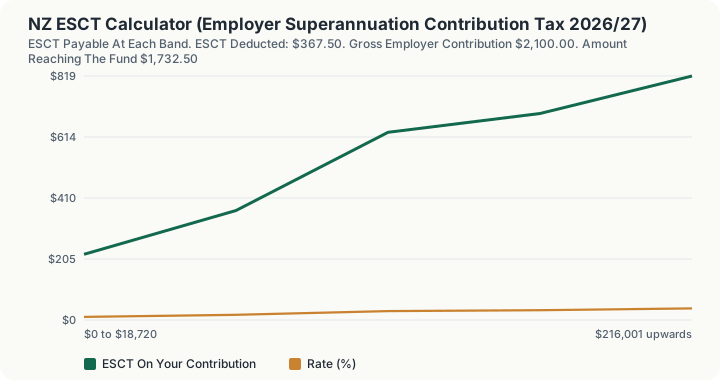
Quick Answer: On a $60,000 salary with the 3.5% compulsory employer contribution, the employer contributes $2,100.00, ESCT takes $367.50 at 17.5%, and $1,732.50 reaches the fund. The band is chosen on salary plus the contribution, and the ESCT thresholds are not the income tax thresholds: Inland Revenue grosses them up to $18,720, $64,200, $93,720 and $216,000. Using the income tax brackets instead would have deducted $630.00 here, which is $262.50 too much.
What does this calculator do?
Employer Superannuation Contribution Tax is deducted from the employer's KiwiSaver or complying fund contribution before it reaches the employee's account. It is not deducted from the employee's own contribution, and it does not appear anywhere on the employee's payslip as a deduction from their pay. It simply means the employer's stated contribution is not what the account receives.
Two rules define it, and both are easy to get wrong.
ESCT is flat, not progressive. One rate is chosen and applied to every dollar of the contribution. There is no tiering of the kind PAYE uses. An employee whose total remuneration reaches the top band pays 39% on the whole contribution, not 39% on a slice of it.
The bands are not the income tax bands. They look similar and the rates are identical, but the dollar thresholds are deliberately different. Inland Revenue grosses the ESCT thresholds up so that an employer contribution is not taxed at a higher rate than the employee's own salary would be. A total remuneration of $62,100 is above the 30% PAYE threshold of $53,500 but comfortably inside the 17.5% ESCT band.
The rate is chosen from the employee's total salary or wages plus gross employer contributions for the previous tax year. For a new employee, the employer estimates this year's figure instead.
How is this calculated?
- Compute the gross employer contribution. The compulsory minimum is 3.5% of gross salary or wages.
Contribution_gross = Salary × rate_employer
- Compute total remuneration by adding the contribution back to the salary. This is what selects the band, and forgetting the second term is the single most common way to land on the wrong rate.
Remuneration_total = Salary + Contribution_gross
- Select one band, and one rate. The bands published by Inland Revenue for the tax year beginning 1 April 2026 are $0 to $18,720 at 10.5%, $18,721 to $64,200 at 17.5%, $64,201 to $93,720 at 30%, $93,721 to $216,000 at 33%, and $216,001 upwards at 39%.
- Or override the banding with the defined benefit flat rate. An employer paying into a defined benefit fund may elect to apply 39% instead. The calculator applies that flat rate and ignores the bands entirely when the option is selected.
- Apply that single rate to the whole contribution, and pay the remainder to the fund.
ESCT = Contribution_gross × rate
Contribution_net = Contribution_gross − ESCT
Worked Example
An employee earns $60,000 and the employer contributes the compulsory 3.5%.
Step 1 - The gross contribution. $60,000 x 3.5% = $2,100.00
Step 2 - Total remuneration. $60,000 + $2,100.00 = $62,100.00
Step 3 - The band. $62,100 falls inside $18,721 to $64,200, so the rate is 17.5%
Step 4 - The tax. $2,100.00 x 17.5% = $367.50
Step 5 - What reaches the fund. $2,100.00 - $367.50 = $1,732.50
Step 6 - The error the income tax thresholds would have caused. $62,100 sits above the 30% PAYE threshold of $53,500. Applying that rate gives $2,100.00 x 30% = $630.00, which is $262.50 more tax on one employee in one year, and $262.50 less in their retirement account.
Now watch the band boundary, which is closer than it looks.
Step 7 - A $62,000 salary. Contribution $2,170.00, total remuneration $64,170.00, still inside the 17.5% band
Step 8 - A $62,100 salary. Contribution $2,173.50, total remuneration $64,273.50, which is over $64,200 and therefore 30%
Step 9 - What that $100 of salary costs. ESCT jumps from $379.75 to $652.05, a rise of $272.30 on a $100 pay rise, because the whole contribution is re-rated at once
Now a case where ignoring the contribution changes the answer.
Step 10 - A $93,000 salary. The salary alone is inside the 30% band, which ends at $93,720
Step 11 - Add the contribution back. $93,000 + $3,255.00 = $96,255.00, which is over $93,720
Step 12 - The correct rate. 33%, not 30%. ESCT is $3,255.00 x 33% = $1,074.15 rather than $976.50
Step 13 - The defined benefit election. On the original $60,000 case, electing 39% gives $2,100.00 x 39% = $819.00 instead of $367.50
The Bands, The Cliff And The Real Cost Of A Dollar
ESCT is a cliff at every boundary, because the rate applies to the whole contribution. Crossing from the 17.5% band into the 30% band re-rates every dollar of the contribution at once. That is why $100 of extra salary at the $64,200 line costs $272.30 of extra ESCT. Nothing smooths it, and no part of the contribution stays at the lower rate.
Priced across all five bands on the same $2,100 contribution, ESCT is $220.50 at 10.5%, $367.50 at 17.5%, $630.00 at 30%, $693.00 at 33% and $819.00 at 39%. The band table on this page shows exactly that, so the cost of moving band is visible rather than inferred.
The gross cost of getting a dollar into the fund is 1 / (1 - rate). At 17.5% the employer spends $1.2121 for every dollar that arrives. At 33% it is $1.4925, and at 39% it is $1.6393. An employer budgeting a target contribution net of tax has to gross it up by those factors.
The gap between the ESCT and PAYE thresholds is largest in the middle. The 17.5% ESCT band runs to $64,200 where the PAYE band ends at $53,500, a gap of $10,700 of total remuneration in which the two systems disagree about the rate by 12.5 percentage points. That is the range where using the wrong table costs the most.
Total remuneration is always higher than salary, so the band can flip on the contribution alone. At the compulsory 3.5% the addition is 3.5% of salary, which is enough to cross a threshold for anyone within about 3.4% of it. A more generous employer contribution widens that window.
A zero contribution produces no tax. The rate still exists, but there is nothing for it to apply to.
What does this calculator not account for?
- PAYE, the ACC earners' levy and student loan deductions, all of which come off the employee's pay and are unrelated to ESCT.
- The employee's own KiwiSaver deduction, which is never subject to ESCT.
- Which prior-year figure to use. The calculator takes the salary you enter as the basis for the band. Inland Revenue's rule is the previous tax year's salary or wages plus gross employer contributions, or an estimate for a new employee, and choosing that figure correctly is the employer's judgement.
- Employees who have worked for the employer for part of a year only, where the estimate rules matter more than the table.
- Contributions to complying funds other than KiwiSaver, which follow the same ESCT rules but may differ in contribution mechanics.
- The option to have the employee pay tax on the contribution through their own PAYE rather than the employer deducting ESCT, which is available in limited circumstances.
- Salary sacrifice arrangements and total-remuneration employment agreements, where the contribution is funded differently.
- Any change to the bands after the April 2026 tables. These thresholds took effect on 1 April 2025 and are those published for the year beginning 1 April 2026.
What mistakes do people make with this?
- Using the income tax thresholds. They are $15,600, $53,500, $78,100 and $180,000. The ESCT thresholds are $18,720, $64,200, $93,720 and $216,000, and the difference is worth hundreds of dollars a year per employee.
- Selecting the band on salary alone. The employer contribution is added back first, and at $93,000 that changes the rate.
- Treating ESCT as progressive. One rate applies to the entire contribution.
- Assuming the employee's 3.5% is taxed too. It is not. Only the employer's contribution is.
- Telling an employee the employer contributes 3.5%. After ESCT at 17.5%, what reaches their account is 2.888% of salary.
- Using this year's salary for an existing employee. The rule looks back to the previous tax year.
Frequently Asked Questions
What is ESCT?
Is ESCT taken out of my pay?
Are the ESCT thresholds the same as the income tax thresholds?
Is ESCT charged in tiers like PAYE?
What is the 39% flat rate?
Which year's income picks the rate?
Sources
- Inland Revenue, "Employer superannuation contribution tax (ESCT)", ird.govt.nz, for the mechanics of deducting ESCT from each employer contribution. Read 31 August 2026. ird.govt.nz/employing-staff/deductions-from-income/employer-superannuation-contribution-tax
Also consulted: Inland Revenue, "IR340: Weekly and fortnightly PAYE deduction tables", April 2026 edition, tax tables for pay periods between 1 April 2026 and 31 March 2027, page 4, under "Employer superannuation contribution tax (ESCT)". The rate table: $0 to $18,720 at 10.5%, $18,721 to $64,200 at 17.5%, $64,201 to $93,720 at 30%, $93,721 to $216,000 at 33%, $216,001 upwards at 39%. Same page: the rate is based on the previous tax year's salary or wages plus gross employer contributions, the estimate rule for new employees, and the optional 39% flat rate for defined benefit funds. Read 31 August 2026; Inland Revenue, "IR341: 4 weekly and monthly PAYE deduction tables", April 2026 edition, which carries the identical ESCT table; The personal income tax thresholds quoted for contrast ($15,600, $53,500, $78,100, $180,000) are from Inland Revenue's "Tax rates for individuals".