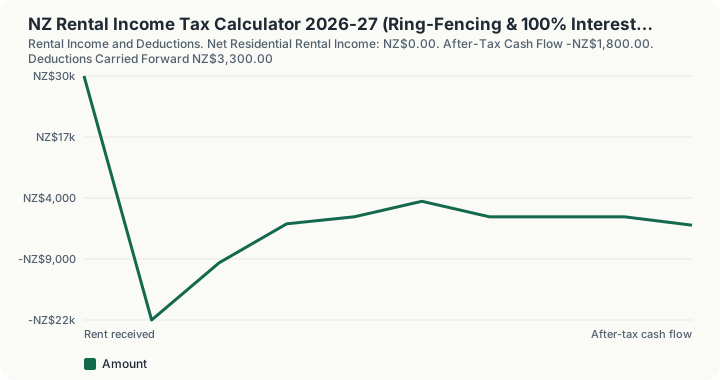
Quick Answer: NZ$30,000 of rent against NZ$33,300 of deductions leaves net residential rental income of NZ$0.00 and income tax of NZ$0.00. The property made a real economic loss of NZ$3,300, but the ring-fence in subpart EL denies that loss this year: it is carried forward as NZ$3,300 of excess deductions, releasable only against future residential rental income. After-tax cash flow is negative NZ$1,800.00, and the refund the ring-fence costs you, at a 33% marginal rate, is NZ$1,089.00.
What does this calculator do?
Two rule changes have reshaped New Zealand rental taxation, and they pull in opposite directions.
The first is favourable. Interest limitation, which progressively denied deductions for interest on residential rental borrowings between 1 October 2021 and 31 March 2025, is gone. From 1 April 2025 you can again claim the full interest charged on money borrowed to finance a rental property. For the 2026-27 year the deductible percentage is 100%.
The second is not. Residential rental losses remain ring-fenced. Under the residential property deduction rules, the deductions you may claim in a year generally cannot exceed your residential rental income for that year. Anything above that is not lost, but it is not usable either: it is carried forward and released only against future residential rental income, or against a taxable gain on sale. It never reduces the tax on your salary.
The third fact underlying every New Zealand rental calculation is that the building itself does not depreciate for tax. Since the 2011-12 income year, depreciation on buildings with an estimated useful life of 50 years or more has been 0%, regardless of when the building was acquired. Only chattels (carpets, appliances, curtains, and similar separately identifiable items) remain depreciable.
Put together, these make the New Zealand rental unusual: interest is fully deductible, the largest asset is not depreciable at all, and the loss that results is deferred rather than refunded.
How is this calculated?
Net rental = max(0, R − min(D_avail, R))
Carried forward = D_avail − min(D_avail, R)
where $R$ is rent received and D_avail is this year's claimable deductions plus any excess deductions brought forward. The tax is then computed by stacking, not at a guessed flat rate.
Step 1: Apply the deductible percentage to the mortgage interest. NZ$22,000 x 100% = NZ$22,000.00 deductible interest
Step 2: Compute the non-deductible remainder. NZ$22,000 - NZ$22,000 = NZ$0.00
Step 3: Sum the other deductions: rates, insurance, repairs, management, chattels depreciation and other expenses. NZ$2,800 + NZ$1,600 + NZ$3,000 + NZ$2,400 + NZ$1,500 + NZ$0 = NZ$11,300.00
Step 4: Add the deductible interest to reach this year's claimable total. NZ$22,000.00 + NZ$11,300.00 = NZ$33,300.00
Step 5: Add any excess deductions brought forward from earlier years. NZ$33,300.00 + NZ$0.00 = NZ$33,300.00 available
Step 6: Apply the ring-fence: allow deductions only up to rental income. min(NZ$33,300.00, NZ$30,000.00) = NZ$30,000.00 allowed
Step 7: Net residential rental income is rent less the allowed deductions. NZ$30,000.00 - NZ$30,000.00 = NZ$0.00
Step 8: The remainder is denied this year and carried forward. NZ$33,300.00 - NZ$30,000.00 = NZ$3,300.00 carried forward
Step 9: Compute tax on your other income alone, at the 2026-27 brackets. Tax on NZ$90,000 = NZ$19,577.50
Step 10: Compute tax on your other income plus the net rental income. Tax on NZ$90,000 + NZ$0 = NZ$19,577.50
Step 11: The tax attributable to the rental is the difference between them. NZ$19,577.50 - NZ$19,577.50 = NZ$0.00
Step 12: Sum the actual cash costs. Depreciation is excluded because it is not cash. NZ$22,000 + NZ$2,800 + NZ$1,600 + NZ$3,000 + NZ$2,400 = NZ$31,800.00
Step 13: After-tax cash flow is rent less cash costs less the tax. NZ$30,000.00 - NZ$31,800.00 - NZ$0.00 = negative NZ$1,800.00
Step 14: Value the blocked loss at your marginal rate: what the ring-fence costs you this year. NZ$3,300.00 x 33% = NZ$1,089.00
Step 14 is the number that does not appear on any tax return. The loss is real, the cash is gone, and in a country without ring-fencing the same NZ$3,300 loss would have produced a NZ$1,089 reduction in the tax on your salary this year. Here it produces nothing this year and a deferred benefit later, if and only if the portfolio eventually earns enough residential rental income to absorb it.
Worked Example
Take the same owner in a later year, when the mortgage has been paid down and the rent has risen: NZ$40,000 of rent, NZ$10,000 of interest, NZ$1,000 of repairs, and NZ$15,000 of previously denied deductions waiting to be released.
Step 1: Other deductions for the year. NZ$2,800 + NZ$1,600 + NZ$1,000 + NZ$2,400 + NZ$1,500 = NZ$9,300.00
Step 2: Add deductible interest. NZ$9,300.00 + NZ$10,000.00 = NZ$19,300.00 claimable this year
Step 3: Add the carried-forward excess deductions. NZ$19,300.00 + NZ$15,000.00 = NZ$34,300.00 available
Step 4: Apply the ring-fence against this year's rent. min(NZ$34,300.00, NZ$40,000.00) = NZ$34,300.00 allowed
Step 5: Net residential rental income. NZ$40,000.00 - NZ$34,300.00 = NZ$5,700.00
Step 6: Nothing is denied, because deductions were below rental income. NZ$34,300.00 - NZ$34,300.00 = NZ$0.00 carried forward
The ring-fence has stopped binding, and the entire NZ$15,000 backlog has been absorbed in a single year. That is the mechanism working as designed: deferral, not denial. But note what it required: a profitable year large enough to swallow the backlog. An owner who sells before that year arrives, in a transaction that is not itself taxable, gets nothing for the accumulated deductions at all.
What does this calculator not account for?
- It models one property, not a portfolio. Ring-fencing applies on a portfolio basis by default, so a loss on one rental can be set against a profit on another before the ring-fence bites. With more than one property, aggregate your figures before entering them.
- It does not apply the property-by-property election, which some owners make instead of the default portfolio basis.
- It does not compute the release of carried-forward deductions on a taxable sale. Excess deductions can be used against a bright-line or other taxable gain on disposal; that is a separate calculation.
- It does not test whether your interest is actually deductible. Interest on borrowings secured over the rental but used for something else is not deductible, and this calculator takes the figure you enter at face value.
- It does not split repairs from improvements. Restoring what was there is deductible; improving beyond the original condition is capital, and if it forms part of the building it is depreciated at 0%. That characterisation is a judgement call, made before you use this tool.
- It does not compute chattels depreciation from a chattels schedule. You supply the annual figure; the engine does not derive it from asset lives or pooling.
- It does not model the mixed-use asset rules that apply where a property is used privately for part of the year, nor the short-stay accommodation rules.
- It excludes ACC levies and KiwiSaver, which are not charged on rental income, and it does not model provisional tax instalments or use-of-money interest.
What mistakes do people make with this?
- Believing the loss is gone. It is deferred, not forfeited. The carried-forward figure is an asset with a real, if uncertain, future value.
- Believing the loss is worth its face value later. Its future worth depends on your marginal rate in the year it is released, which may be lower than today's, and on there being residential rental income to release it against.
- Confusing a tax loss with negative cash flow. These defaults produce a NZ$0 taxable result and a NZ$1,800 cash shortfall. Chattels depreciation reduces the tax figure without touching the bank account; the ring-fence does the opposite. Both are modelled separately here for that reason.
- Assuming interest is still limited. The 2021-2025 interest limitation rules are over. If you are reproducing an earlier year, lower the deductible percentage, 75% for 2023-24 and 50% for 2024-25 on pre-27-March-2021 loans, and watch a taxable profit appear out of an economic loss.
- Claiming building depreciation. It has been 0% since 2011-12 for buildings with a useful life of 50 years or more. Only chattels are depreciable.
- Averaging the tax rate. Rental profit sits on top of your salary, so it is taxed at your top bracket, not your average one. This calculator stacks it for exactly that reason.
- Treating retained bond money as tax-free. Bond applied to rent arrears is rental income. Bond retained for damage is not.
Frequently Asked Questions
Can I offset a rental loss against my salary in New Zealand?
Is mortgage interest deductible on a New Zealand rental in 2026?
Can I claim depreciation on the building?
What happens to my carried-forward deductions if I sell?
Why does the calculator show zero tax but negative cash flow?
Sources
- Inland Revenue, IR264 "Rental income" (current edition), ird.govt.nz: read 2026-08-30. Ring-fencing at page 6: deductions each year "generally cannot be more than your residential rental property income", with disallowed amounts "carried forward for use in a future year". Interest: "From 1 April 2025 you can claim the interest charged on any money you borrow to finance your rental property." Building depreciation at page 14: "depreciation on buildings is 0% where buildings have an estimated useful life of 50 years or more." ird.govt.nz/-/media/project/ir/home/documents/forms-and-guides/ir200---ir299/ir264/ir264.pdf
Also consulted: Inland Revenue, "Residential rental property deductions", ird.govt.nz, read 2026-08-30. Excess deductions cannot be set against "other income such as salary or wages" and must be carried forward from year to year; Inland Revenue, "Tax rates for individuals", ird.govt.nz, the 2026-27 progressive brackets used to stack rental profit onto other income: 10.5% to NZ$15,600, 17.5% to NZ$53,500, 30% to NZ$78,100, 33% to NZ$180,000, and 39% above that. Verified 2026-08-22 and confirmed unchanged by Budget 2026; Income Tax Act 2007, subpart EL: the residential property deduction rules that impose the ring-fence.