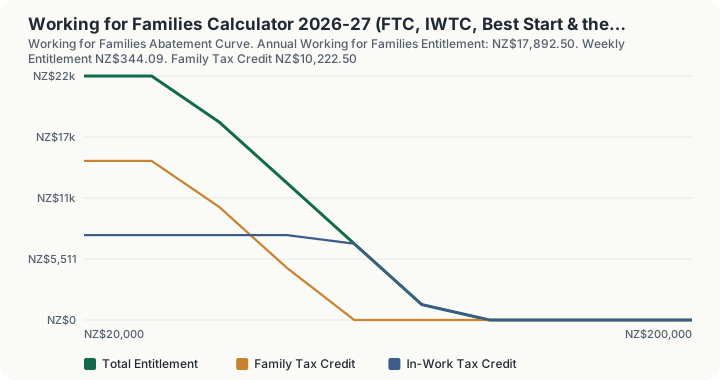
Quick Answer: A two-child family on $60,000 of family scheme income, normally in paid work, is entitled to $17,892.50 per year, or $344.09 a week: a $10,222.50 family tax credit plus the full $7,670 in-work tax credit, with no Best Start. Abatement of 27.5% on income above the $44,900 threshold has cut the maximum $14,375 family tax credit by $4,152.50.
What does this calculator do?
Working for Families is not one payment. It is three separate credits with different eligibility rules, different maximum amounts and, critically, two different abatement schedules. The family tax credit and the in-work tax credit share a single abatement, calculated once and applied in a fixed order. Best Start abates on its own, against a higher threshold and at a lower rate.
That structure produces the effect this calculator exists to make visible. A family earning an extra dollar does not simply pay tax on it. They pay income tax, they pay the ACC earner's levy, they may pay a student loan deduction, and on top of all of that they lose 27.5 cents of Working for Families, or 48.5 cents where the Best Start schedule is running at the same time. The rate at which the next dollar disappears is routinely higher than New Zealand's 39% top income tax rate at incomes nowhere near the top bracket. At $60,000 with two children, it is 59.25%.
The 2026-27 year carries one temporary feature worth naming up front. The maximum in-work tax credit is $7,670 a year, reflecting an increase from $97 a week to $147 a week that took effect on 1 April 2026. That increase is temporary and lapses after 31 March 2027 unless it is extended.
How is this calculated?
The maximum credits come first, from the child counts alone:
max FTC = 7,921 + 6,454 × (n_children − 1)
max IWTC = 7,670 + 780 × max(0, n_children − 3)
max Best Start = 4,041 × n_(under 3)
One abatement amount is then computed and spent, FTC first:
A = 0.275 × max(0, I − 44,900)
With the defaults (two children, $60,000, in paid work, no Best Start children):
Step 1: Build the maximum family tax credit. $7,921 + ($6,454 x 1) = $14,375.00
Step 2: Build the maximum in-work tax credit. Two children is not more than three, so no per-child addition applies: $7,670.00
Step 3: Build the maximum Best Start. $4,041 x 0 children under 3 = $0.00
Step 4: Find income above the abatement threshold. $60,000.00 - $44,900.00 = $15,100.00
Step 5: Apply the 27.5% abatement rate to that excess. $15,100.00 x 0.275 = $4,152.50
Step 6: Take the abatement out of the family tax credit first. $14,375.00 - $4,152.50 = $10,222.50
Step 7: Work out what abatement is left over for the in-work tax credit. $4,152.50 - $14,375.00 = negative, so the spillover is $0.00
Step 8: Apply that spillover to the in-work tax credit. $7,670.00 - $0.00 = $7,670.00
Step 9: Abate Best Start separately, against its own $79,000 threshold at 21%. $60,000 is below $79,000, and there are no Best Start children, so Best Start is $0.00
Step 10: Add the three credits. $10,222.50 + $7,670.00 + $0.00 = $17,892.50 per year
Step 11: Convert to a weekly figure by dividing by 52. $17,892.50 / 52 = $344.09 a week
The engine then computes two exhaustion points by dividing each maximum by the abatement rate and adding the threshold:
Step 12: Find the income at which the family tax credit reaches zero. $44,900 + ($14,375.00 / 0.275) = $97,172.73
Step 13: Find the income at which both credits reach zero. $44,900 + (($14,375.00 + $7,670.00) / 0.275) = $125,063.64
Finally, the combined effective marginal tax rate is assembled from four separate pieces. The income tax marginal rate comes from running the same family scheme income figure through the New Zealand PAYE brackets; the ACC earner's levy is added as a flat 1.75%; a student loan adds 12% if you said you have one and income exceeds $24,128; and the Working for Families withdrawal rate is 27.5% while any FTC or IWTC remains, plus 21% while Best Start is still being withdrawn.
Step 14: Take the income tax marginal rate at $60,000. $60,000 falls in the $53,501 to $78,100 band: 30.00%
Step 15: Add the ACC earner's levy. 30.00% + 1.75% = 31.75%
Step 16: Add the student loan rate (none selected here). 31.75% + 0.00% = 31.75%
Step 17: Add the Working for Families abatement rate. 31.75% + 27.50% = 59.25%
Worked Example
A family with one child and $90,000 of family scheme income, in paid work.
Step 1: Maximum family tax credit for one child. $7,921 + ($6,454 x 0) = $7,921.00
Step 2: Maximum in-work tax credit. $7,670.00
Step 3: Income above the threshold. $90,000.00 - $44,900.00 = $45,100.00
Step 4: Abatement amount. $45,100.00 x 0.275 = $12,402.50
Step 5: Family tax credit after abatement. $7,921.00 - $12,402.50 = negative, floored at $0.00
Step 6: Abatement spilling onto the in-work tax credit. $12,402.50 - $7,921.00 = $4,481.50
Step 7: In-work tax credit after the spillover. $7,670.00 - $4,481.50 = $3,188.50
Step 8: Total entitlement. $0.00 + $3,188.50 + $0.00 = $3,188.50 a year
This is the case the ordering rule exists for. The family tax credit has gone entirely, and yet more than $3,000 of in-work tax credit survives, because the abatement had to consume the FTC in full before it could touch the IWTC at all.
What does this calculator not account for?
- The minimum family tax credit is not computed. The MFTC guarantees a family income of $36,604 a year after tax where the family is in full-time work off a main benefit. The engine holds that figure as a constant but does not apply it, so a very low-income working family may be entitled to more than this page shows.
- The in-work tax credit at $7,670 is temporary. It reflects the increase from $97 to $147 a week effective 1 April 2026, which lapses after 31 March 2027. For 2027-28 the engine's figure will need replacing.
- Eligibility is assumed, not tested. The calculator does not check residency, whether you are receiving a main benefit or student allowance (which blocks the in-work tax credit), whether you are the principal caregiver, or the ages of the children beyond the Best Start count you enter.
- Shared care is not modelled. Where care is shared, entitlement is apportioned by the share of care. This page pays each credit in full to one family.
- Family scheme income is treated as one person's salary for the marginal rate. The combined effective marginal tax rate runs your household family scheme income through the individual PAYE brackets as though a single earner had earned all of it. For a two-earner household the true income tax marginal rate on the next dollar is whatever the person working the extra hour faces, which is usually lower.
- The ACC earner's levy is added as a flat 1.75% with no cap applied. The levy is capped at $156,641 of liable earnings in 2026-27; above that, the marginal levy is zero, and the combined rate shown here would be 1.75 points too high.
- KiwiSaver is switched off. The PAYE call behind the marginal rate opts out of KiwiSaver entirely, so no employee contribution is subtracted anywhere in this calculation.
- The weekly figure is the annual figure divided by 52, not Inland Revenue's weekly ladder. Inland Revenue publishes rounded weekly amounts in IR271; a straight division will differ from them by cents.
- Family scheme income is broader than taxable income. It can include trust income, non-taxable pensions, attributable fringe benefits and other adjustments. The engine takes the figure you enter and does not build it up from components.
What mistakes do people make with this?
Assuming the in-work tax credit goes first. It does not. The abatement is applied to the family tax credit first. That is why a one-child family on $90,000 keeps $3,188.50 of in-work tax credit despite having no family tax credit left at all.
Entering taxable income instead of family scheme income. Family scheme income is a wider concept and it is what the abatement bites on. Using a narrower figure overstates entitlement.
Treating the $44,900 threshold as an eligibility cut-off. It is where withdrawal starts, not where entitlement ends. With two children, payments continue right up to $125,063.64.
Forgetting that Best Start has its own schedule. Best Start abates above $79,000 at 21%, independently. Where the two schedules overlap, 48.5 cents of the next dollar is withdrawn before any income tax is charged.
Reading the combined marginal rate as your tax rate. It is the rate on the next dollar, not on all of your income. The average rate is much lower.
Frequently Asked Questions
How much Working for Families will I get on $60,000 with two children?
At what income does Working for Families stop?
Why do I lose 59 cents of every extra dollar I earn?
How much is the in-work tax credit in 2026-27?
Is Best Start income-tested in the first year?
Does the calculator include the minimum family tax credit?
Sources
- Inland Revenue, Family tax credit: ird.govt.nz/working-for-families/types/family-tax-credit, $7,921 a year for the eldest child, $6,454 for every other child, abating above $44,900 at 27.5%.
- Inland Revenue, In-work tax credit: ird.govt.nz/working-for-families/types/in-work-tax-credit, $7,670 a year for up to three children plus $780 for every child after that; "From 1 April 2026, the maximum weekly in-work tax credit will increase from $97 a week to $147 a week."
- Inland Revenue, Best Start: ird.govt.nz/working-for-families/types/best-start, "The full entitlement is $77 a week", abating above $79,000 at 21%.
- Inland Revenue, "Tax rates for individuals": the 2026-27 personal income tax brackets used for the marginal rate, and the ACC earners' levy rate of $1.75 per $100 of liable earnings (capped at $156,641), read at ird.govt.nz. ird.govt.nz/income-tax/income-tax-for-individuals/tax-codes-and-tax-rates-for-individuals/tax-rates-for-individuals
Also consulted: Inland Revenue guide IR271, Working for Families weekly payments (April 2026 edition, 1 April 2026 to 31 March 2027), confirms the weekly ladder, the four-child in-work tax credit step, and the $36,604 minimum family tax credit figure; Income Tax Act 2007, subparts MD and MG (Working for Families tax credits and the abatement order).
All Working for Families figures read from Inland Revenue on 2026-08-30 for the 2026-27 tax year.