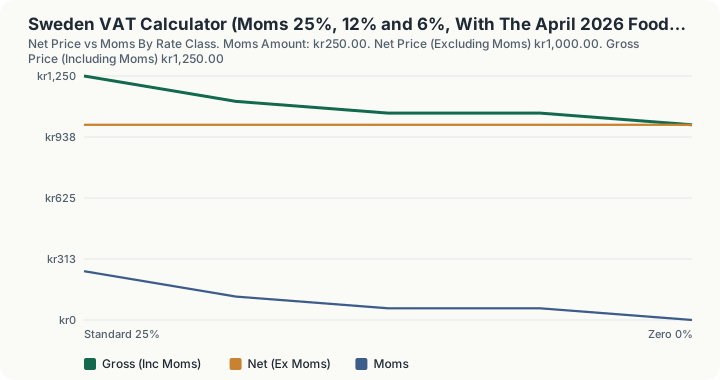
Quick Answer: Adding standard-rate Swedish moms to a net price of 1,000 kr gives 250 kr of VAT and a gross price of 1,250 kr, at a rate of 25.00%. Note that the same 250 kr is only 20.0000% of the gross price, which is why removing moms from a till price is not the same operation as adding it.
What does this calculator do?
Sweden charges moms at four rates: a standard 25%, a reduced 12%, a super-reduced 6%, and zero. The 25% rate covers most goods and services. The 12% rate covers restaurant and catering services, hotel accommodation and certain repairs. The 6% rate covers books, newspapers and magazines including electronic publications, passenger transport, and admission to cultural events.
Groceries are the awkward case, and this calculator treats them as a function of the transaction date rather than as a constant. Livsmedel are taxed at 12% up to and including 31 March 2026, and at 6% from 1 April 2026 onward. Both figures are correct within calendar year 2026, depending on the day of supply, so any tool that hardcodes a single grocery rate for 2026 is wrong for part of the year. Food and drink served for consumption on the premises of a restaurant or cafe is a restaurangtjanst, a different supply, and stays at 12% throughout.
The calculator works in both directions. It adds moms to a net price, or extracts the moms already contained in a gross one, and it prices the same net amount under every rate class side by side so you can see what a misclassification would cost. It also checks an optional annual turnover figure against the 120,000 kr omsattningsgrans, the ceiling below which a Sweden-established business can stay outside the moms system.
How is this calculated?
Two formulas, chosen by direction. Adding:
VAT = N × r; Gross = N × (1 + r)
Removing, which uses the VAT fraction rather than the rate:
VAT = G × r/(1 + r); Net = G − VAT
Step 1: Resolve the rate. The engine maps the selected rate class to a number. For the grocery class only, it compares the transaction date against 2026-04-01 and returns 12% for anything earlier, 6% for that date or later.
Standard rate selected, so $r$ = 0.25
Step 2: Apply the rate to the net price.
1,000 x 0.25 = 250 kr of moms
Step 3: Add the moms to the net price.
1,000 + 250 = 1,250 kr gross
Step 4: Express the moms as a share of the gross price. This is $r / (1 + r)$, the figure to use when working backwards from a till receipt.
0.25 / 1.25 = 20.0000% of the gross price
Step 5: Price the same net amount as groceries before the change.
1,000 x 1.12 = 1,120 kr
Step 6: Price it as groceries from 1 April 2026.
1,000 x 1.06 = 1,060 kr
Step 7: Take the difference.
1,120 - 1,060 = 60 kr of gross price removed by the cut, if the whole rate change reaches the shelf price.
Step 8: Convert the turnover ceiling to a gross figure. The 120,000 kr omsattningsgrans is measured on the beskattningsunderlag, the ex-moms base.
120,000 x 1.25 = 150,000 kr of standard-rated gross invoicing at the ceiling
With turnover left at zero the engine reports the exemption check as "Not assessed", because it cannot tell an empty field from a genuinely zero-turnover business.
Worked Example
You have a till receipt of 1,250 kr for standard-rated goods and need the moms figure for a deduction claim.
Step 1: Take 25% of the gross price, which is the common mistake.
1,250 x 0.25 = 312.50 kr, which is wrong
Step 2: Use the VAT fraction instead.
0.25 / (1 + 0.25) = 0.20
Step 3: Apply the fraction to the gross price.
1,250 x 0.20 = 250 kr of moms
Step 4: Subtract to recover the net price.
1,250 - 250 = 1,000 kr net
Step 5: Check the size of the error you avoided.
312.50 - 250 = 62.50 kr, a 25% overstatement of the input moms
The same fraction at the other rates is 12/112, or 10.7143% of gross, and 6/106, or 5.6604% of gross.
What does this calculator not account for?
- The grocery rate is date-dependent, not a constant. Livsmedel are at 12% through 31 March 2026 and 6% from 1 April 2026. The engine selects on the transaction date you choose, and only for the grocery rate class. If you pick the wrong date you will get the wrong, though internally consistent, answer.
- Classification is yours to get right. The calculator applies whichever rate class you select. It cannot tell whether a particular supply is a restaurangtjanst at 12% or takeaway livsmedel at 6%, and the distinction is a common source of assessments.
- The April 2026 saving assumes full pass-through. A rate cut reaching the shelf price is a pricing decision by the retailer, not a tax rule. The 60 kr figure is the arithmetic maximum, not a prediction.
- The exemption check is a single-year test. The engine compares your figure against 120,000 kr. The real rule also requires that the ceiling was not exceeded in either of the two preceding calendar years and that the business is established in Sweden. Neither condition is modelled.
- Genuinely exempt supplies are not the same as zero-rated ones. Healthcare, dental care, social care, education, and some financial and insurance services fall outside moms entirely, with no input VAT recovery. Selecting "Zero 0%" produces the same number but not the same legal position.
- Cross-border supplies are out of scope. Reverse charge, EU distance selling and the OSS scheme, and imports all change who accounts for the tax, and none of that is modelled here.
- No rounding rules for invoices are applied beyond the platform's standard money rounding.
What mistakes do people make with this?
- Taking 25% off a gross price. On a 1,250 kr till total that yields 312.50 kr instead of the correct 250 kr, overstating input moms by 62.50 kr.
- Hardcoding "Swedish food is 12%". True through 31 March 2026, wrong from 1 April 2026, and the same trolley therefore has two correct answers within one calendar year.
- Applying the 6% grocery rate to a restaurant bill. Eating in is a restaurangtjanst at 12%. The rate cut did not touch it.
- Measuring the 120,000 kr ceiling on gross invoicing. The test is on the ex-moms base, so a standard-rated business can invoice 150,000 kr gross and still qualify.
- Assuming the exemption is automatic. It applies to a business established in Sweden that has also stayed under the ceiling in the two preceding years, and staying outside the moms system means no input VAT recovery either.
Frequently Asked Questions
How much VAT is in a 1,000 kr Swedish price?
When does Swedish food VAT drop to 6%?
Does the food VAT cut apply to restaurants?
What is the Swedish VAT registration threshold?
Why is 25% moms only 20% of the price I pay?
Which goods are at 6% in Sweden?
Sources
- Skatteverket, "Momssatser och undantag fran moms": skatteverket.se/foretag/moms/saljavarorochtjanster/momssatspavarorochtjanster.4.58d555751259e4d66168000409.html, the 25/12/6 rate structure, the share-of-price fractions, and the quoted rule that from 1 April 2026 livsmedel are taxed at 6%.
- Skatteverket, momsregistrering guidance, "I vissa fall behover du inte registrera ditt foretag for moms": skatteverket.se/foretag/moms/momsregistrering/ivissafallbehoverduinteregistreradittforetagformoms.4.3152d9ac158968eb8fd1efe.html, the 120,000 kr omsattningsgrans measured on the ex-VAT taxable base, raised from 80,000 kr with effect from 1 January 2025.