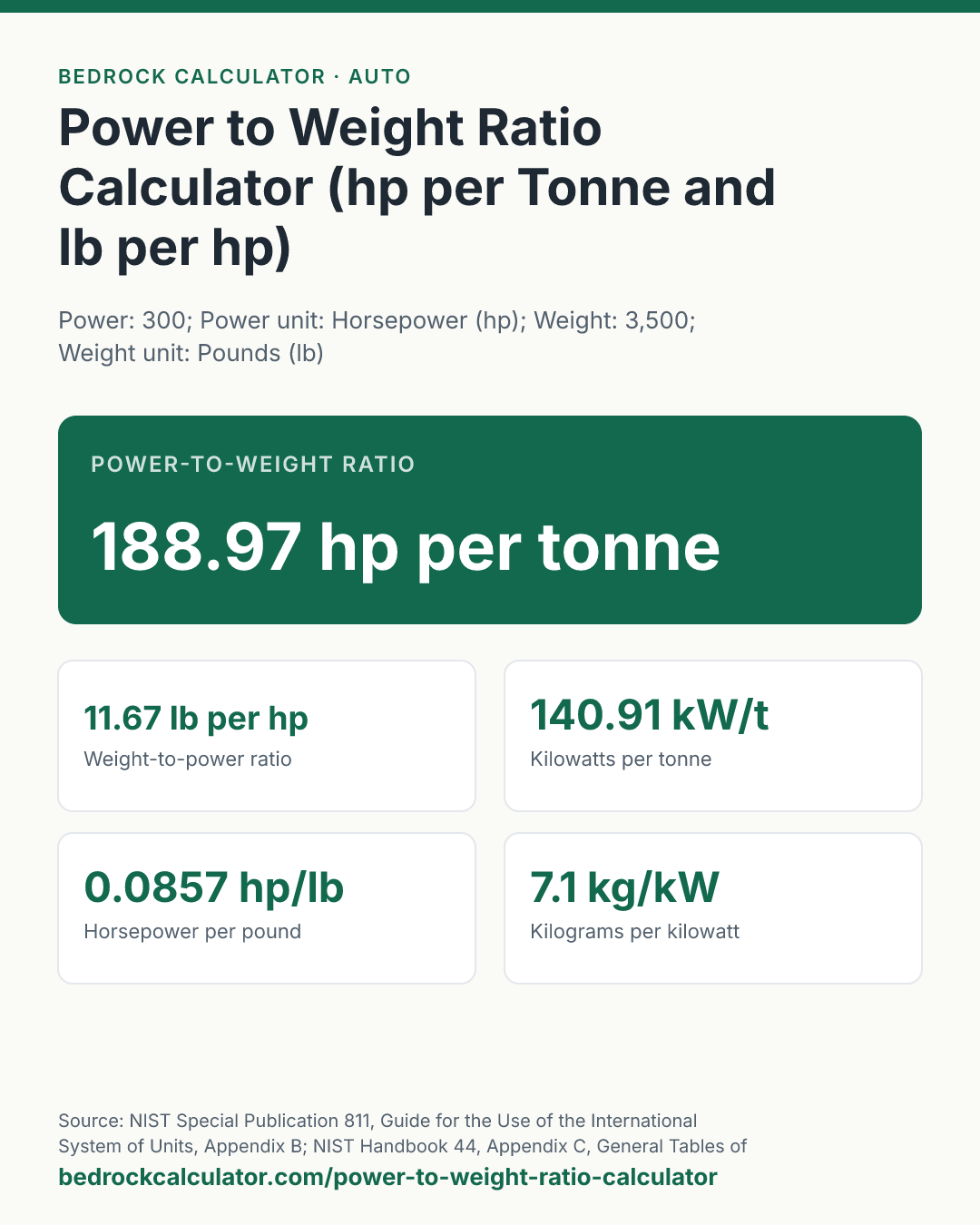

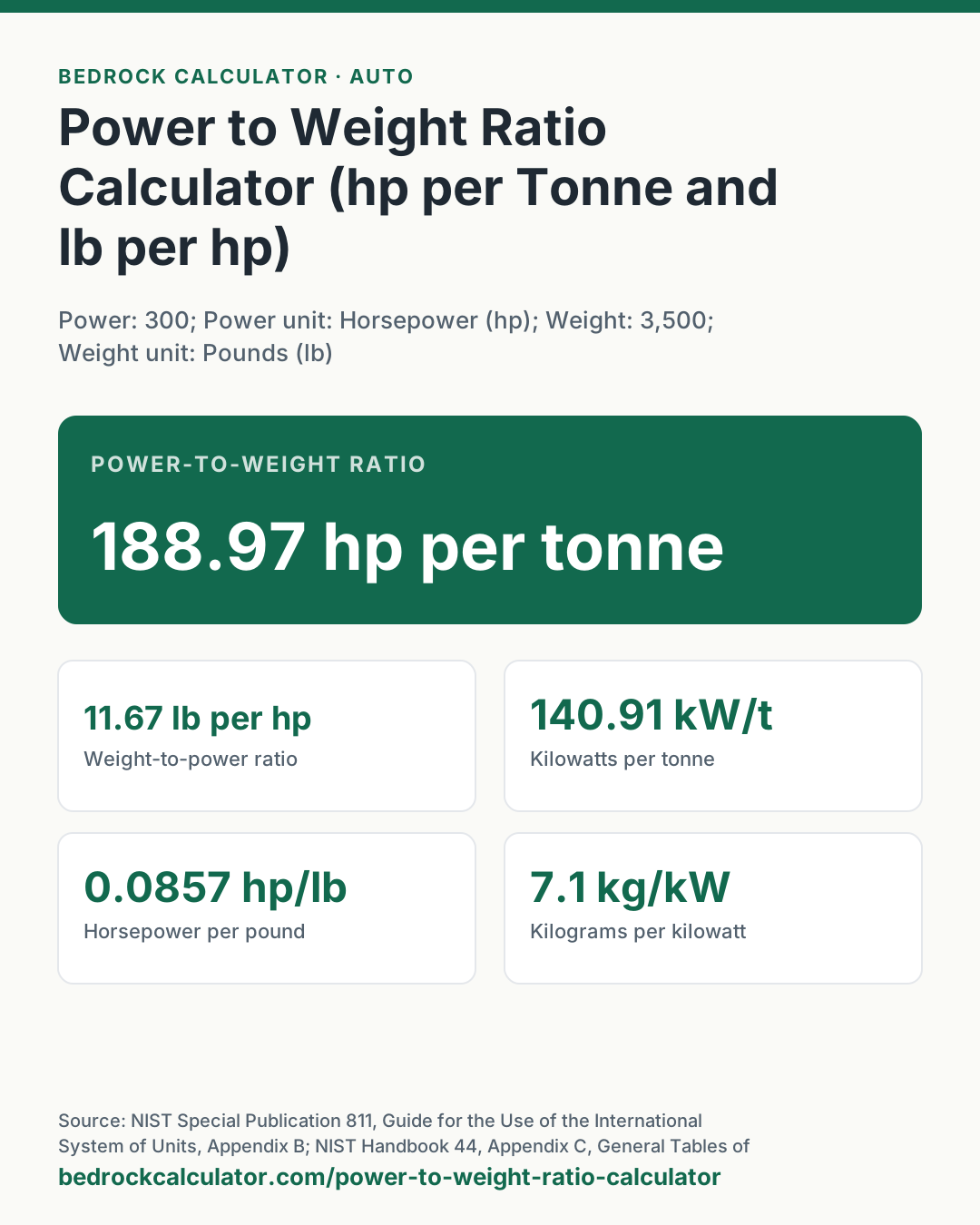
Quick Answer: A 300 hp car that weighs 3,500 lb has a power-to-weight ratio of 188.97 hp per tonne, which is 11.67 lb for every horsepower. Divide the power by the weight, or the weight by the power for the inverse.
What does this calculator do?
This power to weight ratio calculator divides a vehicle's power by its weight and shows the result the ways it is quoted around the world: horsepower per metric tonne, kilowatts per tonne and horsepower per pound, plus the inverse, the weight each unit of power has to move, in pounds per horsepower and kilograms per kilowatt.
Power-to-weight is the single number that best explains how quickly a vehicle can accelerate. Two cars with the same engine feel very different if one is 500 lb heavier, and a 100 hp motorcycle can out-accelerate a 300 hp sedan because it has a fraction of the mass to push. Comparing horsepower alone misses that; comparing the ratio does not.
You can enter power in horsepower, metric horsepower (PS or CV, as European brochures print it) or kilowatts, and weight in pounds or kilograms. The calculator converts everything through exact definitions before dividing, so a figure from a US spec sheet and one from a German brochure land on the same scale.
Using the Power to Weight Ratio Calculator
- Enter the power figure and pick its unit. Use the maker's rated figure, or a dynamometer reading if you have one, and note whether it is measured at the crank or at the wheels.
- Enter the weight and pick pounds or kilograms. Curb weight is the usual basis; add the driver and fuel if you want the ratio as the car is actually driven.
- Read the ratio in hp per tonne at the top. The cards below give the weight-to-power ratio, the metric kW per tonne, hp per pound and kg per kW, and the power and weight converted to the other units.
The presets load a sport motorcycle, an electric car rated in kilowatts and a hatchback rated in PS. Two tables below the calculator show how the ratio moves with power at a fixed weight, and with weight at a fixed power.
How is this calculated?
- Convert the power. The power is converted to mechanical horsepower and to kilowatts. One horsepower is defined as 550 foot-pounds-force per second, which works out to exactly 745.69987158227022 watts. One metric horsepower is 75 kilogram-force metres per second, exactly 735.49875 watts.
- Convert the weight. The weight is converted to pounds, kilograms and metric tonnes, using the exact pound of 0.45359237 kg and the tonne of 1,000 kg.
- Divide power by weight. The power-to-weight ratio is the power over the mass, in whichever pair of units you want to read it in.
hp per tonne = horsepower/(weight in tonnes); kW per tonne = kilowatts/(weight in tonnes)
- Divide weight by power. The weight-to-power ratio is the same comparison upside down: how much mass each unit of power carries.
lb per hp = (weight in pounds)/horsepower; kg per kW = (weight in kilograms)/kilowatts
- Round for display. The arithmetic keeps 34 significant digits. Ratios are rounded to two decimal places, except horsepower per pound, which is shown to four because it is a small number.
Worked Example
With the default inputs, 300 hp and 3,500 lb:
- Weight: 3,500 lb is 1,587.6 kg.
- Power-to-weight: 300 hp divided by the weight in tonnes is 188.97 hp per tonne. In metric power units, 300 hp is 223.7 kW, so the ratio is 140.91 kW per tonne.
- Weight-to-power: 3,500 ÷ 300 = 11.67 lb per hp, or 7.1 kg per kW.
- Per pound: 300 ÷ 3,500 = 0.0857 hp per lb.
A 100 hp motorcycle weighing 450 lb comes out at 489.92 hp per tonne and 4.5 lb per hp. It has a third of the car's power but carries less than half as much weight per horsepower, which is why it is quicker off the line.
An electric car with 150 kW weighing 2,000 kg is exactly 75 kW per tonne, which is 100.58 hp per tonne or 21.92 lb per hp. A hatchback rated 150 PS at 1,300 kg reaches 113.81 hp per tonne, because 150 PS is only 147.9 mechanical horsepower.
What Is the Weight to Horsepower Ratio?
The weight-to-horsepower ratio is the weight divided by the power, usually in pounds per horsepower. It says how many pounds each horsepower has to move, so a lower number means quicker acceleration. It is the form most US sources use, because the numbers are easy to compare: the default car at 11.67 lb per hp, the motorcycle at 4.5.
It carries exactly the same information as the power-to-weight ratio. One is simply the reciprocal of the other, so a car that doubles its hp per tonne halves its lb per hp. Pick whichever your source uses and compare like with like.
Horsepower, PS and Kilowatts
Three power units appear on spec sheets, and they are not interchangeable:
- Horsepower (hp) in the US and UK is mechanical horsepower, 550 ft·lbf per second.
- Metric horsepower (PS in German, CV in French, Italian and Spanish) is 75 kgf·m per second, about 1.4% smaller. A car rated 150 PS has 147.9 hp.
- Kilowatts (kW) are the SI unit of power, used for electric motors and in most official specifications outside the US. One kilowatt is about 1.341 hp.
The calculator handles all three, so you do not need to convert first. Mixing them without converting is the most common way to get a ratio that is a few percent out.
What does this calculator not account for?
- Torque and gearing. Peak power is reached at one engine speed. How much power is available across the rev range, and how the gears keep the engine near it, matters as much for real acceleration.
- Traction. A powerful car that spins its tyres cannot use its ratio. All-wheel drive and tyre grip change launch times.
- Aerodynamic drag. At high speed, drag rather than weight limits acceleration, and it does not appear in this ratio.
- Crank versus wheel power. A rated figure is usually at the crankshaft. Power at the wheels is lower after drivetrain losses. The calculator uses whatever figure you enter.
- Driver, passengers and fuel. Curb weight excludes them. A full load can add several hundred pounds and lower the ratio noticeably.
- Electric horsepower. The 746 W electric horsepower used for some motors is not offered; enter such a rating in kilowatts.
What mistakes do people make with this?
- Treating PS as hp. European and Japanese figures are often PS. Entering them as hp overstates the power by about 1.4%.
- Comparing curb weight with gross weight. A spec sheet might quote either. Use the same basis for every vehicle you compare.
- Mixing short tons and tonnes. "Per ton" in an American source can mean 2,000 lb, while "per tonne" means 1,000 kg. This calculator uses the metric tonne.
- Reading a bigger lb per hp as better. For the weight-to-power ratio, smaller is quicker. For hp per tonne, bigger is quicker.
- Using wheel horsepower for one car and crank horsepower for another. Drivetrain losses make the wheel figure noticeably lower, and that gap can be bigger than the real difference between the two cars.
Frequently Asked Questions
How do I calculate the horsepower to weight ratio?
What is the weight to power ratio of a 300 hp, 3,500 lb car?
Is a higher power to weight ratio better?
How do I compare a motorcycle and a car?
Should I include the driver's weight?
How do I convert kW per tonne to hp per tonne?
Sources
- NIST Special Publication 811, Guide for the Use of the International System of Units, Appendix B: conversion factors for horsepower (550 ft·lbf/s), metric horsepower and the watt. nist.gov/pml/special-publication-811
- NIST Handbook 44, Appendix C, General Tables of Units of Measurement: the international pound of 0.45359237 kg. nist.gov/pml/owm/nist-handbook-44-current-edition
- BIPM, The International System of Units (SI Brochure), 9th edition: the watt, the kilogram and the tonne. bipm.org/en/publications/si-brochure