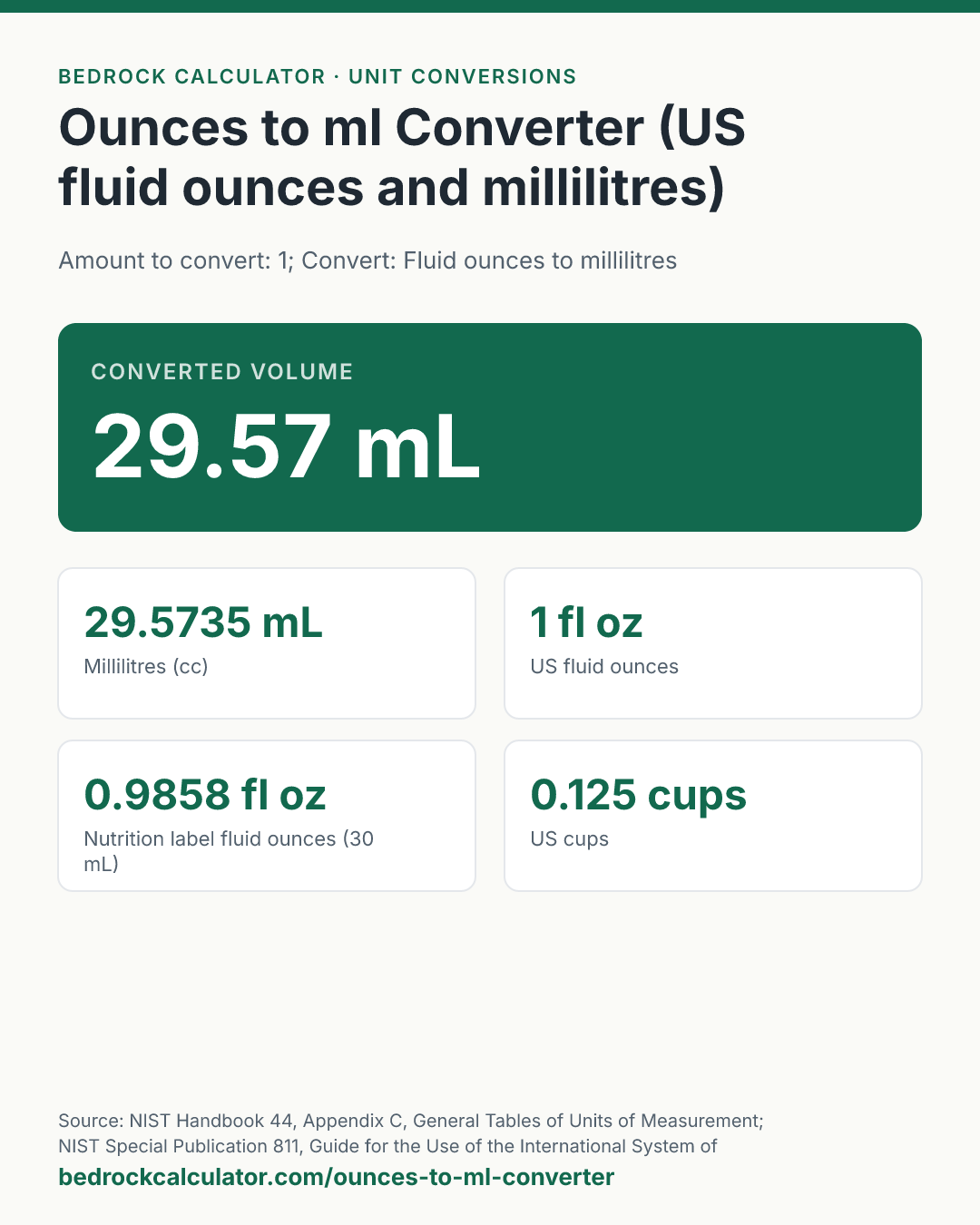
Quick Answer: One US fluid ounce is 29.57 mL (29.5735 mL to four places), so 8 fluid ounces is 236.59 mL. Going the other way, 100 mL is 3.3814 fluid ounces.
What does this calculator do?
This ounces to ml converter changes US fluid ounces into millilitres and millilitres back into fluid ounces. Pick a direction, type the amount, and it shows the converted volume along with the same amount in US cups, tablespoons and litres, and in the 30 mL fluid ounce that US nutrition labels use.
The ounce here is the US fluid ounce, a unit of volume. NIST Handbook 44 defines it as one 128th of the US gallon, and the gallon as 231 cubic inches. Because the inch is exactly 2.54 cm, the fluid ounce works out to exactly 29.5735295625 millilitres. The converter uses that full figure; the 29.57 you see in the headline is only that number rounded for reading.
A millilitre and a cubic centimetre (cc) are the same volume, so every millilitre figure on this page is also a cc figure. That is handy for syringes, medicine cups and engine displacement, which are often marked in cc.
Using the Ounces to ml Converter
- Type the amount. Decimals are fine: 2.7 fl oz or 7.5 mL.
- Choose Fluid ounces to millilitres or Millilitres to fluid ounces.
- Read the result at the top. It shows millilitres to two decimal places or fluid ounces to four. The cards below give millilitres to four places, US fluid ounces, label fluid ounces, cups, tablespoons and litres.
The presets load 8 fluid ounces (a cup), 100 mL (the usual limit for a liquid container in carry-on luggage) and 50 mL (a small travel bottle). Two tables below the converter cover common sizes in each direction, from half a fluid ounce to a gallon and from 1 mL to a litre, and download as CSV.
How is this calculated?
- Choose the starting unit. The direction says whether your number is in US fluid ounces or millilitres. A negative amount is read as zero.
- Convert through the cubic metre. The fluid ounce is stored as one 128th of the US gallon, and the gallon as 231 cubic inches of 2.54 cm each. The millilitre is a millionth of a cubic metre. The converter multiplies your amount by the size of the starting unit and divides by the size of the target unit.
mL = fl oz × 29.5735295625; fl oz = mL/29.5735295625
- Repeat for the other units. The same step gives the 30 mL label fluid ounce from 21 CFR 101.9, the US cup (8 fluid ounces), the US tablespoon (half a fluid ounce) and the litre (1,000 mL).
- Round for display only. The arithmetic runs at 34 significant digits. The headline rounds millilitres to two places and fluid ounces to four; the cards round millilitres, fluid ounces, cups and tablespoons to four places and litres to six. Rounding is half up and trailing zeros are dropped.
Worked Example
The default, 1 fluid ounce to millilitres:
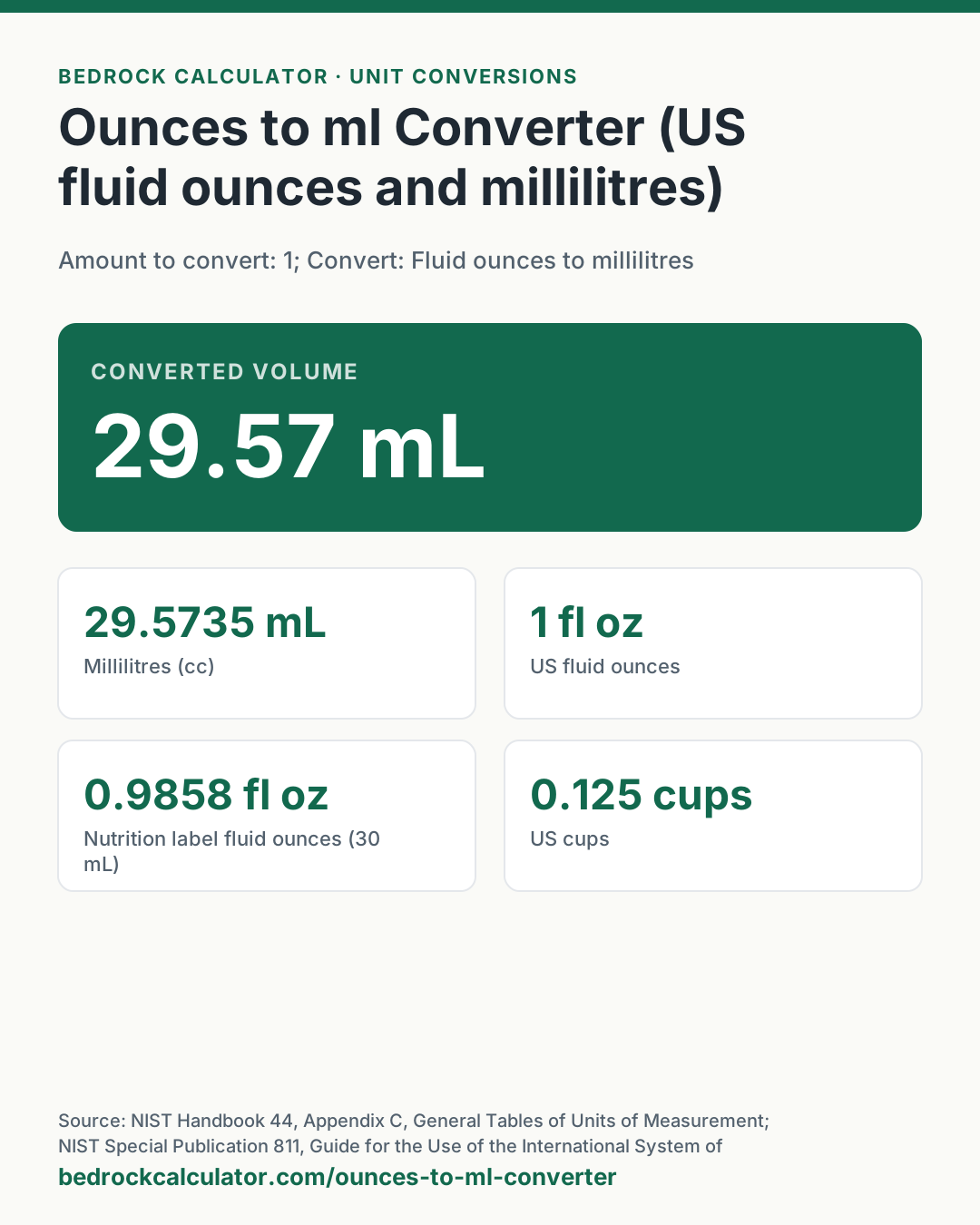
- Millilitres: 1 × 29.5735295625 = 29.57 mL in the headline, or 29.5735 mL on the card.
- In label fluid ounces of 30 mL: 0.9858. A label fluid ounce is slightly bigger than a US customary one.
- Cups: 0.125, an eighth of a cup. Tablespoons: 2.
A cup of liquid, 8 fluid ounces: 8 × 29.5735295625 = 236.59 mL.
100 mL to fluid ounces: 100 ÷ 29.5735295625 = 3.3814 fl oz, which is 0.4227 cups. On a nutrition label's 30 mL scale the same bottle reads 3.3333 label fluid ounces.
600 mL, a common bottle size: 20.2884 fl oz. On the label scale that is exactly 20, which is why a 600 mL bottle can be labelled 20 fl oz.
Fluid Ounces and Millilitres at a Glance
| US fluid ounces | Millilitres |
|---|---|
| 0.5 | 14.7868 |
| 1 | 29.5735 |
| 2 | 59.1471 |
| 4 | 118.2941 |
| 8 | 236.5882 |
| 12 | 354.8824 |
| 16 | 473.1765 |
| 32 | 946.3529 |
| 128 | 3,785.4118 |
Every figure is taken from the converter's reference table. Sixteen fluid ounces is a US pint, 32 a quart and 128 a gallon.
How Many ml Are in an Ounce?
There are 29.5735295625 mL in one US fluid ounce, which most people round to 29.57 or, loosely, to 30. The rounding to 30 is not just a habit: US Nutrition Facts labels are required to use a fluid ounce of exactly 30 mL when they state serving sizes in metric units. That is a labelling convention.
A measuring cup, a bartender's jigger and a recipe all use the customary fluid ounce of 29.57 mL.
The difference is small for one ounce and grows with the volume. The reference tables show it: 600 mL is 20.2884 US fluid ounces but exactly 20 label fluid ounces.
US Versus UK Fluid Ounces
This converter uses the US fluid ounce only. British recipes and older UK packaging use the imperial fluid ounce, which belongs to the imperial pint of 568.26125 mL set by the Weights and Measures Act 1985. The imperial fluid ounce is a little smaller than the US one, so a British recipe's fluid ounces should not go through this converter.
What does this calculator not account for?
- Weight ounces. An ounce on a kitchen scale is a weight, one sixteenth of a pound. This page converts volume only. How much a fluid ounce weighs depends on the liquid; the ml to grams converter on this site handles that with a stated density.
- Imperial fluid ounces. Only the US customary fluid ounce is used.
- Measuring error. Kitchen measuring cups and medicine cups have printed scales that are far less precise than the four decimal places shown here.
- Temperature. A volume of liquid expands slightly as it warms. The conversion between units is exact at any temperature, but a fluid ounce of hot water holds slightly less water than a fluid ounce of cold.
What mistakes do people make with this?
- Treating 30 mL as exact. It is the label convention, not the customary unit. For scaling up a recipe or dosing in bulk, use 29.57.
- Confusing ounces of weight with fluid ounces. A bag of coffee marked 12 oz is a weight. Converting it to millilitres makes no sense without a density.
- Mixing US and UK recipes. An imperial recipe's fluid ounces convert to slightly fewer millilitres than a US recipe's.
- Dropping the leading zero. Small volumes such as 1 mL are 0.0338 fluid ounces. Writing .0338 on a note invites a misread.
Frequently Asked Questions
How many ml is 1 oz?
How many ounces is 1 ml?
How many ounces is 100 ml?
How many ounces is 50 ml?
How many ml is 8 oz?
How many ml is 10 oz?
How many ml is 5 ounces?
How many cc are in an ounce?
How many ounces is 15 ml?
¿Cuántos ml tiene una onza?
Sources
- NIST Handbook 44, Appendix C, General Tables of Units of Measurement: the US gallon and fluid ounce. nist.gov/pml/owm/nist-handbook-44-current-edition
- NIST Special Publication 811, Guide for the Use of the International System of Units (2008), Appendix B: conversion factors to SI. nist.gov/pml/special-publication-811
- eCFR, 21 CFR 101.9(b)(5)(viii), Nutrition labeling of food: the 30 mL fluid ounce for serving sizes. ecfr.gov/current/title-21/chapter-I/subchapter-B/part-101/subpart-A/section-101.9
- UK legislation, Weights and Measures Act 1985, Schedule 1: the imperial pint. legislation.gov.uk/ukpga/1985/72/schedule/1