Quick Answer: One pound is exactly 16 ounces, so 2.5 pounds is 40 ounces and 24 ounces is 1.5 pounds. To go from pounds to ounces, multiply by 16; to go from ounces to pounds, divide by 16.
What does this calculator do?
This pounds to ounces converter works in both directions. Enter a weight, choose pounds to ounces or ounces to pounds, and it gives the converted figure along with the same weight written four other ways: total ounces, total pounds, whole pounds plus leftover ounces, and the metric equivalent in kilograms and grams.
The pound and ounce on this page are the avoirdupois units used for groceries, body weight, postage and most everyday weighing in the United States. Their relationship is fixed by definition rather than by measurement: an ounce is one sixteenth of a pound. Since the international yard and pound agreement of 1959, the pound itself has been defined as exactly 0.45359237 kilograms, which is why the kilogram figures here can be stated without any measuring error, only the rounding chosen for display.
The split into pounds and ounces is the part most converters leave out, and it is the one people usually need. A digital scale that reads 2.3 lb is not showing 2 pounds 3 ounces. It is showing two and three tenths of a pound, which is 2 pounds 4.8 ounces. The converter does that split for you.
Using the Pounds to Ounces Converter
- Type the weight you have in the box. Decimals are allowed, so 0.75 or 2.3 are both fine.
- Choose Pounds to ounces if the number you typed is in pounds, or Ounces to pounds if it is in ounces.
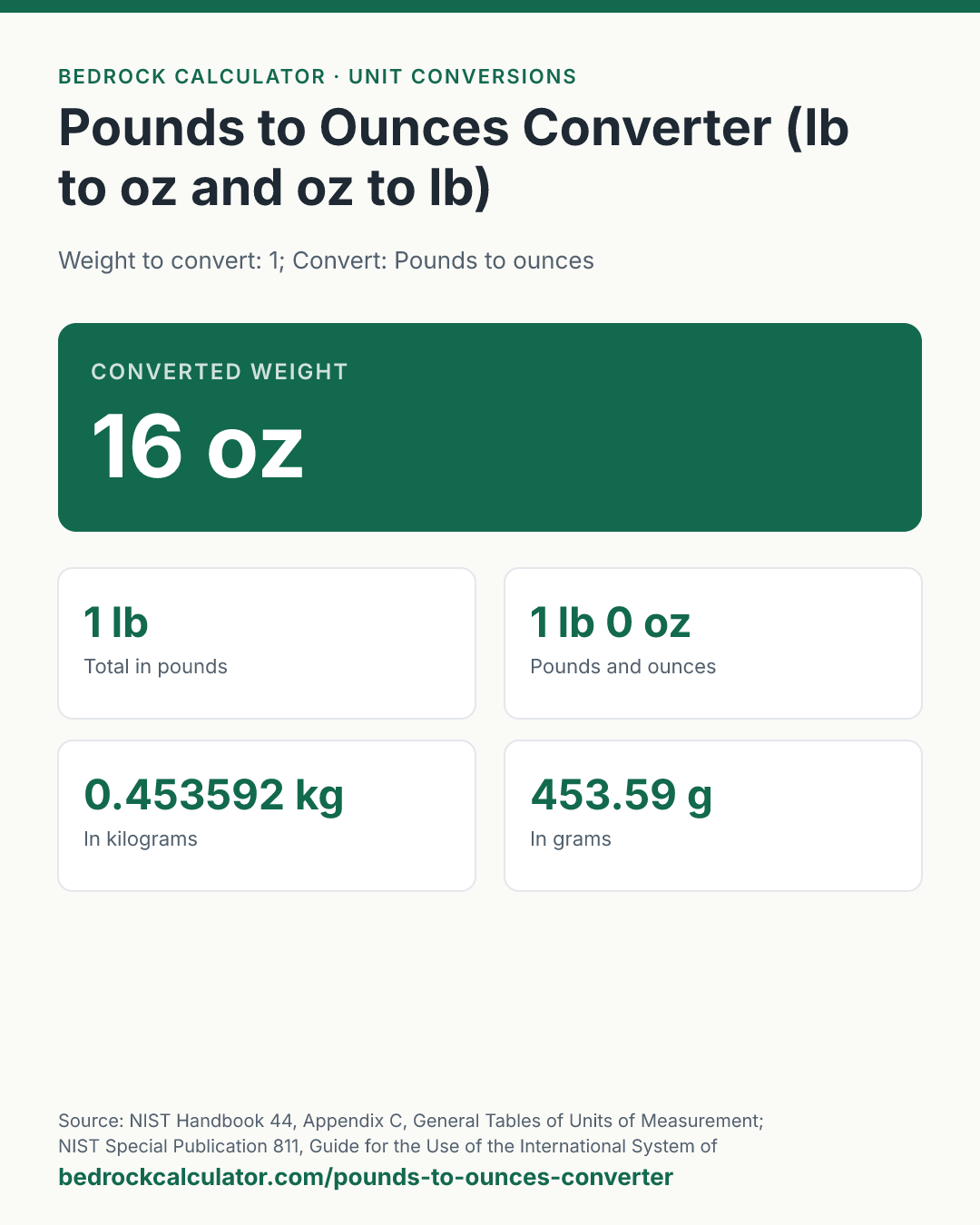
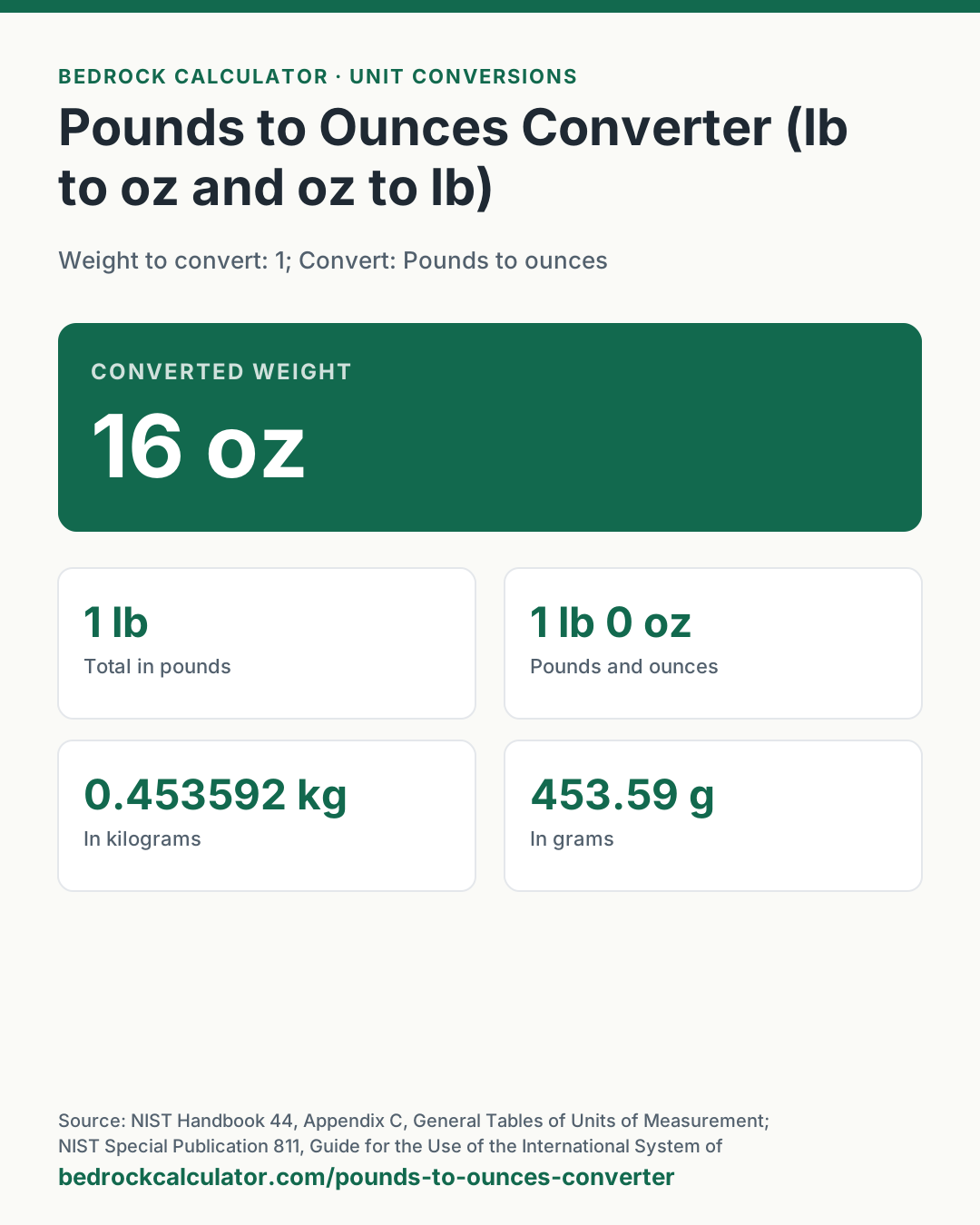
- Read the converted weight at the top of the results. The cards below it repeat the weight in ounces, pounds, pounds and ounces, kilograms and grams.
The preset buttons load three common cases: one pound, a 2.3 lb scale reading, and a 24 oz package. Below the converter, two tables list common weights in each direction, and each can be downloaded as a CSV file.
How is this calculated?
- Choose the starting unit. The direction you pick tells the converter whether your number is in pounds or in ounces. A negative number is read as zero, since a weight cannot be less than nothing.
- Convert through the kilogram. Each unit is stored once as its exact size in kilograms: the pound as 0.45359237 kg and the ounce as one sixteenth of that, 0.028349523125 kg. A conversion multiplies your number by the size of the unit you started in and divides by the size of the unit you want. Because both sizes are exact, the ratio between them is exactly 16 and nothing is lost along the way.
ounces = pounds × 0.45359237/0.028349523125 = pounds × 16
pounds = ounces/16
- Split into pounds and ounces. The total in pounds is cut at the decimal point. The whole part is the pounds; the fraction left over is multiplied by 16 to give the ounces, which are rounded half up to two decimal places. If the leftover ounces round up to a full 16, the converter adds one to the pounds and shows zero ounces, so you will never see a reading like 1 lb 16 oz.
whole pounds = ⌊ pounds ⌋; leftover ounces = (pounds − whole pounds) × 16
- Convert to metric. The same total is converted to kilograms and grams through the exact definition of the pound.
kilograms = pounds × 0.45359237
- Round for display only. The arithmetic runs at 34 significant digits and is rounded half up only when it is shown: pounds to six decimal places, ounces to four, kilograms to six and grams to two, with trailing zeros dropped. For any input with up to two decimal places, the pound and ounce figures need no rounding at all, because dividing by 16 adds at most four decimal places.
Worked Example
Using the converter's default input, 1 pound, pounds to ounces:
- Ounces: 1 × 16 = 16 oz.
- Pounds and ounces: one whole pound with nothing left over, 1 lb 0 oz.
- Kilograms: 1 × 0.45359237 = 0.45359237, shown as 0.453592 kg.
- Grams: 453.59 g.
A kitchen scale reading of 2.3 lb:
- Ounces: 2.3 × 16 = 36.8 oz.
- Split: 2 whole pounds, and 0.3 × 16 = 4.8 ounces left over, so 2 lb 4.8 oz.
- Kilograms: 2.3 × 0.45359237 = 1.043262451, shown as 1.043262 kg, or 1,043.26 g.
Going the other way, 50 ounces to pounds:
- Pounds: 50 ÷ 16 = 3.125 lb.
- Split: 3 whole pounds are 48 ounces, leaving 3 lb 2 oz.
- Kilograms: 1.417476 kg, or 1,417.48 g.
And a weight already written in pounds and ounces, such as 5 lb 3 oz, goes in as ounces first: 5 × 16 + 3 = 83 ounces. Entered as 83 in ounces to pounds mode, it returns 5.1875 lb and 2.35301 kg.
How Many Ounces Are in a Pound?
There are exactly 16 ounces in a pound. That is the definition of the avoirdupois ounce, not a rounded figure, and it has been the same in the United States and the United Kingdom since both adopted the international pound. A half pound is 8 ounces, a quarter pound is 4 ounces, and 4 pounds is 64 ounces.
What does this calculator not account for?
- Fluid ounces. A fluid ounce measures volume, not weight. This converter only handles the weight ounce. How much a fluid ounce weighs depends on what is in the cup; for water it is slightly more than one weight ounce. To turn fluid ounces into pounds, use the water weight calculator, which also covers common ingredients.
- Troy ounces. Gold, silver and other precious metals are priced in troy ounces, which belong to a different system. A troy ounce is heavier than the ounce used here, and a troy pound has 12 troy ounces rather than 16. Do not use this converter for metal prices.
- Pounds and ounces typed together. There is one input box. To convert a weight like 5 lb 3 oz, turn it into ounces first (5 × 16 + 3 = 83) and convert that, as in the worked example.
- Very long decimals. Inputs with more than two decimal places can produce ounce or pound figures with more digits than the display shows, and those are rounded half up. The download tables hold the same rounded values.
- Scale accuracy. The conversion is exact, but the reading you start from is only as good as the scale that produced it.
What mistakes do people make with this?
- Reading decimal pounds as pounds and ounces. 2.5 lb is 2 lb 8 oz, not 2 lb 5 oz, because the decimal is a fraction of 16 ounces, not of 10. This is the most common slip with digital scales, which nearly all show decimal pounds.
- Confusing ounces with fluid ounces. A recipe that lists 8 fluid ounces of milk is asking for a cup by volume. Weighing out 8 ounces of milk gets you close, but not the same amount, and for flour or sugar the two are far apart.
- Using 0.45 for a pound in kilograms. The shortcut always comes out light, and the gap grows with the weight, so it is fine for a quick guess and wrong for a shipping label or a recipe scaled up many times. The converter uses the exact 0.45359237.
- Rounding twice. If you round pounds before converting to ounces, the error multiplies by 16. Convert first, round last, as the converter does.
- Mixing up the abbreviation. "lb" is the pound and "oz" the ounce. "lbs" is just an informal plural; it is the same unit.
Frequently Asked Questions
How many pounds are in an ounce?
How do I convert ounces to pounds and ounces?
How many pounds is 24 ounces?
How many ounces are in 4 pounds?
How do I convert pounds and ounces to kilograms?
Why is the pound abbreviated lb?
Is a UK pound the same as a US pound?
Are fluid ounces the same as ounces?
Sources
- NIST Handbook 44, Appendix C, General Tables of Units of Measurement: definitions of the avoirdupois pound and ounce. nist.gov/pml/owm/nist-handbook-44-current-edition
- NIST Special Publication 811, Guide for the Use of the International System of Units (2008), Appendix B: conversion factors to SI. nist.gov/pml/special-publication-811
- National Bureau of Standards Miscellaneous Publication 233, Units of Weight and Measure (revised to the 1959 refinement of the yard and the pound announced in the Federal Register, 24 FR 5348). nvlpubs.nist.gov/nistpubs/Legacy/MP/nbsmiscellaneouspub233.pdf