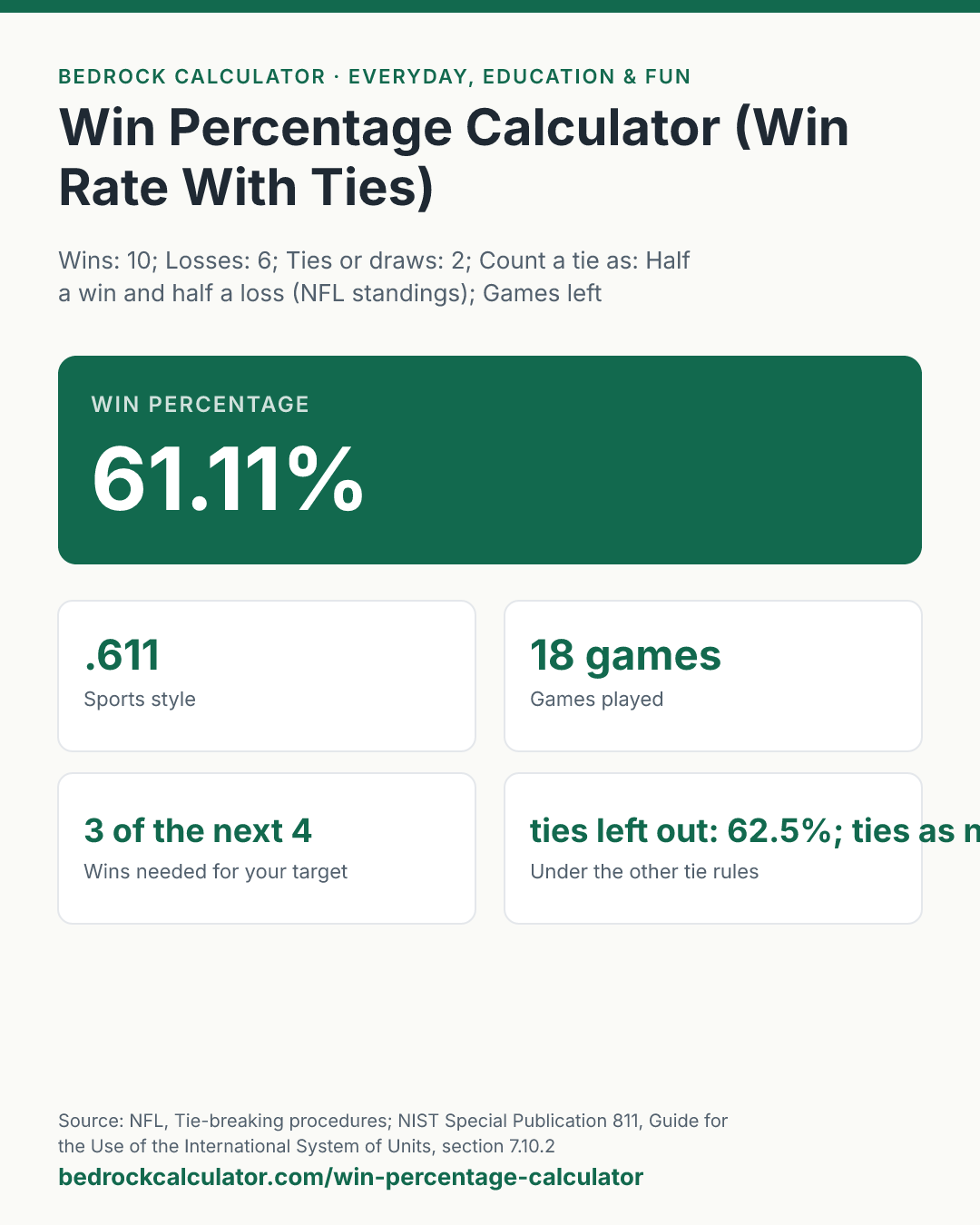

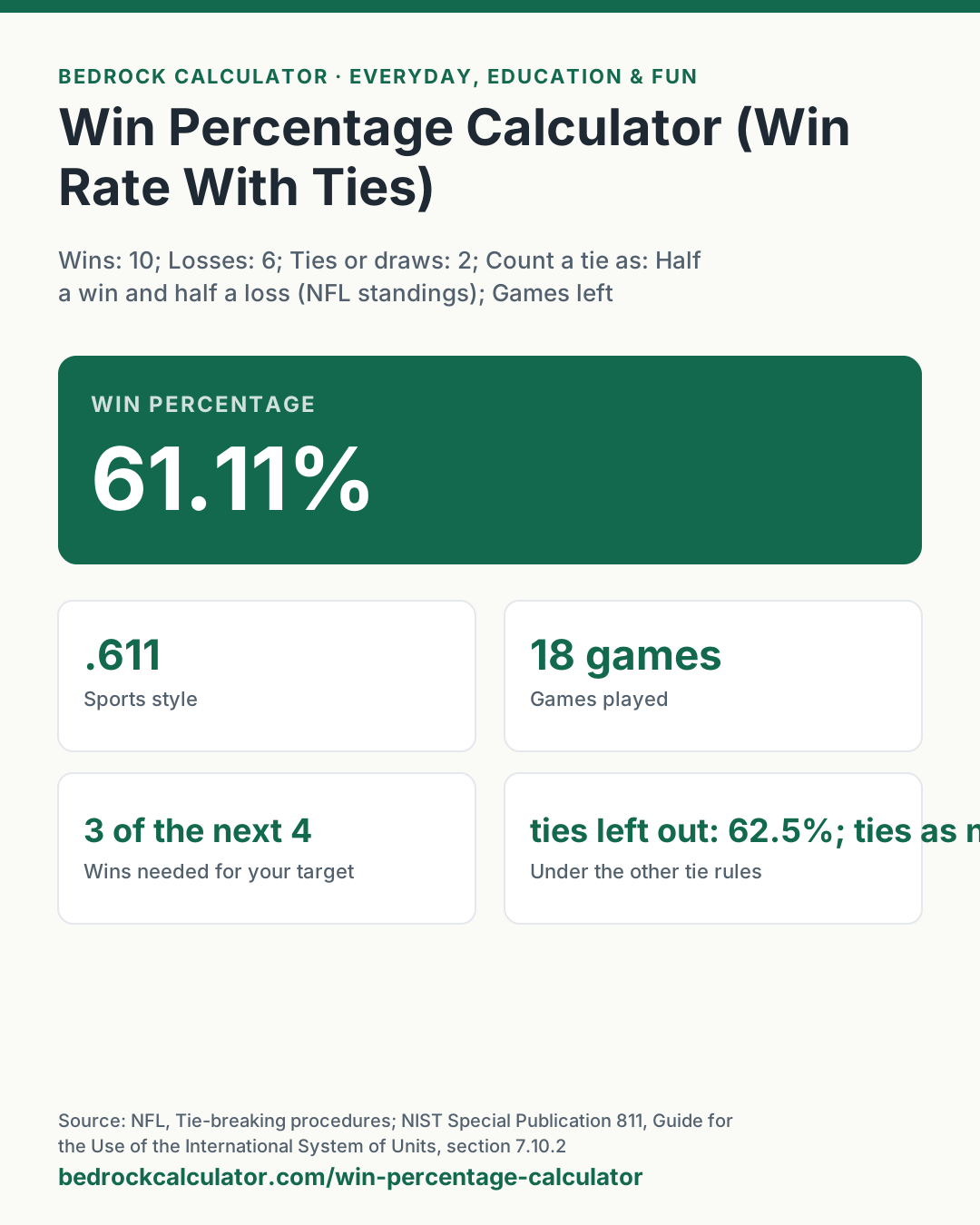
Quick Answer: A 10-6-2 record, counting each tie as half a win, is a 61.11% win percentage, written .611 in standings. Leaving the ties out gives 62.5%, and counting them as games not won gives 55.56%.
What does this calculator do?
This win percentage calculator works out a win rate from wins, losses and ties, for a sports team, a player, a chess club or an online game. It gives the percentage, the three-place decimal that sports standings print, the record and the number of games.
It also shows how many of your remaining games you need to win to reach a target percentage.
Without ties, the win percentage is simply wins divided by games played. Ties are where leagues disagree, and the calculator makes you pick a rule rather than hiding one. The NFL counts a tie as half a win and half a loss. Many people leave ties out altogether and divide wins by wins plus losses. Others, especially in games where a draw is as good as a loss for ranking, count a tie as a game not won. The same record gives a different percentage under each rule, so the calculator shows the other two alongside the one you chose.
Percentages are shown to two decimal places. Standings usually drop the leading zero and show three places, so 61.1% is printed .611 and a perfect record 1.000.
Using the Win Percentage Calculator
- Enter Wins, Losses and Ties or draws.
- Choose how to Count a tie: half a win, left out, or a game not won.
- Optionally, enter the Games left and a Target win percentage to see how many more wins you need.
- Read the win percentage at the top, with the sports-style decimal, record, games played, wins needed and the result under the other tie rules.
The presets show a record with ties, a 12-5 NFL season, a soccer-style record with many draws, and a gamer's win rate over 100 matches with 20 more to play.
How is this calculated?
- Choose the tie rule. Under half a win, a tie adds half a win and every game counts. If ties are left out, they are removed from both the wins and the games. As a game not won, a tie counts as a game but adds nothing to wins.
half a win: (W + T/2)/(W + L + T); left out: W/(W + L); not won: W/(W + L + T)
- Divide. The result is a fraction from 0 to 1. With no games played, it is 0.
- Format. The percentage is the fraction times 100 to two places, rounded half up. The sports style rounds the fraction to three places and drops the leading zero.
- Wins needed. For the target, the calculator tries 0, 1, 2 and so on up to the number of games left, each time adding that many wins and counting the rest of the remaining games as losses, with no new ties. The first count that reaches the target is the answer. If even winning them all falls short, it says so.
Worked Example
The default record, 10 wins, 6 losses and 2 ties, with ties as half a win:
- Credit for wins is 10 + 2 ÷ 2 = 11.
- Games played are 10 + 6 + 2 = 18 games.
- 11 ÷ 18 = 0.6111, so the win percentage is 61.11%, or .611.
- Leaving the ties out, it is 10 ÷ 16 = 62.5%. Counting them as not won, 10 ÷ 18 = 55.56%.
- With 4 games left and a target of 60%, winning 3 of them makes it 14 credits from 22 games, which reaches the target: 3 of the next 4.
A 12-5 season with no ties is 12 ÷ 17 = 70.59%, or .706, under every tie rule.
How Do You Calculate Win Rate?
Divide the wins by the games played and multiply by 100. 54 wins in 100 matches is a 54% win rate. To reach 60% over the next 20 matches, the calculator shows you need 18 of the next 20, because the total would need to be 72 wins out of 120.
How Do Ties Count in Win Percentage?
It depends on the league. In the NFL a tie counts as half a win and half a loss, which is the default here.
In leagues that award points for draws, such as most soccer leagues, the table is ranked by points, not win percentage; if you want a win rate from such a record, leaving the draws out or counting them as not won are both used. A 15-10-13 record gives 60% with draws left out, 56.58% with draws as half, and 39.47% with draws as not won.
What does this calculator not account for?
- League points systems. Many leagues, including most soccer leagues, rank teams by points awarded for wins and draws rather than by win percentage. This calculator does not compute points.
- Tiebreakers. Standings break equal percentages with head-to-head records, division records and other rules. None of those are applied.
- Forfeits, overtime losses and shootouts. Some leagues record these separately. Decide whether each is a win, a loss or a tie and enter it that way.
- Strength of schedule. A win rate treats every game the same, whoever the opponent was.
- Future ties. The wins-needed figure assumes no more ties.
What mistakes do people make with this?
- Mixing tie rules. Comparing one team's percentage with ties as half against another's with ties left out is not a fair comparison. Use the same rule for both.
- Reading .611 as 611%. The sports style is a decimal fraction with the zero dropped. .611 is 61.1%.
- Forgetting that losses grow with games left. The wins-needed figure counts every remaining game you do not win as a loss.
- Rounding before comparing. Two records can both show .600 and still differ slightly. Use the two-place percentage for close comparisons.
- Dividing wins by losses. A win-loss ratio, such as 10 to 6, is not a win percentage. Divide wins by games played.
Frequently Asked Questions
What is a good win percentage?
How is win percentage calculated in the NFL?
How do I calculate my win rate in a game?
How many games do I need to win to reach 60%?
Why does a 17-0 record show 1.000?
Is win percentage the same as winning percentage?
Sources
- NFL, Tie-breaking procedures: tie games count as one-half win and one-half loss for both clubs. nfl.com/standings/tie-breaking-procedures
- NIST Special Publication 811, Guide for the Use of the International System of Units, section 7.10.2: the percent sign as the number 0.01. nist.gov/pml/special-publication-811/nist-guide-si-chapter-7-rules-and-style-conventions-expressing-values