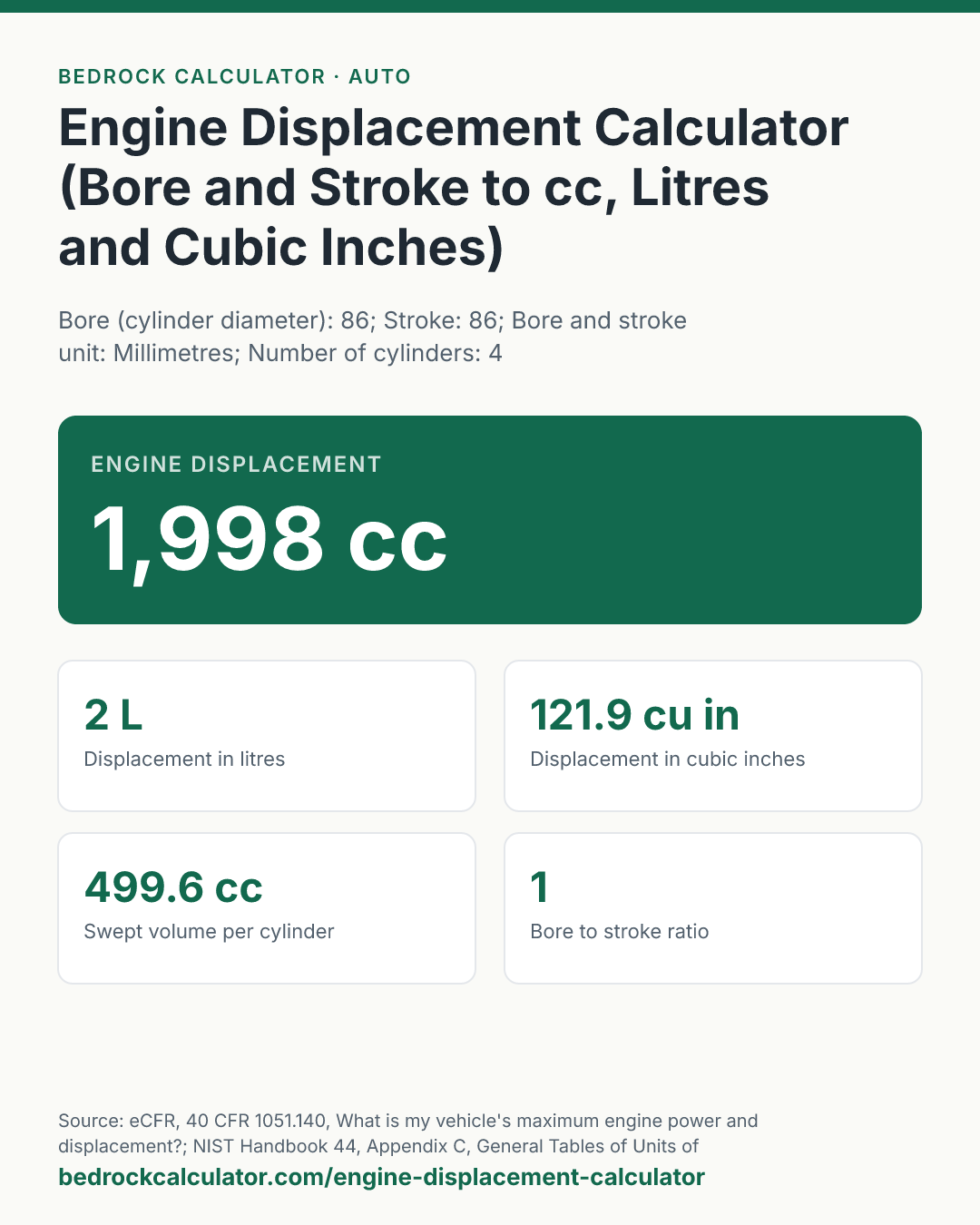
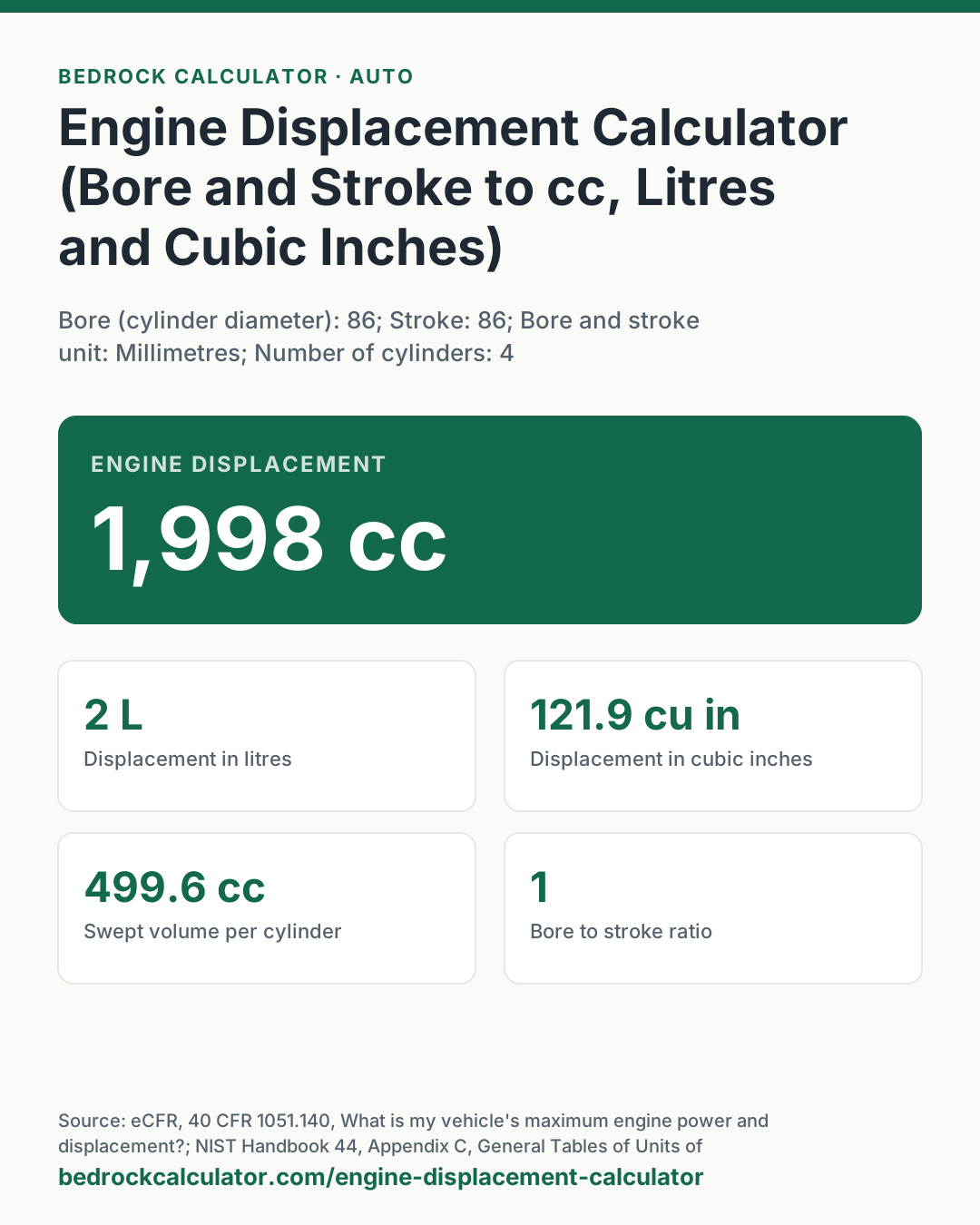
Quick Answer: A four-cylinder engine with an 86 mm bore and an 86 mm stroke displaces 1,998 cc, which is 2 litres or 121.9 cubic inches. Displacement is the area of the bore times the stroke times the number of cylinders.
What does this calculator do?
This engine displacement calculator works out an engine's size from three measurements: the bore (the inside diameter of a cylinder), the stroke (how far the piston travels) and the number of cylinders. It returns the total swept volume in cubic centimetres, litres and cubic inches.
It also gives the volume of a single cylinder and the bore-to-stroke ratio that tells you whether the engine is square, oversquare or undersquare.
Displacement is what people mean by engine size or engine capacity. A "2.0-litre" badge, a "350" V8 and a "600 cc" motorcycle are all quoting the same quantity in different units. The figure is fixed by the engine's geometry, so if you know the bore, stroke and cylinder count you can check a quoted size, work out what a rebore will do, or size up an engine whose badge is missing.
The formula is the one US emission rules use. Under 40 CFR 1051.140, an engine's displacement is its swept volume: the internal cross-section area of the cylinders, times the stroke length, times the number of cylinders, rounded to the nearest cubic centimetre. The headline here follows that rounding.
Using the Engine Displacement Calculator
- Enter the bore and the stroke, and choose millimetres, centimetres or inches. Both must be in the same unit.
- Enter the number of cylinders.
- Read the displacement in cubic centimetres at the top. The cards give the same figure in litres and cubic inches, the volume of one cylinder, the displacement to two decimal places, and the bore-to-stroke ratio.
The presets load a classic V8 measured in inches, the single-cylinder example from the federal regulation, and a small three-cylinder engine. Two tables below the calculator show how displacement grows with the number of cylinders and with the bore of a square four-cylinder engine.
How is this calculated?
- Convert to centimetres. The bore and stroke are converted to centimetres using exact factors (1 inch is 2.54 cm, 1 mm is 0.1 cm), so the volume comes out directly in cubic centimetres.
- Find the bore area. The bore is a circle, so its area is pi times the radius squared, where the radius is half the bore. Pi is carried to 34 digits.
- Multiply by the stroke. The piston sweeps a cylinder of that area and the stroke's length, which gives the swept volume of one cylinder.
V_cylinder = π × (bore/2)² × stroke
- Multiply by the cylinder count. The engine's displacement is that volume times the number of cylinders.
V_engine = π × (bore/2)² × stroke × cylinders
- Convert and compare. The total is converted to litres (1,000 cc) and to cubic inches (16.387064 cc each, exact). The bore-to-stroke ratio is the bore divided by the stroke.
- Round for display. The headline is rounded to the nearest cubic centimetre, as 40 CFR 1051.140 does. Litres are shown to two decimal places, cubic inches and the per-cylinder volume to one, and the ratio to three.
Worked Example
With the default inputs, 86 mm bore, 86 mm stroke, 4 cylinders:
- Radius: 86 ÷ 2 = 43 mm, or 4.3 cm. Stroke: 8.6 cm.
- One cylinder: pi × 4.3² × 8.6 = 499.6 cc.
- Four cylinders: 1,998.23 cc, which rounds to 1,998 cc.
- In other units: 2 litres or 121.9 cubic inches.
- Bore and stroke are equal, so the ratio is 1 and the engine is square.
The federal regulation's own example is a single cylinder with a 6.00 cm bore and a 6.25 cm stroke: 1 × (6.00 ÷ 2)² × pi × 6.25 = 176.71 cc, which the rule rounds to 177 cc. The calculator gives the same answer with the second preset.
A V8 with a 4.00 inch bore and a 3.48 inch stroke works out to 349.8 cubic inches, or 5,733 cc (5.73 litres). Its bore-to-stroke ratio is 1.149, so it is oversquare.
What Is Engine Capacity, and Is It the Same as Engine Size?
Yes. Engine capacity, engine size, engine volume and cubic capacity are all names for displacement, the total volume the pistons sweep in one full stroke. It is not the volume of fuel or air the engine holds, and it does not include the combustion chamber above the piston at the top of its stroke.
A cylinder head with a bigger or smaller chamber changes the compression ratio but not the displacement.
Manufacturers round their badges. The default engine's 1,998 cc would wear a 2.0 badge, and a "350" V8 is the rounded figure for the 349.8 cubic inches shown above. To know the exact capacity, measure or look up the bore and stroke and run them here.
Square, Oversquare and Undersquare
The bore-to-stroke ratio describes an engine's shape:
- Square (ratio 1): bore equals stroke, as in the default 86 by 86 mm engine.
- Oversquare (above 1): the bore is wider than the stroke is long. Short strokes keep piston speeds down at high revs, so many high-revving engines are built this way. The V8 preset at 1.149 is oversquare.
- Undersquare (below 1): the stroke is longer than the bore, common in engines tuned for low-speed pulling. The three-cylinder preset at 0.961 is undersquare.
Two engines with the same displacement can have very different ratios, which is why the ratio is shown alongside the volume.
What does this calculator not account for?
- Rotary engines. A Wankel engine has no pistons or stroke, and its displacement is defined differently. This calculator covers piston engines only.
- Two-stroke versus four-stroke. Displacement is the same geometric volume for both. How much air the engine moves per revolution differs, but that is not displacement.
- Compression ratio and chamber volume. Neither is computed. They need the combustion chamber volume, which is not an input.
- Measured versus nominal dimensions. Manufacturing tolerance, wear and a rebore all change the real bore slightly. The result is only as accurate as the dimensions you enter.
- Unequal cylinders. Every cylinder is assumed to share the same bore and stroke, which is true of practically every production engine.
What mistakes do people make with this?
- Using the radius as the bore. The bore is a diameter. Entering the radius gives a quarter of the right volume.
- Mixing units. A bore in millimetres and a stroke in inches give nonsense. Convert one first so both share a unit.
- Forgetting the cylinder count. A single cylinder's volume is easy to mistake for the engine's.
- Rebore arithmetic in your head. Going 0.5 mm over on the bore adds more volume than it sounds, because the area grows with the square of the bore. Run the new bore through the calculator.
- Comparing badges to the calculation. A badge is a rounded marketing figure. A small difference between the badge and the calculated volume is normal.
Frequently Asked Questions
How do I calculate engine cc from bore and stroke?
How do I convert cc to cubic inches?
What is piston displacement?
How much bigger does an engine get if I bore it out?
Why does the badge say 2.0 when the calculator says 1,998 cc?
Does a turbocharger change displacement?
Sources
- eCFR, 40 CFR 1051.140, What is my vehicle's maximum engine power and displacement?: displacement as swept volume, with the 177 cc worked example. ecfr.gov/current/title-40/section-1051.140
- NIST Handbook 44, Appendix C, General Tables of Units of Measurement: the inch of 2.54 cm and the cubic inch. nist.gov/pml/owm/nist-handbook-44-current-edition
- NIST Special Publication 811, Guide for the Use of the International System of Units: the litre and cubic centimetre. nist.gov/pml/special-publication-811