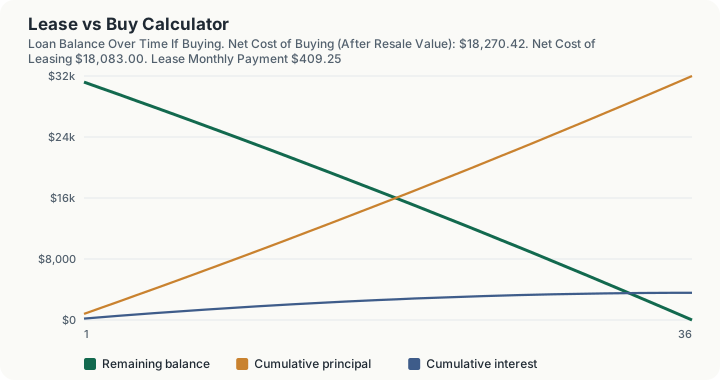
Quick Answer: On a $35,000 vehicle with $3,000 down over 36 months (0.00125 money factor, 58% residual, 7.0% loan APR), leasing runs $409.25 a month against $988.07 a month to finance. But on a net basis, once the buy path's retained $20,300 resale value is subtracted out, buying nets $18,270.42 total against leasing's $18,083.00, meaning leasing is actually the cheaper path here by $187.42.
Overview
Comparing a lease payment to a loan payment directly is the single most common mistake in vehicle financing decisions, and it always favors leasing, because leasing is engineered to produce a lower monthly number. A lease payment only covers the vehicle's expected depreciation over the term plus a finance charge; it never repays the full price. A loan payment repays the full amount financed. At the end of the loan, you own an asset worth real money. At the end of the lease, you own nothing and hand the keys back.
This calculator does the comparison the way it should be done: on a net cost basis. It totals every dollar that leaves your pocket under each path, then subtracts the value you still hold at the end of the buy path (the vehicle's resale value), since leasing leaves you holding $0 of value at term-end by design. That net figure, not the monthly payment, is the number that actually tells you which path costs less.
Both paths start from the same negotiated price, the same upfront cash, and the same assumed resale value at the end of the horizon, so the only thing driving the difference is financing structure: a lease's money factor and residual value versus a loan's APR and amortization.
How This Is Calculated
Lease payment (standard closed-end lease formula):
Adjusted cap cost is the negotiated price minus the cap cost reduction (down payment/trade equity) plus any capitalized acquisition fee. This is the same convention used by Consumer Reports and Edmunds in their lease-shopping guides.
Money factor to APR: A money factor like 0.00125 isn't directly comparable to a loan's APR. The standard industry approximation is:
This works because a money factor is conventionally an annualized rate divided by 2400 (the factor of 24 comes from doubling the average outstanding balance convention, and 100 converts to a percentage). A 0.00125 money factor is therefore roughly equivalent to a 3.0% APR. It's an approximation, not an exact conversion, since a lease's finance charge is computed on the sum of the adjusted cap cost and residual value rather than on a declining loan balance, but it's the standard shorthand for sanity-checking a lease quote against loan rate offers.
Loan payment: The buy path uses this platform's standard fixed-rate amortization engine on the amount financed (price minus down payment), producing a full month-by-month schedule that reconciles to $0.00.
Net cost of leasing = cap cost reduction + sum of all lease payments + disposition fee. Retained value is $0 because the vehicle is returned.
Net cost of buying = down payment + sum of all loan payments − assumed resale value at the end of the horizon. The resale value assumption is deliberately set equal to the lease's residual value percentage, since both represent the same vehicle at the same age and mileage; only the financing differs.
Worked Example
A $35,000 vehicle, $3,000 down either way, 36 months, a 0.00125 money factor against a 7.0% loan APR, and a 58% residual. Take the lease side first.
Step 1 -- The residual value. $35,000 x 58% = $20,300.00
Step 2 -- The adjusted cap cost. $35,000.00 - $3,000.00 + $650.00 acquisition fee = $32,650.00
Step 3 -- The depreciation fee. ($32,650.00 - $20,300.00) / 36 = $343.06 a month
Step 4 -- The finance fee. ($32,650.00 + $20,300.00) x 0.00125 = $66.19 a month
Note what Step 4 uses: the sum of cap cost and residual, not a declining balance. A lease charges finance on a base that never falls.
Step 5 -- The monthly lease payment. $343.06 + $66.19 = $409.25
Step 6 -- Thirty-six of those payments. $409.25 x 36 = $14,733.00
Step 7 -- Net cost of leasing. $3,000.00 + $14,733.00 + $350.00 disposition fee = $18,083.00, against $0.00 of value retained
Now the buy side, where the payment is more than twice as large and the net cost is not.
Step 8 -- The amount financed. $35,000.00 - $3,000.00 = $32,000.00
Step 9 -- The monthly loan payment. $32,000 amortized at 7.0% over 36 months = $988.07
Step 10 -- Month 1 of that loan. Interest $186.67, principal $801.40, balance down to $31,198.60
Step 11 -- Month 2. Interest $181.99, principal $806.08, balance $30,392.52, and cumulative interest of $368.66 across the two months
Step 12 -- Halfway, month 18. Interest $103.38, principal $884.69, balance $16,836.76, cumulative interest $2,622.02
Step 13 -- Month 36. Interest $5.73, a final payment of $987.97, balance $0.00, and lifetime interest of $3,570.42
Step 14 -- Total cash out on the buy path. $3,000.00 + $35,570.51 of payments = $38,570.51
Step 15 -- Net of the car you still own. $38,570.51 - $20,300.00 = $18,270.42
Step 16 -- The comparison that matters. $18,270.42 - $18,083.00 = $187.42, so leasing is cheaper on this horizon
Compare that $187.42 to the raw payment gap. The lease costs $409.25 a month and the loan $988.07, a difference of $578.82 a month and $20,837.51 across the whole term. Only $187.42 of that survives the netting, so more than 99% of the gap a showroom comparison shows is not a cost difference at all. It is the equity built up in steps 10 through 13.
Two variations:
Step 17 -- A stronger lease deal, money factor 0.00075. Lease payment falls to $382.77 (an equivalent APR of 1.8% rather than 3.0%) and leasing's advantage widens to $1,140.70
Step 18 -- The same comparison stretched to 48 months. Lease $323.48 a month against a loan payment of $766.28, net costs of $18,877.04 and $19,481.39, so leasing leads by $604.35
Step 19 -- And at 60 months. Leasing leads by $1,047.22
Steps 18 and 19 need reading carefully rather than as a verdict on long holds. The calculator applies the residual percentage you enter at whatever term you choose, so a 60-month horizon here still assumes the car is worth 58% of its price. A real five-year-old car is not, and correcting that assumption downward is what actually reverses the ranking. The tool will not do it for you: lower the residual percentage yourself when you lengthen the term.
What This Does Not Account For
- Sales tax. Most states tax either the full purchase price (buy) or only the monthly lease payment (lease), and the two methods produce different effective tax burdens. Neither path in this calculator includes sales tax; add your state's estimate to both totals before comparing to a real quote.
- Mileage overage charges. Leases cap annual mileage (commonly 10,000-15,000 miles) and charge a per-mile fee, often $0.15-$0.30, for every mile over. High-mileage drivers should weight the buy path more heavily than this calculator's net numbers alone suggest.
- Excess wear-and-tear charges. Leases can bill for damage beyond normal wear at turn-in; owned vehicles carry no such bill.
- Financing the lease's or loan's sales tax and fees. Real quotes often roll additional costs into the monthly payment; this calculator isolates the core financing math.
- Depreciation as a function of the term you chose. The residual percentage is applied unchanged at whatever term you enter, so a 60-month comparison still values the vehicle at the percentage you typed. That is realistic for a 36-month lease residual and increasingly generous beyond it. Because the buy path is the only one credited with that value, holding the percentage constant while lengthening the term flatters leasing rather than buying. Lower the residual yourself when extending the horizon.
- The time value of money. This is a simple sum of nominal cash flows on each path, not a discounted present-value comparison. For most consumer lease-vs-buy decisions over 2-5 years the distinction is minor, but it means the calculator doesn't credit buying for the fact that loan payments happen later in the term than lease cap cost reduction.
Common Pitfalls
- Comparing monthly payments only. A lease payment will almost always look smaller than a loan payment on the same car, because a lease payment never repays the full price. That is not the same as leasing being the cheaper choice; run the net comparison instead.
- Ignoring the residual value assumption. The whole "buying nets out resale value" calculation depends on that resale estimate being realistic. Lenders set lease residuals conservatively (partly to protect themselves); if you believe the car will actually be worth meaningfully more or less than the money-factor sheet's residual percentage, adjust it and re-run the comparison.
- Not converting the money factor to an APR. A money factor of "2.5" quoted by a dealer is really 0.00250 -- dealers sometimes state money factors without the leading zeros, which can make a mediocre rate look unrecognizable. Always convert to the equivalent APR before judging whether a lease rate is competitive.
- Assuming a longer term always favors buying. It usually does, since more of the loan gets paid down and the vehicle still has resale value, but a weak loan APR relative to a strong lease money factor can offset that. Use the scenario buttons to check your specific numbers rather than assuming the general rule holds.
- Forgetting mileage and wear-and-tear exposure. A close net-cost race between leasing and buying can flip entirely once mileage overage or excess-wear charges are added for a driver who exceeds the lease's annual mileage allowance.
Frequently Asked Questions
Why does the lease payment look so much lower than the loan payment?
What is a "money factor" and why isn't it just an interest rate?
What residual value percentage should I use?
Does a longer loan term always make buying look better in this comparison?
Should I ever choose the option that costs more on this net basis?
Sources
- Federal Trade Commission: Consumer guidance on comparing vehicle leasing and financing. consumer.ftc.gov
- Federal Reserve Board: Consumer Leasing Act (Regulation M) disclosure requirements for motor vehicle leases. federalreserve.gov
- Myers, S. C., Dill, D. A. and Bautista, A. J. (1976), "Valuation of Financial Lease Contracts," The Journal of Finance 31(3). doi.org/10.1111/j.1540-6261.1976.tb01924.x
Also consulted: Consumer Reports: Car leasing guide and money factor/residual value terminology conventions; Edmunds: Lease payment formula (depreciation fee plus finance fee) and money-factor-to-APR conversion convention.