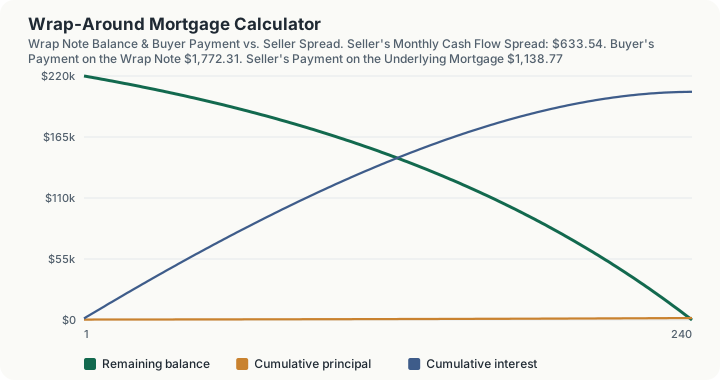
Quick Answer: A wrap-around mortgage lets a seller finance a buyer on a new, larger note that "wraps around" the seller's existing mortgage, and this calculator shows the buyer's monthly payment, the seller's continuing payment on the underlying loan, and the monthly cash flow spread the seller pockets in between.
Overview
A wrap-around mortgage is a form of seller financing used when a home seller still owes money on their own mortgage but wants (or needs) to finance the sale directly rather than requiring the buyer to qualify for a new bank loan. Instead of paying off the existing loan at closing, the seller keeps the original mortgage in place and signs a new, larger promissory note directly with the buyer. That new note "wraps around" the old one: its face amount typically equals the underlying loan balance plus the equity the seller is financing, and its interest rate is usually set higher than the rate on the underlying loan.
Every month, the buyer sends one payment to the seller. The seller uses part of that payment to keep the original mortgage current and keeps the rest. That remainder, the difference between what the buyer pays on the wrap note and what the seller owes on the underlying note, is the seller's cash flow spread. It compensates the seller for extending credit and for the risk of remaining personally liable on the original loan while someone else's payment stream determines whether it stays current.
Wrap-around mortgages show up most often in seller's markets with tight credit conditions, between family members, in owner-financed rural or investment property sales, and any time a buyer cannot immediately qualify for institutional financing but a seller is willing to carry the paper. They are legally distinct from a simple assumption (where the buyer formally takes over the existing loan) and from a land contract (where legal title does not transfer until the note is paid off). A wrap-around typically does transfer title at closing, subject to the wrap note and, in most cases, subject to the underlying mortgage remaining outstanding.
How This Is Calculated
This calculator treats the arrangement as two separate, fully amortizing loans running in parallel:
- The wrap note (buyer's obligation). The buyer owes the seller the full wrap loan amount, amortized at the wrap rate over the wrap term. This calculator runs that principal, rate, and term through the platform's standard amortization engine to produce the buyer's exact monthly payment and a full period-by-period schedule of principal, interest, and remaining balance.
- The underlying note (seller's obligation). The seller still owes the original lender the underlying balance, amortized at the underlying rate over its own remaining term. That loan is amortized separately using the same engine.
For every month that both notes are active, the seller's cash flow spread is simply:
`
Monthly Spread = Buyer's Wrap Payment − Seller's Underlying Payment
`
If the underlying loan pays off before the wrap note does (a common design, since the wrap term is often set to outlast the underlying loan's remaining amortization), the seller no longer owes anything to the original lender. From that month forward, the seller keeps the buyer's entire wrap payment, and the schedule reflects the underlying payment dropping to zero. The calculator sums these monthly spreads across the full wrap term to produce a lifetime cash flow figure for the seller, alongside the buyer's total interest cost on the wrap note and the seller's total interest cost on the underlying note.
Worked Example
Consider a seller who owes $180,000 on their existing mortgage at 4.5% with 240 months (20 years) remaining. They sell the home and finance the buyer on a wrap note of $220,000 at 7.5% for 240 months (the extra $40,000 represents the seller's equity being carried).
- Buyer's monthly wrap payment: $1,772.31
- Seller's monthly payment on the underlying mortgage: $1,138.77
- Seller's monthly cash flow spread: $1,772.31 − $1,138.77 = $633.54
- Total spread collected over 240 months (both notes run the same term here): $633.54 × 240 = $152,049.60
- Buyer's total interest paid over the wrap note's life: $205,353.21
- Seller's total interest paid on the underlying note: $93,304.53
That $633.54 monthly spread is the seller's compensation for financing $40,000 of equity and for carrying the rate risk and payment risk of the arrangement over two decades.
What This Does Not Account For
This calculator models the cash flow mechanics of a wrap-around note. It does not account for:
- The due-on-sale clause. Most conventional mortgages contain a due-on-sale clause that gives the original lender the right to call the entire underlying loan immediately due if the property is sold or title transfers, which a wrap-around arrangement does. This is the single biggest legal risk in a wrap and is not modeled here.
- Escrow, taxes, and insurance. Figures here are principal and interest only. Real payments typically also include property tax and homeowner's insurance escrow.
- Default and foreclosure mechanics. If the buyer stops paying, the seller remains contractually obligated to the original lender regardless. If the seller stops forwarding payments, the underlying lender can foreclose even though the buyer may be current on the wrap note. Neither scenario is modeled.
- Closing costs, loan servicing fees, or a third-party escrow/servicing agent, which sophisticated wrap transactions often use to reduce trust risk between buyer and seller.
- State-specific usury limits and seller-financing disclosure requirements, which vary and can restrict permissible wrap rates or require licensing.
Common Pitfalls
- Ignoring the due-on-sale clause. Structuring a wrap without addressing this risk, or without legal review of the underlying note's language, can result in the entire underlying balance being called due at the worst possible time.
- Setting the wrap term far shorter than the underlying term without planning for the shortfall. If the wrap note pays off before the underlying note, the seller can be left owing a remaining balance on the original mortgage with no offsetting buyer payment.
- Confusing a wrap-around with a simple loan assumption. In an assumption, the buyer formally takes over the original loan and the seller is (ideally) released from liability. In a wrap, the seller remains personally on the hook for the underlying loan the entire time.
- Not verifying the buyer's ability to pay before extending seller financing. The seller is taking on effectively the same credit risk a bank would, without a bank's underwriting resources.
- Overlooking that the spread is not risk-free profit. It compensates for real default risk, servicing effort, and the due-on-sale exposure described above.
Frequently Asked Questions
Is a wrap-around mortgage legal?
What happens if the underlying lender calls the loan due?
Why is the wrap rate usually higher than the underlying rate?
Can the wrap note and the underlying note have different terms?
Does the buyer ever deal directly with the original lender?
Sources
- Consumer Financial Protection Bureau: Regulation Z and the Dodd-Frank seller-financing exemptions for owner-financed transactions. ecfr.gov/current/title-12/chapter-X/part-1026
- Internal Revenue Service: Publication 537, Installment Sales, for tax treatment considerations relevant to seller-financed transactions. irs.gov/publications/p537
Also consulted: Uniform Commercial Code and state real property statutes governing wraparound and purchase-money mortgage instruments.