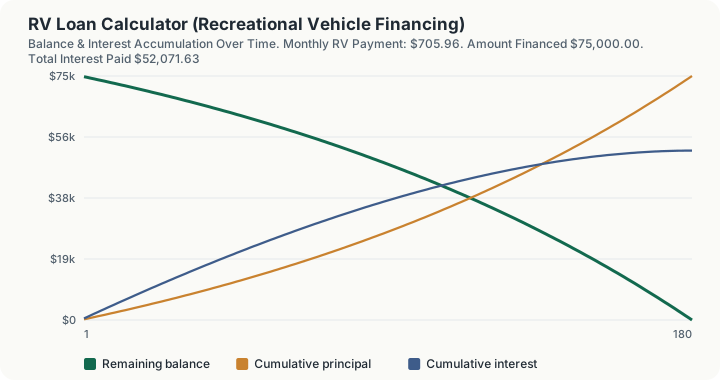
Quick Answer: A $75,000 RV loan at 7.75% APR over 180 months (15 years) costs $705.96 a month and $52,072.23 in total interest.
Overview
RV financing works like auto financing stretched over a much longer horizon. Because motorhomes and large towable trailers can cost as much as a house, and because they hold their value differently than a typical car, lenders commonly offer much longer terms than you'd see on a vehicle loan: 10, 15, even 20 years on larger units, compared to 5 or 6 years for a typical car. The tradeoff is the same one that applies to any long-term loan: a lower, more manageable monthly payment in exchange for meaningfully more interest paid over the life of the loan.
This calculator runs a standard loan amortization on the amount financed after your down payment or trade-in, using whichever term and rate apply to your loan. It doesn't add state sales tax or registration fees, since those vary widely by state and by vehicle classification; if you want taxes and fees included, add them to the RV price before entering it.
How This Is Calculated
The amount financed is the RV's price minus your down payment. There is no separate trade-in input, so if you are trading a unit in, fold its agreed value into the down payment figure:
`
Amount Financed = RV Price − Down Payment
`
The monthly payment uses the standard fixed-rate loan amortization formula:
`
PMT = P × i / (1 − (1 + i)^−n)
`
where P is the amount financed, i is the monthly interest rate (APR divided by 12), and n is the loan term in months. Each payment splits between interest, calculated on the outstanding balance, and principal, which reduces that balance going forward. Because RV loan terms run so much longer than auto loan terms, the early years of the schedule are especially interest-heavy: a larger share of each payment goes to interest for a longer stretch than on a shorter loan, simply because there are more months during which the still-large balance accrues interest.
A full month-by-month schedule is generated and reconciles exactly: the sum of every principal portion across the schedule equals the original amount financed, to the cent.
Worked Example
Take an $85,000 RV purchased with a $10,000 down payment, financed at 7.75% APR over 180 months (15 years):
- Amount financed: $85,000 − $10,000 = $75,000
- Monthly interest rate: 7.75% ÷ 12 = 0.0064583
- Monthly payment: solving the amortization formula for $75,000 over 180 months at that rate gives $705.96
- Total of all payments: $705.96 × 180 = $127,072.80
- Total interest paid: $127,072.80 − $75,000 = $52,072.23
Stretch that same $75,000 loan to 240 months (20 years) instead of 180, and the monthly payment drops, but total interest climbs well past $52,072.23, since the balance sits outstanding, accruing interest, for five additional years. Shorten it to 120 months (10 years) and the opposite happens: the monthly payment rises but total interest falls substantially. The 15-year term in this example sits in between those two outcomes.
What This Does Not Account For
- State sales tax, title, and registration fees. These vary significantly by state and by whether the unit is classified as a motor vehicle, a trailer, or in some states even real property for tax purposes. Add them into the RV price if you want them financed as part of the loan.
- Depreciation and loan-to-value risk on long terms. RVs, like most vehicles, depreciate substantially in the first several years. A long loan term paired with a small down payment can leave you owing more than the RV is worth for a meaningful stretch of the loan, a gap that's larger and lasts longer than on a typical car loan.
- Insurance, storage, and maintenance costs. RV insurance, seasonal storage fees, and maintenance on a large vehicle or towable unit are real ongoing costs not reflected in the loan payment this calculator produces.
- Age restrictions on loan term. Many lenders cap the maximum loan term based on the RV's age, offering shorter terms on used units than on new ones. Enter the term you've actually been quoted rather than assuming the maximum is always available.
- Balloon payment structures. Some RV loans, particularly on very large or specialty units, are structured with a balloon payment due at the end of a shorter term rather than a fully amortizing schedule across the whole term. This calculator assumes full amortization across the entered term.
Common Pitfalls
- Choosing the longest term without checking total interest cost. A 20-year RV loan can look attractive for the low monthly payment, but on a depreciating asset, a very long term means paying interest on a shrinking-in-value item for a long time, and increases the odds of being underwater on the loan for years.
- Underestimating total cost of ownership. The loan payment is often the smallest recurring RV expense once insurance, storage, fuel, and maintenance are added in. Budget for the full picture, not just the payment this calculator produces.
- Assuming RV loan rates track auto loan rates closely. RV loans are underwritten somewhat differently than car loans, and rates can run higher, particularly for older units, towable trailers versus motorized units, or longer terms.
- Not comparing dealer financing against a bank or credit union. As with auto loans, dealer-arranged RV financing is convenient but not always the lowest rate available. It's worth getting a pre-approval from your own bank or credit union before shopping at the dealership.
- Overlooking how a large down payment shortens the loan-to-value gap. Because RVs depreciate quickly, a bigger down payment does more than lower your payment: it reduces how long you're financially exposed to owing more than the unit is worth.
Frequently Asked Questions
Why are RV loan terms so much longer than car loan terms?
Is RV loan interest tax-deductible?
How much down payment do I need for an RV loan?
Do RV loan rates differ between motorhomes and towable trailers?
Can I pay off an RV loan early?
Sources
- Consumer Financial Protection Bureau (CFPB): Vehicle loan disclosure requirements and APR calculation standards under Regulation Z (Truth in Lending Act). ecfr.gov/current/title-12/chapter-X/part-1026
- Internal Revenue Service (IRS): Publication 936, Home Mortgage Interest Deduction, covering qualifying second-home interest deductions applicable to certain RVs. irs.gov/publications/p936
Also consulted: Recreation Vehicle Industry Association (RVIA): Consumer guidance on RV financing structures and typical loan terms.