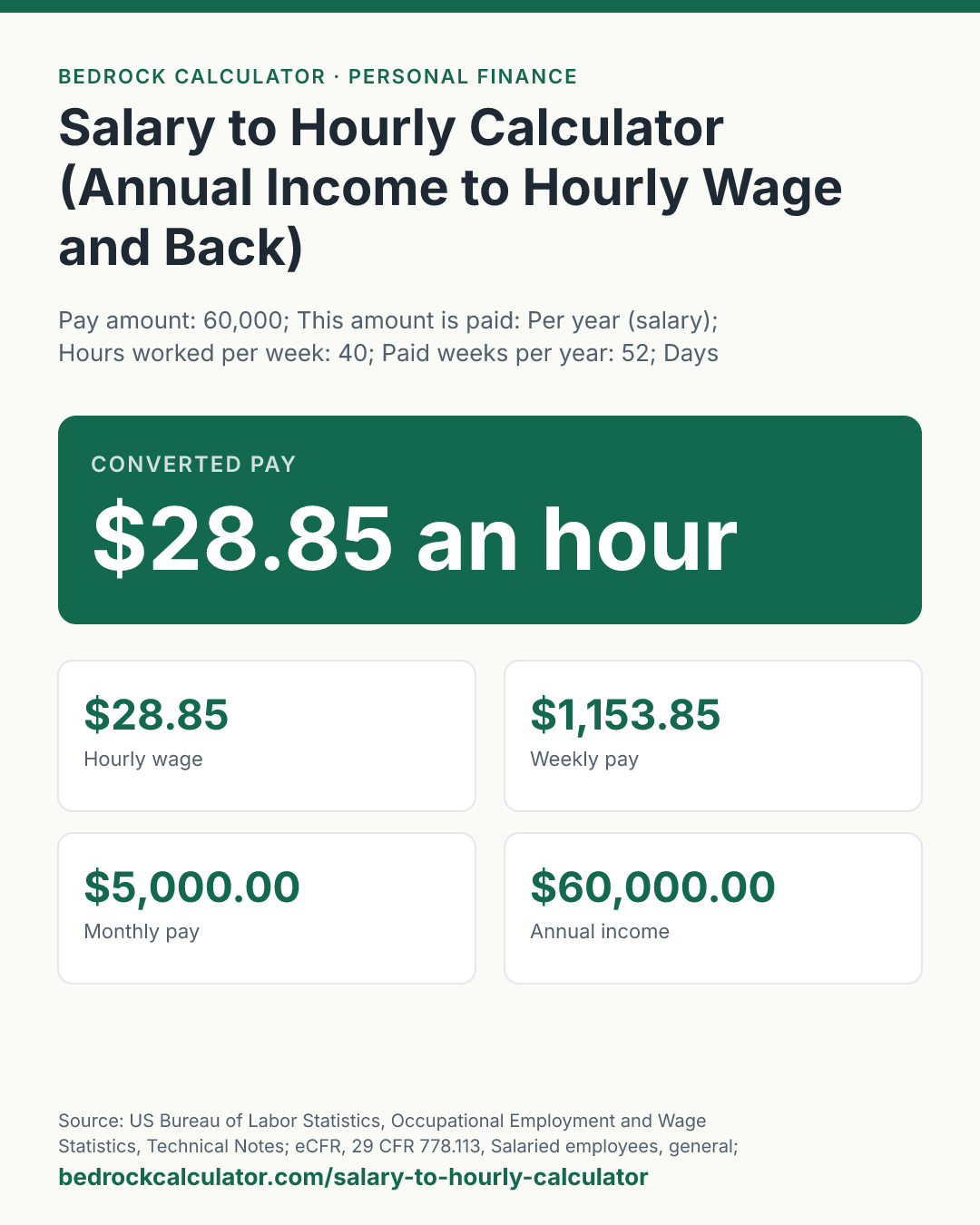

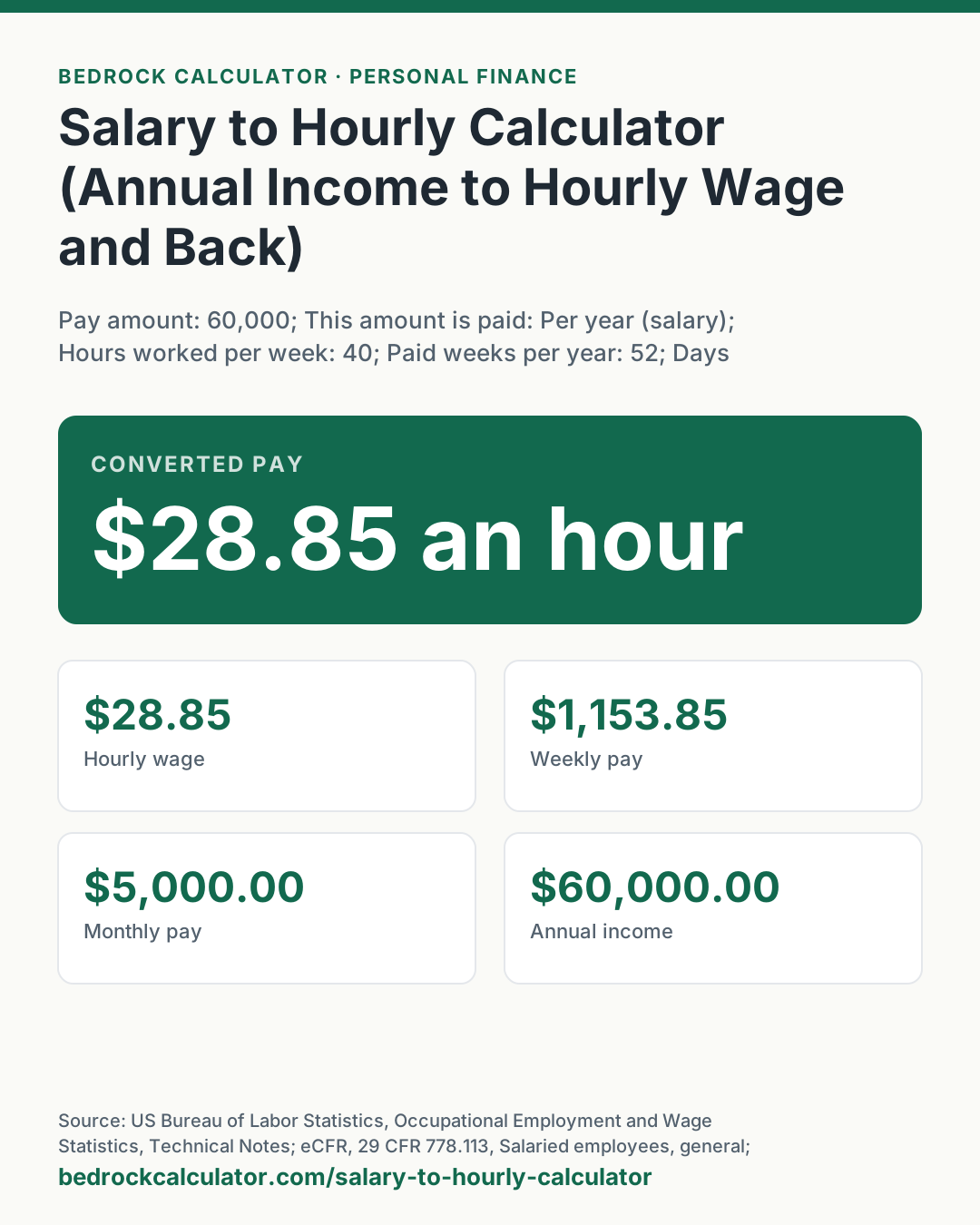
Quick Answer: A salary of $60,000 a year is $28.85 an hour for someone who works 40 hours a week and is paid for 52 weeks. Divide the annual salary by the hours worked in a year; to go the other way, multiply the hourly wage by them.
What does this calculator do?
This salary to hourly calculator restates one rate of pay in every period people quote it in: per hour, per day, per week, every two weeks, twice a month, per month and per year. Enter the pay you know, say how often it is paid, and set the hours and weeks it covers. The calculator returns the hourly wage if you started from a salary, or the yearly income if you started from an hourly wage, and fills in all the other periods alongside.
That is useful whenever two offers are quoted differently. A job paying $25 an hour and one paying $50,000 a year are not easy to compare until both are in the same unit, and the answer depends on the hours. At 40 hours a week and 52 paid weeks, $25 an hour is $52,000 a year.
Every figure here is gross pay: what an employer pays before income tax, Social Security, Medicare, retirement contributions and health premiums come out. For take-home pay, use a paycheck calculator for your state after you have the gross figure from this one.
Using the Salary to Hourly Calculator
- Enter the pay amount, before tax.
- Choose how often that amount is paid: per year, per month, twice a month, every two weeks, per week, per day or per hour.
- Set the hours you work in a typical week. Full time in most US jobs is 40.
- Set the paid weeks in a year. Leave it at 52 if your vacation and holidays are paid. Lower it if you take weeks off without pay, such as a school-year job.
- Set the days you work in a week if you want a daily rate.
The presets show four common questions: $25 an hour as a yearly income, $2,000 a month as yearly and hourly pay, a part-time salary of $30,000 for a 25-hour week, and a $60,000 salary spread over 50 paid weeks. Two tables below the calculator list common salaries as hourly wages and common hourly wages as salaries.
How is this calculated?
- Count the periods in a year. Each pay period is defined by how many of it fit in one year, using your schedule: hours per week times paid weeks for an hour, days per week times paid weeks for a day, the paid weeks for a week, half of them for two weeks, 24 for twice a month, 12 for a month and 1 for a year.
- Turn the pay into a yearly figure. The amount you entered is multiplied by the number of its periods in a year.
annual pay = amount × periods per year
- Divide the year back out. Each other period's pay is the annual figure divided by that period's count. The hourly wage, for example, is:
hourly wage = (annual pay)/(hours per week × paid weeks)
- Round for display. The arithmetic runs in full decimal precision, and every result is rounded to the cent only when it is shown.
At 40 hours and 52 weeks, a year has 2,080 working hours. That is the same "typical work year of 2,080 hours" the Bureau of Labor Statistics uses to turn hourly wages into annual ones. It also matches the federal rule for working out a salaried employee's regular hourly rate: under 29 CFR 778.113, a monthly salary is turned into a weekly wage by multiplying by 12 and dividing by 52, and the weekly wage is divided by the hours it pays for.
Worked Example
With the default inputs, a $60,000 annual salary at 40 hours a week and 52 paid weeks:
- Hours in a year: 40 × 52 = 2,080.
- Hourly wage: $60,000 ÷ 2,080 = $28.85.
- Weekly pay: $60,000 ÷ 52 = $1,153.85.
- Biweekly pay: $60,000 ÷ 26 = $2,307.69.
- Semimonthly pay: $60,000 ÷ 24 = $2,500.00.
- Monthly pay: $60,000 ÷ 12 = $5,000.00.
- Daily pay: $60,000 ÷ 260 days = $230.77.
Going the other way, $25 an hour full time is 25 × 2,080 = $52,000.00 a year, or $4,333.33 a month.
The same $60,000 over 50 paid weeks, with two weeks unpaid, works out to $30.00 an hour. The salary is spread over fewer hours, so each hour is worth more, while the monthly figure stays at $5,000.00.
What Is Annual Income?
Annual income is the total you earn in a year. On a job offer or a loan application, it usually means gross annual income: pay before taxes and deductions, the figure this calculator works with. For a salaried job it is the salary itself. For an hourly job it is the hourly wage times the hours you work in a year.
Gross income in the tax sense is broader. The Internal Revenue Code defines it in 26 U.S.C. 61 as all income from whatever source derived, listing wages and other compensation for services alongside business income, interest, rents, dividends and pensions. When a form asks for your annual income, check whether it means wages only or every source; the two can differ a lot.
Net income, or take-home pay, is what is left after withholding. It is always lower than gross pay, and it is not what this calculator shows.
How Do You Calculate an Hourly Wage From an Annual Salary?
Divide the salary by the number of hours you work in a year. At full time, that is 40 hours a week times 52 weeks, or 2,080 hours, so $60,000 a year is $28.85 an hour. The common mental shortcut of halving the salary and dropping three zeros assumes 2,000 hours, which overstates the hourly rate a little; use the calculator when the difference matters.
What does this calculator not account for?
- Taxes and deductions. Every figure is gross pay. Federal and state income tax, FICA, retirement contributions and benefit premiums are not subtracted.
- Overtime. Hours above 40 in a week are paid at the same rate as the rest. Under federal law many hourly workers earn time and a half for those hours, so a schedule with regular overtime earns more than shown.
- Bonuses, commissions and tips. Only the base rate you enter is converted.
- Unequal months. Monthly pay is the year divided by 12, and biweekly pay assumes 26 paydays at 52 weeks. Some years contain 27 biweekly paydays; the calculator does not count calendar paydays.
- Benefits. Health insurance, paid leave and retirement matching have real value but are not part of the wage figures.
- Unpaid breaks. If your scheduled hours include an unpaid lunch, enter only the paid hours.
What mistakes do people make with this?
- Comparing a salary with an hourly wage at different hours. A $55,000 salary for a 50-hour week is worth less per hour than a $50,000 salary for a 40-hour week. Enter the real hours for each.
- Mixing up biweekly and semimonthly. Biweekly is every other week, 26 times a year. Semimonthly is twice a month, 24 times a year. On the same salary, the semimonthly check is larger.
- Forgetting unpaid time off. If you take two weeks of unpaid leave, your hourly rate on a fixed salary is higher than 52 weeks suggests, and your annual income from an hourly job is lower.
- Reading monthly pay as four weeks. A month averages more than four weeks, so multiplying weekly pay by 4 understates the monthly figure. Monthly pay is the year divided by 12.
- Treating gross as take-home. A budget built on gross pay will come up short.
Frequently Asked Questions
How much is $25 an hour per year?
What is $2,000 a month as a yearly income?
How do I convert my hourly wage to a yearly salary?
What is $30,000 a year as an hourly wage for part-time work?
Is annual income the same as salary?
Why does my paycheck not match the biweekly figure?
How many working hours are in a year?
Sources
- US Bureau of Labor Statistics, Occupational Employment and Wage Statistics, Technical Notes: annual wages calculated from hourly wages over a 2,080-hour work year. bls.gov/oes/current/oes_tec.htm
- eCFR, 29 CFR 778.113, Salaried employees, general: converting weekly, semimonthly and monthly salaries to a regular hourly rate. ecfr.gov/current/title-29/section-778.113
- United States Code, 26 U.S.C. 61, Gross income defined (via GovInfo). govinfo.gov/content/pkg/USCODE-2023-title26/html/USCODE-2023-title26-subtitleA-chap1-subchapB-partI-sec61.htm