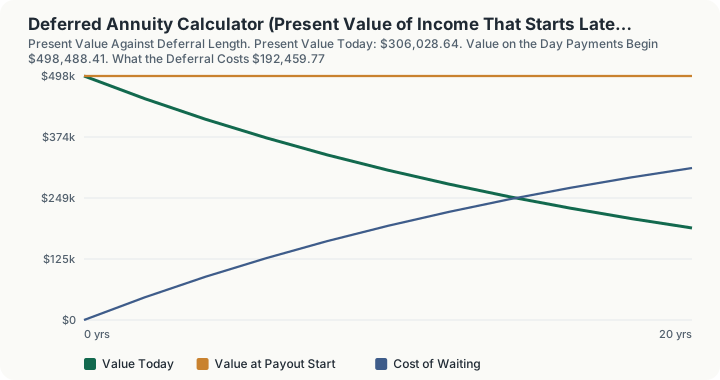
Quick Answer: An income of $40,000 a year for 20 years that does not begin until 10 years from now is worth $306,028.64 today at a 5% discount rate. The same income starting immediately would be worth $498,488.41, so the decade of waiting costs $192,459.77, or 39% of the value. Funding it takes a level deposit of $39,632.11 a year through the accumulation phase.
What does this calculator do?
A deferred annuity is an income stream with a gap in front of it. Nothing is paid during the accumulation phase; payments begin after it and then run for a fixed term.
That gap is the whole subject. Two identical income streams, one starting now and one starting in ten years, differ in value by a factor that depends only on the discount rate and the length of the wait. At 5% over ten years that factor is 1.6289, so the deferred stream is worth 61% of the immediate one.
This page values the stream in two places and reports both:
- at the moment payments begin, which is the lump sum you would need to have accumulated by then, and
- today, which is what the promise is worth now.
It then answers the practical question that follows: what level annual deposit, made through the accumulation phase and earning the same rate, arrives at that lump sum exactly.
This is a fixed-term calculation. Payments run for the number of years you enter and then stop. It is not a life annuity and carries no mortality assumption.
How is this calculated?
- Value the payout phase as an ordinary annuity, at the moment it begins. Each of the $n$ payments is discounted back to the start of the payout phase, with the first payment arriving one year after that point.
PV_start = PMT × (1 − (1 + i)⁻ⁿ)/i
- Discount that figure back over the deferral. The value at the start of the payout phase is divided by one plus the rate, raised to the number of deferral years.
PV_today = PV_start/((1 + i)^d)
- Report the difference between the two as the cost of waiting. This is a subtraction, and the two figures plus the difference reconcile to the cent.
- Value the advance-payment version by shortening the deferral by one period. If each payment arrives at the beginning of its year rather than the end, every payment sits one period earlier, which is exactly one less period of discounting. The calculator therefore calls the same function with a deferral of $d - 1$. Where the deferral is zero it uses the annuity due form directly instead.
- Solve for the level deposit that funds the lump sum. Using the standard time value relationship with a present value of zero, a future value equal to the lump sum from step 1, the deferral years as the number of periods, and the same rate:
PMT_deposit = (FV × i)/((1 + i)^d − 1)
- Express the answer as a multiple of one payment. The present value divided by the annual payment, which makes streams of different sizes comparable at a glance.
The table repeats step 2 at deferrals from zero to twenty years, holding the payout phase constant, so the cost of each additional year of waiting is visible directly.
Worked Example
A pension promise pays $40,000 a year for twenty years, beginning in ten years. The discount rate is 5%.
Step 1: Value the twenty payments at the moment they start. The annuity factor is (1 − 1.05⁻²⁰)/0.05 = (1 − 0.376889)/0.05 = 12.462210
$40{,}000 \times 12.462210 =$ $498,488.41
Step 2: Discount that back ten years. $1.05^{10} = 1.628895$
$498{,}488.41 / 1.628895 =$ $306,028.64
Step 3: The cost of the wait. $498{,}488.41 - 306{,}028.64 =$ $192,459.77
Nearly two fifths of the value is consumed by the deferral, and no fee was charged. It is arithmetic: money arriving later is worth less, and ten years at 5% is a substantial "later".
Step 4: What it takes to fund. The accumulation factor for ten annual deposits at 5% is (1.05¹⁰ − 1)/0.05 = 12.577893
$498{,}488.41 / 12.577893 =$ $39,632.11 a year
Step 5: Note the gap between deposits and lump sum. Ten deposits total $396,321.10, against a lump sum of $498,488.41. The $102,167.31 difference is interest earned during the accumulation phase, which is 20.5% of the target.
Step 6: Compare against the total eventually received. Twenty payments of $40,000 total $800,000, against a present value of $306,028.64. The stream pays out 2.6 times its own current value, and both figures are correct: one is undiscounted cash, the other is what that cash is worth now.
Now vary the two inputs that matter.
Step 7: Extend the deferral to 25 years. $498{,}488.41 / 1.05^{25} = 498{,}488.41 / 3.386355 =$ $147,205.01
Fifteen more years of waiting removes another $158,823 of value, more than halving it again.
Step 8: Drop the discount rate to 2%. The annuity factor rises to 16.351433, giving $654,057.33 at the payout date, and $1.02^{10} = 1.218994$ discounts that to $536,554.82.
The same promise is worth 75% more at 2% than at 5%. Deferred income is far more sensitive to the discount rate than immediate income, because the rate is applied over the deferral as well as across the payout phase.
Step 9: The timing of each payment. Moving each payment to the start of its year lifts the value to $321,330.07, which is the ordinary figure multiplied by 1.05. Paying in advance is worth exactly one period of interest, regardless of how long the term runs.
What does this calculator not account for?
- Mortality. This is a fixed-term calculation. A real deferred life annuity pays until death, and the insurer's price reflects survival probabilities that this page does not model.
- Insurer charges, commissions and surrender penalties. A commercial deferred annuity contract deducts these, and they are typically front-loaded.
- Credit risk. The formula assumes every payment arrives. A promise from a weak counterparty deserves a higher discount rate, and the value falls accordingly.
- Tax. All figures are pre-tax. The tax treatment of an annuity's build-up and its payout phase differs by jurisdiction and by wrapper.
- Inflation. Payments here are level in nominal terms. Twenty years of fixed payments lose a great deal of purchasing power. Use a real rate with real payments if you want the answer in today's money.
- A rate that changes. One rate is used for both the accumulation and the payout phases. Real contracts often credit one rate before payments begin and another afterwards.
- Payment frequency. Payments are annual. Monthly payments of one twelfth the amount are worth slightly more, because they arrive earlier on average.
- Flexible start dates. The deferral is a fixed number of whole years.
What mistakes do people make with this?
- Discounting the payments twice. The annuity formula already brings every payment back to the start of the payout phase. Applying the deferral factor to each payment individually as well is the most common error here, and it produces a value far too low.
- Discounting by the wrong number of years. With payments beginning in year eleven, the deferral is ten years, not eleven. The annuity formula places the first payment one period after the point it values, so those two conventions must not both be applied.
- Confusing the lump sum with the present value. $498,488.41 is what you need to have accumulated on the day payments start. $306,028.64 is what that obligation is worth today. Quoting the first as the cost of the promise overstates it by 63%.
- Assuming the deposit total equals the lump sum. It does not, and the gap is interest. Here $396,321 of deposits becomes $498,488.
- Using a life expectancy as the term. Half of annuitants outlive their life expectancy. A fixed-term calculation set to a median lifespan understates a life annuity's value materially.
- Comparing a deferred annuity with an immediate one on payment size alone. The deferred one pays more per dollar of premium precisely because it pays later, and often for less time.
Frequently Asked Questions
Why is the value today so much lower than the lump sum at the payout date?
What discount rate should I use?
Does the deferral length or the payout length matter more?
Is this the same as a deferred income annuity sold by an insurer?
What if payments start at the beginning of each year?
Can I use this for a lottery or structured settlement offer?
Sources
- Internal Revenue Service, the official authority for the tax rules this calculator relates to. irs.gov
There is no statutory or regulatory source for these formulas, and none is invented here. The present value of an ordinary annuity, the deferral factor, and the level payment that accumulates to a target sum are standard results of time value mathematics rather than legal constructs. Where rules do exist for annuities they govern taxation, disclosure and reserving, and none of them changes the arithmetic on this page.
The implementations are deferredAnnuityPV, ordinaryAnnuityPV and annuityDuePV in engine/primitives/annuities.ts, and solvePMT in engine/primitives/tvm.ts, proven against hand-derived vectors in engine/vectors/annuities.test.ts, engine/vectors/tvm.test.ts and this calculator's own vectors.test.ts. Related pages: the annuity due calculator for the timing question in isolation, the perpetuity calculator for a stream with no end date, and the annuity payout calculator for a life-contingent income instead of a fixed term.