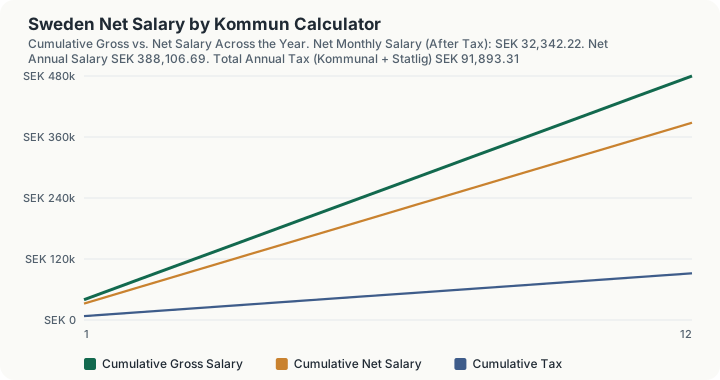
Quick Answer: SEK 40,000 gross per month (SEK 480,000 per year) in Stockholm kommun (30.55% kommunalskatt) nets out to SEK 32,342.22 per month (SEK 388,106.69 per year) after tax. The same salary in Örebro, the highest-tax kommun of the 8 modeled here at 33.65%, nets SEK 31,565.17 per month, SEK 777.05 less, purely from where you live.
Overview
Sweden's income tax is dominated, for the vast majority of taxpayers, by kommunalskatt: a flat-rate combined municipal-plus-region tax that applies to essentially all taxable earned income, regardless of how much you make. Unlike statlig inkomstskatt (the national income tax), which only kicks in above a high threshold and affects a minority of earners, kommunalskatt applies from the first taxable krona and varies meaningfully by where you are registered as a resident, from just over 30% in some kommuner to nearly 35% in others.
This calculator answers the question every Swedish job offer, relocation, or apartment search eventually raises: given a gross salary, what does it actually net out to HERE, in this specific kommun? It applies the correct grundavdrag (basic deduction), the selected kommun's combined municipal-plus-region rate, the jobbskatteavdrag (earned income credit), and, for high earners, the statlig inkomstskatt above the 2026 threshold, then reports monthly and annual net salary side by side with the kommunalskatt rate actually used.
Eight major kommuner are modeled directly: Stockholm, Göteborg, Malmö, Uppsala, Linköping, Örebro, Västerås, and Helsingborg. These span nearly the full range of Swedish kommunalskatt rates, from Stockholm's comparatively low 30.55% (a product of a large, high-income tax base) to Örebro's 33.65%.
How This Is Calculated
- Annual gross income. Monthly gross salary multiplied by 12.
- Grundavdrag. A basic deduction subtracted from gross income to arrive at taxable income; it varies with income level, peaking around SEK 45,600 in the middle of the income distribution and tapering to a floor of SEK 17,400 for high earners.
- Kommunalskatt. Taxable income multiplied by the selected kommun's combined municipal-plus-region rate.
- Jobbskatteavdrag. A credit against the municipal tax bill, scaled to income and (in this calculator's modeling) to the kommun's rate relative to the national average.
- Statlig inkomstskatt. 20% on any taxable income above the SEK 643,000 2026 skiktgräns; most salaries modeled here fall below it.
- Net salary. Gross income minus the sum of municipal tax (after credit) and national tax, divided by 12 for the monthly figure.
Worked Example
Using the calculator's default inputs (SEK 40,000/month, Stockholm):
- Annual gross: 40,000 × 12 = SEK 480,000.00.
- Grundavdrag at this income: SEK 17,400.00. The deduction declines from its SEK 45,600 peak as income rises and reaches its SEK 17,400 floor at SEK 466,000, so a SEK 480,000 salary already sits on that floor. Taxable income: 480,000 − 17,400 = SEK 462,600.00.
- Municipal tax before credit: 462,600 × 30.55% = SEK 141,324.30.
- Jobbskatteavdrag at this income and Stockholm's rate: SEK 49,430.99. Municipal tax after credit: 141,324.30 − 49,430.99 = SEK 91,893.31 total tax (kommunal net of credit; no statlig tax at this income).
- Net annual salary: 480,000 − 91,893.31 = SEK 388,106.69. Net monthly: 388,106.69 ÷ 12 = SEK 32,342.22.
Net Monthly Salary Across All 8 Kommuner (SEK 40,000/Month Gross)
| Kommun | Kommunalskatt | Net Monthly Salary | Net Annual Salary |
|---|---|---|---|
| Stockholm | 30.55% | SEK 32,342.22 | SEK 388,106.69 |
| Västerås | 31.24% | SEK 32,169.27 | SEK 386,031.20 |
| Helsingborg | 31.39% | SEK 32,131.67 | SEK 385,580.00 |
| Linköping | 31.75% | SEK 32,041.43 | SEK 384,497.14 |
| Malmö | 32.42% | SEK 31,873.48 | SEK 382,481.80 |
| Göteborg | 32.60% | SEK 31,828.36 | SEK 381,940.37 |
| Uppsala | 32.85% | SEK 31,765.70 | SEK 381,188.38 |
| Örebro | 33.65% | SEK 31,565.17 | SEK 378,782.01 |
The spread between the lowest (Stockholm) and highest (Örebro) kommun in this table is SEK 777.05 per month, SEK 9,324.68 per year, on identical gross pay.
Carrying the Stockholm Case Across the Year
Step 1 -- After month one. Cumulative gross SEK 40,000.00, cumulative tax SEK 7,657.78, cumulative net SEK 32,342.22
Step 2 -- After month two. Gross SEK 80,000.00, tax SEK 15,315.56, net SEK 64,684.44
Step 3 -- After month six. Gross SEK 240,000.00, tax SEK 45,946.68, net SEK 194,053.32
Step 4 -- After month twelve. Gross SEK 480,000.00, tax SEK 91,893.36, net SEK 388,106.64
The monthly schedule accumulates the rounded monthly tax of SEK 7,657.78, so it lands five ore above the annual figure of SEK 91,893.31 computed directly from the annual taxable income. The annual figure is the correct one; the five ore is the cost of paying in twelve equal parts.
Half a year in, SEK 45,946.68 has gone in tax and SEK 194,053.32 has arrived in the account. That midyear split is the useful number when sizing a mortgage or a rental application, because Swedish lenders assess against net, and at this income the effective rate of 19.14% is a long way below the 30.55% kommunalskatt that the payslip appears to imply.
What This Does Not Account For
- Only 8 kommuner are modeled. Sweden has 290 kommuner; if yours isn't listed, use the closest-rate kommun as an approximation, or look up your own kommun's combined rate on Skatteverket's published table and mentally adjust the municipal tax line.
- Jobbskatteavdrag is a disclosed approximation, not the exact statutory formula. It ramps linearly to a verified national-average maximum of SEK 52,392/year (under 66) at SEK 480,000 of income, then scales that figure by the kommun's rate divided by the 32.38% national average, which means a kommun taxing above the average produces a modeled credit above SEK 52,392 (SEK 54,446.91 in Örebro at this income). The exact statutory piecewise calculation could not be located in a directly quotable primary source during this build.
- Grundavdrag is a linear approximation of Skatteverket's official stepped 2026 table, typically within roughly SEK 100-300 of the official cell for any given income.
- Church fee (kyrkoavgift) and burial fee (begravningsavgift) are excluded, since kyrkoavgift only applies to Svenska kyrkan members and begravningsavgift is a separate statutory fee, not income tax proper.
- Pension contributions, benefits, bonuses, and capital income are not modeled; this is a straight salary-to-net-pay calculator for ordinary monthly arbetsinkomst.
- Payroll rounding conventions used by real Swedish employers (which withhold via Skatteverket's own monthly skattetabeller, not a continuous formula) can differ from this calculator's continuous computation by a small amount month to month, though the annual totals converge closely.
Common Pitfalls
- Comparing job offers by gross salary alone. A SEK 2,000/month higher offer in a high-tax kommun can net out to less than a lower gross offer in a low-tax kommun; always compare net, not gross, especially across a relocation.
- Assuming kommunalskatt is uniform across Sweden. It is one of the most variable line items in a Swedish paycheck; the spread between the lowest and highest-taxing kommuner nationally is larger than the 3.1 percentage point range shown in the 8-kommun table above.
- Forgetting that your kommun is fixed by registration, not by workplace. Kommunalskatt is determined by your folkbokföringsadress (registered residential address) as of 1 November of the prior year, not by where your employer is located.
- Ignoring the statlig inkomstskatt cliff. Crossing the SEK 643,000 taxable-income threshold adds a full 20% marginal rate on top of your kommunalskatt on every krona above it; a raise that pushes you just over the line is worth noticeably less at the margin than the same raise below it.
- Treating this as a payroll system. This calculator estimates; it does not withhold, remit, or report anything to Skatteverket or an employer.
Frequently Asked Questions
Why is Stockholm's kommunalskatt lower than other major cities?
Does my employer automatically use my kommun's correct rate?
What happens if I move kommun partway through the year?
Is kommunalskatt the same as "income tax" in Sweden?
Why does the net-pay gap between kommuner look smaller than the tax-rate gap?
Sources
- Skatteverket: "Kommunala skattesatser 2026" (skattesatser-kommuner-2026.xlsx), official published data, parsed directly for all 8 kommuner in this calculator. skatteverket.se
Also consulted: SCB (Statistics Sweden): "Totala kommunala skattesatser 2026, kommunvis," independently corroborating the same 8 kommunalskatt figures; Skatteverket: "När ska man betala statlig inkomstskatt och hur hög är den?" (2026 skiktgräns SEK 643,000, 20% rate, quoted directly); Skatteverket: "Tabell för grundavdrag inkomstår 2026" (Bilaga 1), official table read in full; ekonomifakta.se: 2026 jobbskatteavdrag maximum credit and abolition of the high-income phase-out (jobbskatteavdrag modeled as an approximation; see "What This Does Not Account For").